Birrell Mark A, Battram Cliff H, Woodman Paul, McCluskie Kerryn, Belvisi Maria G
Imperial College School of Medicine, London, UK.
Respir Res. 2003;4(1):3. doi: 10.1186/rr197. Epub 2003 Mar 21.
The link between eosinophils and the development of airway hyperresponsiveness (AHR) in asthma is still controversial. This question was assessed in a murine model of asthma in which we performed a dose ranging study to establish whether the dose of steroid needed to inhibit the eosinophil infiltration correlated with that needed to block AHR.
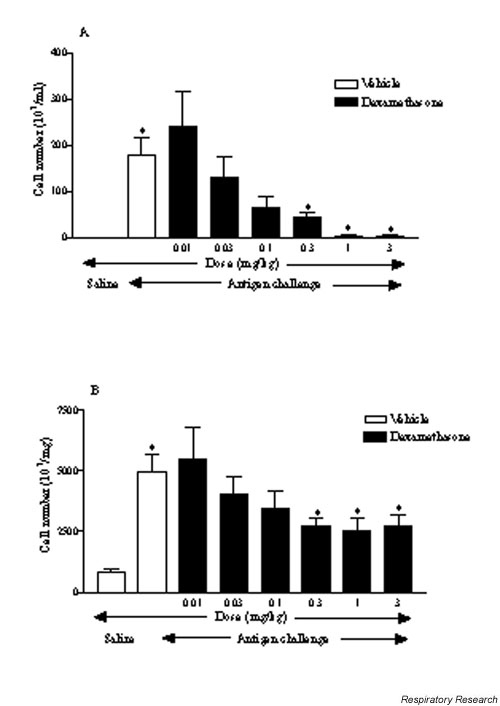
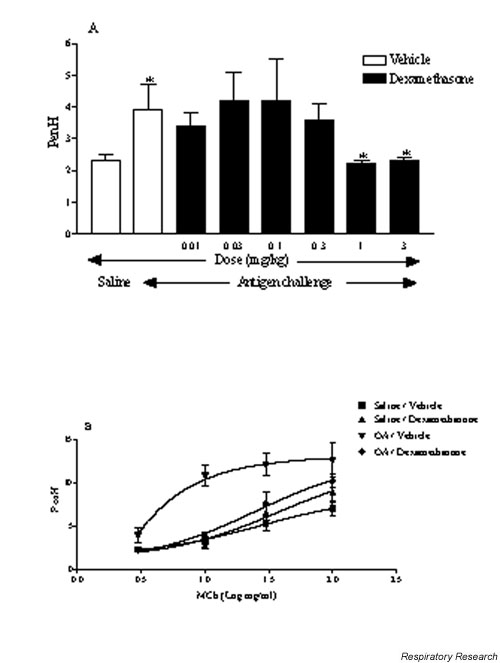
The sensitised BALB/c mice were dosed with vehicle or dexamethasone (0.01-3 mg/kg) 2 hours before and 6 hours after each challenge (once daily for 6 days) and 2 hours before AHR determination by whole-body plethysmography. At 30 minutes after the AHR to aerosolised methacholine the mice were lavaged and differential white cell counts were determined. Challenging with antigen caused a significant increase in eosinophils in the bronchoalveolar lavage (BAL) fluid and lung tissue, and increased AHR.
Dexamethasone reduced BAL and lung tissue eosinophilia (ED50 values of 0.06 and 0.08 mg/kg, respectively), whereas a higher dose was needed to block AHR (ED50 of 0.32 mg/kg at 3 mg/ml methacholine. Dissociation was observed between the dose of steroid needed to affect AHR in comparison with eosinophilia and suggests that AHR is not a direct consequence of eosinophilia.
This novel pharmacological approach has revealed a clear dissociation between eosinophilia and AHR by using steroids that are the mainstay of asthma therapy. These data suggest that eosinophilia is not associated with AHR and questions the rationale that many pharmaceutical companies are adopting in developing low-molecular-mass compounds that target eosinophil activation/recruitment for the treatment of asthma.
嗜酸性粒细胞与哮喘气道高反应性(AHR)发展之间的联系仍存在争议。在一个哮喘小鼠模型中评估了这个问题,我们进行了剂量范围研究,以确定抑制嗜酸性粒细胞浸润所需的类固醇剂量是否与阻断AHR所需的剂量相关。
致敏的BALB/c小鼠在每次激发前2小时和激发后6小时(每天一次,共6天)以及通过全身体积描记法测定AHR前2小时给予赋形剂或地塞米松(0.01 - 3mg/kg)。在对雾化乙酰甲胆碱的AHR测定后30分钟,对小鼠进行灌洗并测定白细胞分类计数。抗原激发导致支气管肺泡灌洗(BAL)液和肺组织中的嗜酸性粒细胞显著增加,并增加了AHR。
地塞米松减少了BAL和肺组织中的嗜酸性粒细胞(ED50值分别为0.06和0.08mg/kg),而阻断AHR需要更高的剂量(在3mg/ml乙酰甲胆碱时ED50为0.32mg/kg)。观察到影响AHR所需的类固醇剂量与嗜酸性粒细胞增多之间存在解离,这表明AHR不是嗜酸性粒细胞增多的直接后果。
这种新的药理学方法通过使用作为哮喘治疗主要药物的类固醇,揭示了嗜酸性粒细胞增多与AHR之间的明显解离。这些数据表明嗜酸性粒细胞增多与AHR无关,并对许多制药公司在开发靶向嗜酸性粒细胞活化/募集的低分子量化合物用于治疗哮喘时所采用的基本原理提出了质疑。