Naor David, Nedvetzki Shlomo
Lautenberg Center for General and Tumor Immunology, Hebrew University-Hadassah Medical School, Jerusalem, Israel.
Arthritis Res Ther. 2003;5(3):105-15. doi: 10.1186/ar746. Epub 2003 Feb 28.
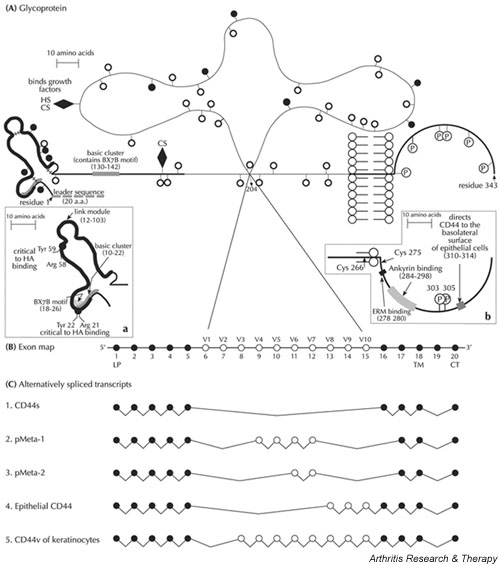
CD44 is a multistructural cell-surface glycoprotein that can theoretically generate close to 800 isoforms by differential alternative splicing. At present, several dozen isoforms are known. The polymorphic nature of CD44 might explain its multifunctionality and its ability to interact with many cell-surface and extracellular ligands, the principal one being hyaluronic acid (HA). Of the many CD44 functions, our review focuses on its involvement in cell-cell and cell-matrix interactions, as well as on its implication in the support of cell migration and the presentation of growth factors to their cognate receptors. Cells involved in pathological activities such as cancer cells and destructive inflammatory cells, and also normal cells engaged in physiological functions, use cell-surface CD44 for their localization and expansion at extravascular sites. This article reviews the evidence that the joint synovium of patients with rheumatoid arthritis (RA) contains considerable amounts of various CD44 isoforms as well as the HA ligand. The review also shows that anti-CD44 monoclonal antibody (mAb) directed against constant epitopes, shared by all CD44 isoforms, can markedly reduce the inflammatory activity of arthritis induced by collagen or proteoglycans in mice. Anti-CD44 mAb also interferes with the migration of RA synovial-like fibroblasts in vitro and is able to disturb the destructive interaction between RA synovial-like fibroblasts and the cartilaginous matrix. However, the transition from the experimental model to the patient's bedside is dependent on the ability to target the CD44 of cells engaged in RA pathology, while skipping the CD44 of normal cells.
CD44是一种多结构的细胞表面糖蛋白,理论上可通过差异可变剪接产生近800种异构体。目前已知有几十种异构体。CD44的多态性可能解释了其多功能性以及与许多细胞表面和细胞外配体相互作用的能力,其中主要配体是透明质酸(HA)。在众多CD44功能中,我们的综述重点关注其在细胞间和细胞与基质相互作用中的作用,以及在支持细胞迁移和将生长因子呈递给其同源受体方面的意义。参与病理活动的细胞,如癌细胞和具有破坏性的炎症细胞,以及参与生理功能的正常细胞,利用细胞表面的CD44在血管外部位进行定位和增殖。本文综述了类风湿关节炎(RA)患者的关节滑膜中含有大量各种CD44异构体以及HA配体的证据。该综述还表明,针对所有CD44异构体共有的恒定表位的抗CD44单克隆抗体(mAb)可显著降低小鼠中由胶原蛋白或蛋白聚糖诱导的关节炎的炎症活性。抗CD44 mAb还可在体外干扰RA滑膜样成纤维细胞的迁移,并能够破坏RA滑膜样成纤维细胞与软骨基质之间的破坏性相互作用。然而,从实验模型到患者床边的转变取决于靶向参与RA病理过程的细胞的CD44的能力,同时避开正常细胞的CD44。