Talavera Karel, Janssens Annelies, Klugbauer Norbert, Droogmans Guy, Nilius Bernd
Laboratorium voor Fysiologie, Campus Gasthuisberg, KU Leuven, Belgium.
J Gen Physiol. 2003 Jun;121(6):529-40. doi: 10.1085/jgp.200308794. Epub 2003 May 12.
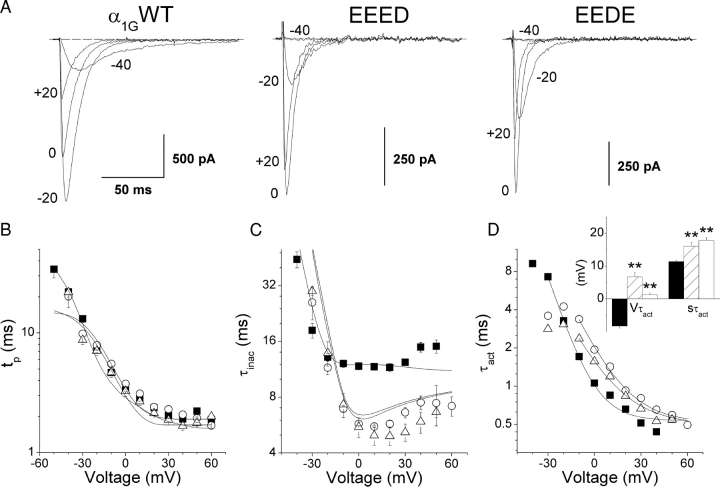
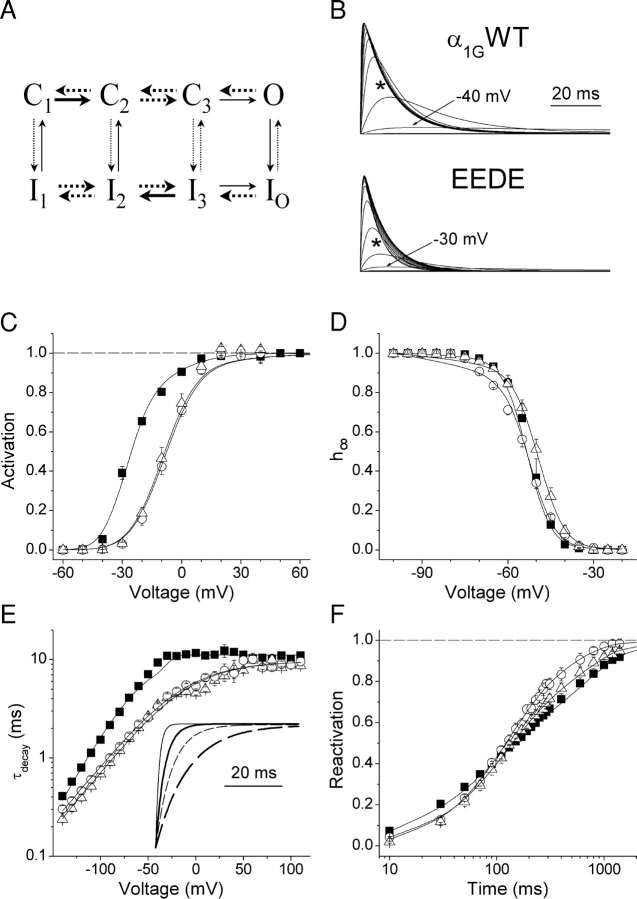
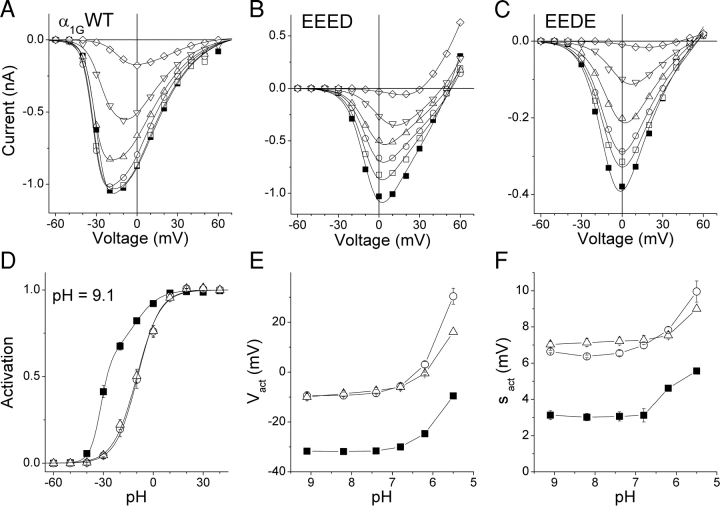
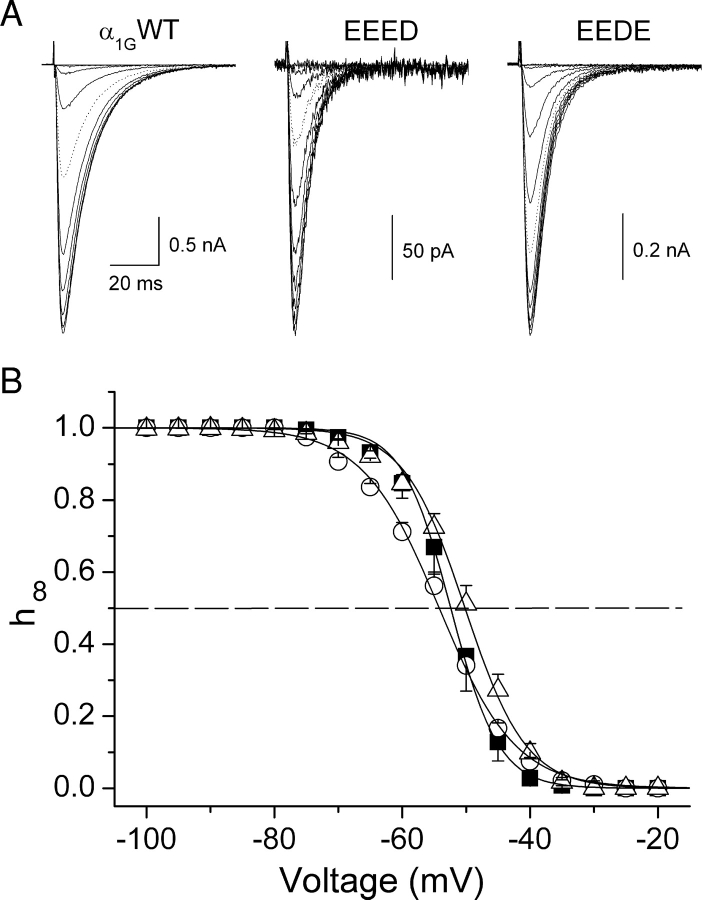
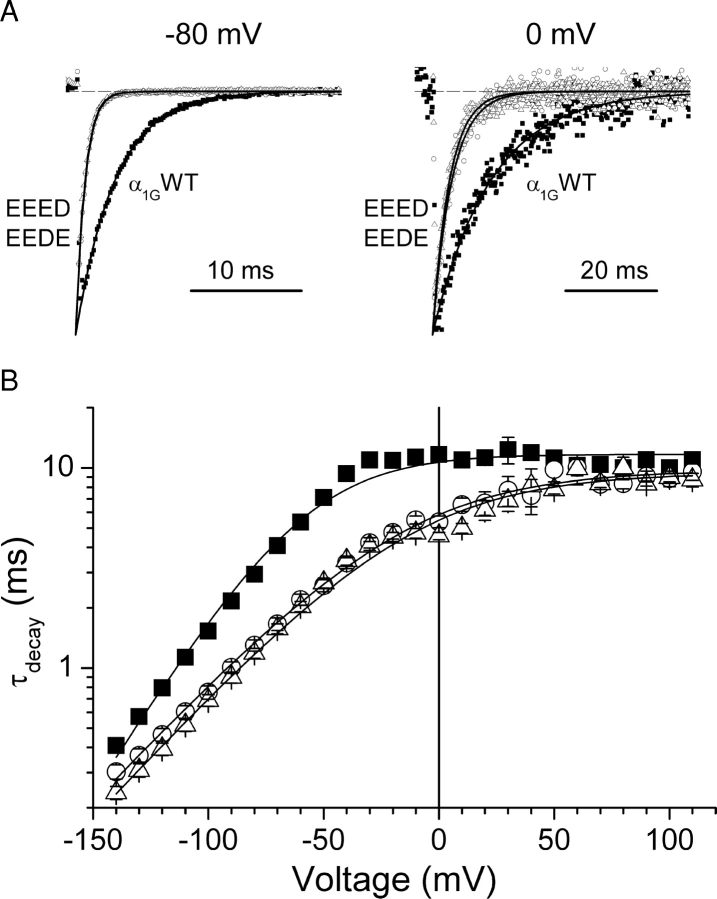
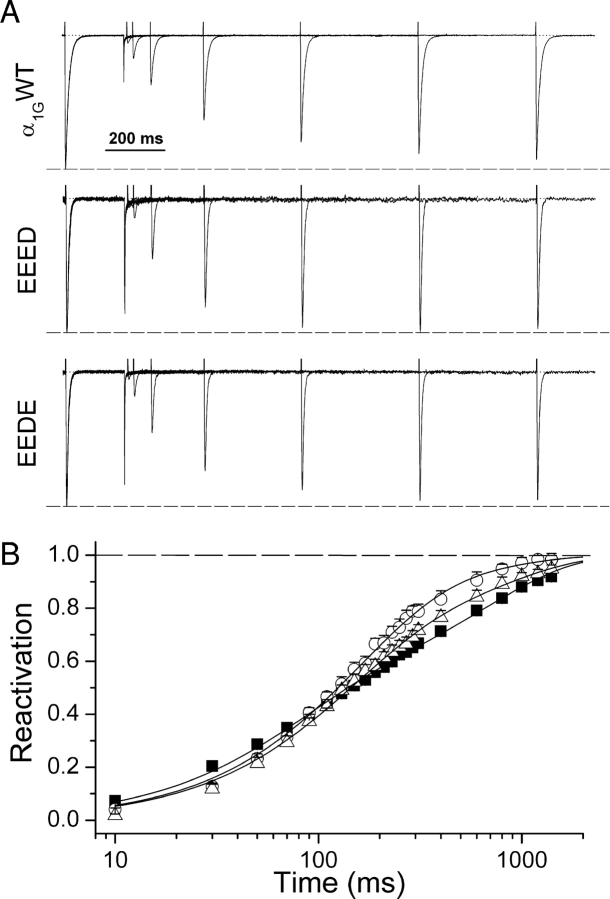
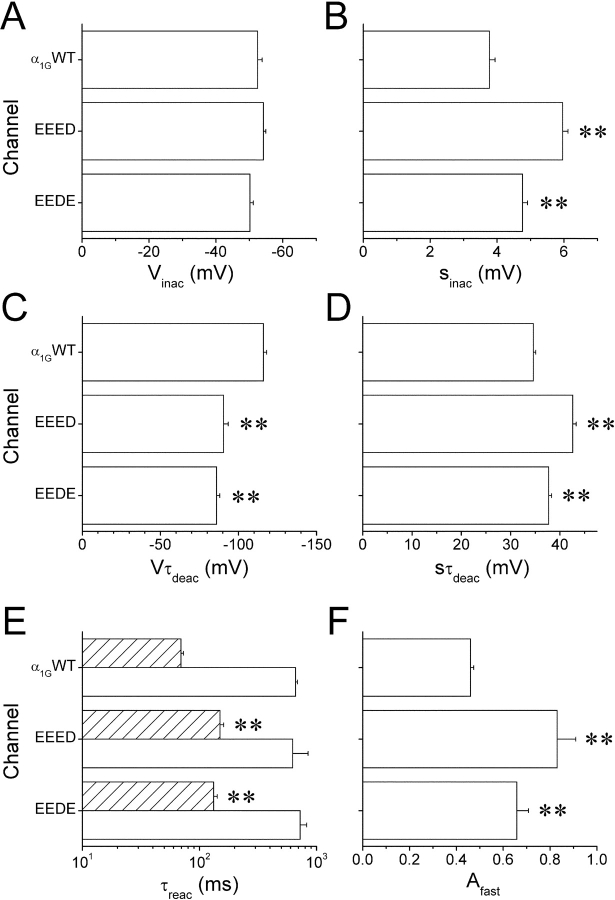
The selectivity filter of all known T-type Ca2+ channels is built by an arrangement of two glutamate and two aspartate residues, each one located in the P-loops of domains I-IV of the alpha1 subunit (EEDD locus). The mutations of the aspartate residues to glutamate induce changes in the conduction properties, enhance Cd2+ and proton affinities, and modify the activation curve of the channel. Here we further analyze the role of the selectivity filter in the gating mechanisms of T-type channels by comparing the kinetic properties of the alpha1G subunit (CaV3.1) to those of pore mutants containing aspartate-to-glutamate substitution in domains III (EEED) or IV (EEDE). The change of the extracellular pH induced similar effects on the activation properties of alpha1G and both pore mutants, indicating that the larger affinity of the mutant channels for protons is not the cause of the gating modifications. Both mutants showed alterations in several gating properties with respect to alpha1G, i.e., faster macroscopic inactivation in the voltage range from -10 to 50 mV, positive voltage shift and decrease in the voltage sensitivity of the time constants of activation and deactivation, decrease of the voltage sensitivity of the steady-state inactivation, and faster recovery from inactivation for long repolarization periods. Kinetic modeling suggests that aspartate-to-glutamate mutations in the EEDD locus of alpha1G modify the movement of the gating charges and alter the rate of several gating transitions. These changes are independent of the alterations of the selectivity properties and channel protonation.
所有已知T型Ca2+通道的选择性过滤器由两个谷氨酸和两个天冬氨酸残基排列构成,每个残基位于α1亚基结构域I-IV的P环中(EEDD位点)。将天冬氨酸残基突变为谷氨酸会引起传导特性的变化,增强Cd2+和质子亲和力,并改变通道的激活曲线。在此,我们通过比较α1G亚基(CaV3.1)与在结构域III(EEED)或IV(EEDE)中含有天冬氨酸到谷氨酸替换的孔突变体的动力学特性,进一步分析选择性过滤器在T型通道门控机制中的作用。细胞外pH的变化对α1G和两个孔突变体的激活特性产生了类似的影响,这表明突变通道对质子的更大亲和力不是门控修饰的原因。相对于α1G,两个突变体在几个门控特性上都表现出改变,即在-10至50 mV的电压范围内宏观失活更快,激活和失活时间常数的电压敏感性出现正电压偏移和降低,稳态失活的电压敏感性降低,以及在长时间复极化期间从失活中恢复更快。动力学建模表明,α1G的EEDD位点中天冬氨酸到谷氨酸的突变会改变门控电荷的移动,并改变几个门控转换的速率。这些变化与选择性特性和通道质子化的改变无关。