Ai Xingbin, Do Anh-Tri, Lozynska Olga, Kusche-Gullberg Marion, Lindahl Ulf, Emerson Charles P
Department of Cell and Developmental Biology, University of Pennsylvania School of Medicine, Philadelphia, PA 19104, USA.
J Cell Biol. 2003 Jul 21;162(2):341-51. doi: 10.1083/jcb.200212083. Epub 2003 Jul 14.
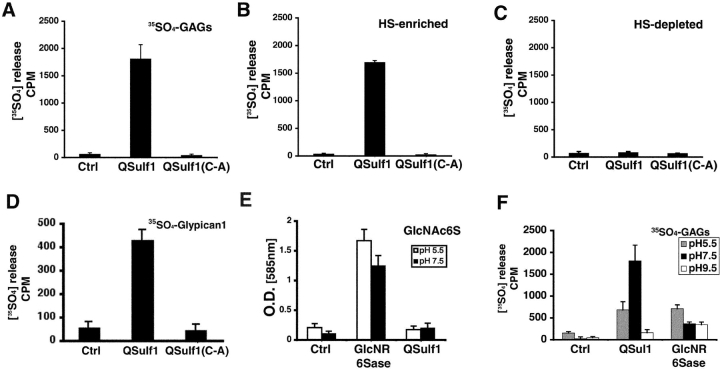
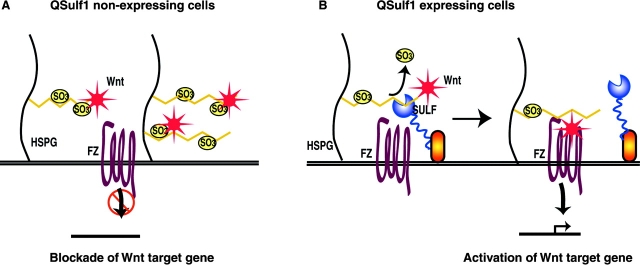
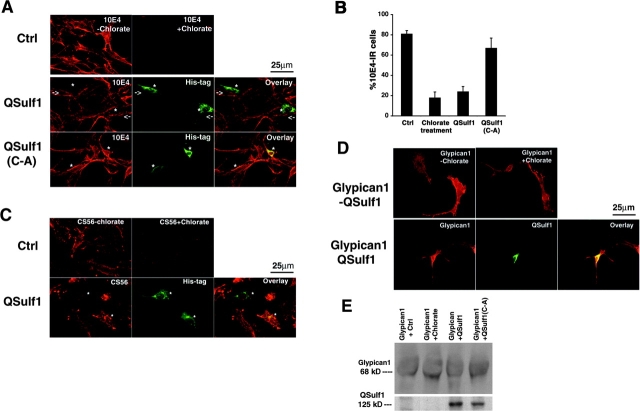
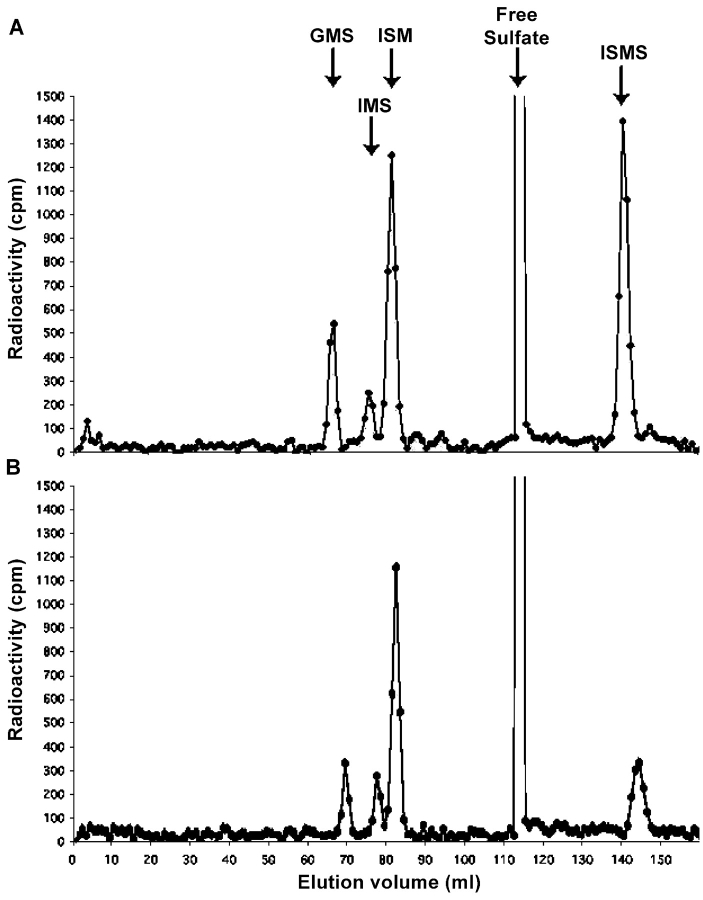
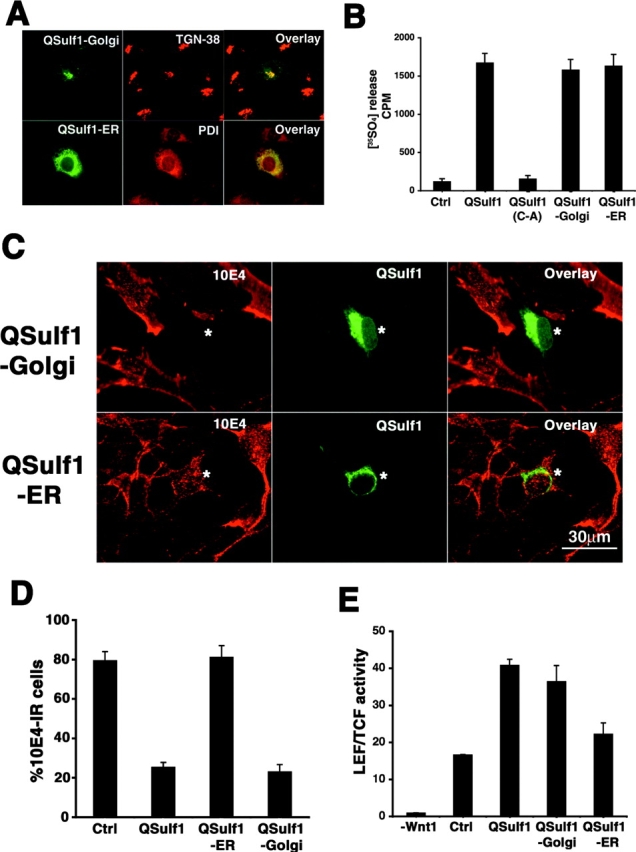
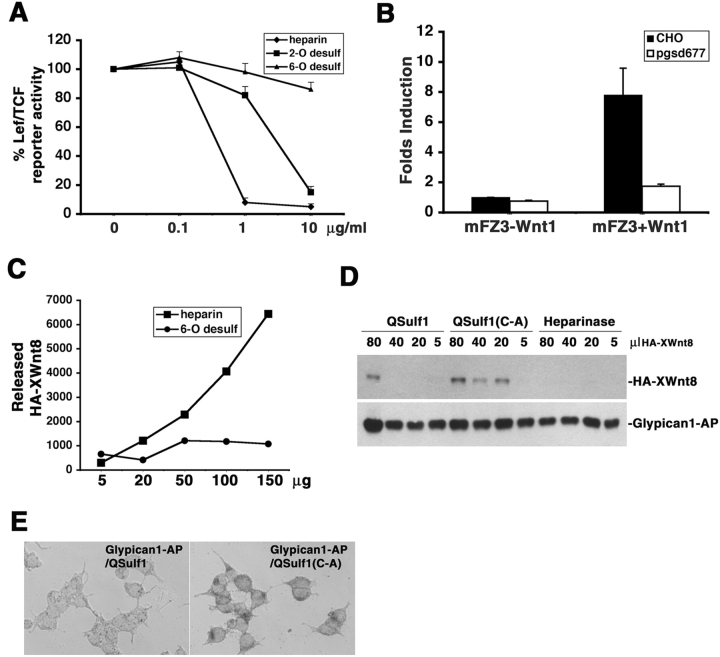
The 6-O sulfation states of cell surface heparan sulfate proteoglycans (HSPGs) are dynamically regulated to control the growth and specification of embryonic progenitor lineages. However, mechanisms for regulation of HSPG sulfation have been unknown. Here, we report on the biochemical and Wnt signaling activities of QSulf1, a novel cell surface sulfatase. Biochemical studies establish that QSulf1 is a heparan sulfate (HS) 6-O endosulfatase with preference, in particular, toward trisulfated IdoA2S-GlcNS6S disaccharide units within HS chains. In cells, QSulf1 can function cell autonomously to remodel the sulfation of cell surface HS and promote Wnt signaling when localized either on the cell surface or in the Golgi apparatus. QSulf1 6-O desulfation reduces XWnt binding to heparin and HS chains of Glypican1, whereas heparin binds with high affinity to XWnt8 and inhibits Wnt signaling. CHO cells mutant for HS biosynthesis are defective in Wnt-dependent Frizzled receptor activation, establishing that HS is required for Frizzled receptor function. Together, these findings suggest a two-state "catch or present" model for QSulf1 regulation of Wnt signaling in which QSulf1 removes 6-O sulfates from HS chains to promote the formation of low affinity HS-Wnt complexes that can functionally interact with Frizzled receptors to initiate Wnt signal transduction.
细胞表面硫酸乙酰肝素蛋白聚糖(HSPGs)的6 - O硫酸化状态受到动态调节,以控制胚胎祖细胞谱系的生长和分化。然而,HSPG硫酸化的调节机制尚不清楚。在此,我们报告了一种新型细胞表面硫酸酯酶QSulf1的生化及Wnt信号活性。生化研究表明,QSulf1是一种硫酸乙酰肝素(HS)6 - O内切硫酸酯酶,尤其偏好HS链内的三硫酸化艾杜糖醛酸2 -硫酸 - N - 乙酰葡糖胺6 - 硫酸二糖单元。在细胞中,当QSulf1定位于细胞表面或高尔基体时,它可以自主发挥作用,重塑细胞表面HS的硫酸化并促进Wnt信号传导。QSulf1的6 - O去硫酸化降低了XWnt与Glypican1的肝素和HS链的结合,而肝素与XWnt8具有高亲和力结合并抑制Wnt信号传导。HS生物合成缺陷的CHO细胞在Wnt依赖的卷曲受体激活方面存在缺陷,这表明HS是卷曲受体功能所必需的。这些发现共同提出了一种用于QSulf1调节Wnt信号传导的双态“捕获或呈现”模型,其中QSulf1从HS链上去除6 - O硫酸盐,以促进低亲和力HS - Wnt复合物的形成,该复合物可与卷曲受体进行功能相互作用以启动Wnt信号转导。