Koenraadt Constantianus J M, Paaijmans Krijn P, Githeko Andrew K, Knols Bart G J, Takken Willem
Laboratory of Entomology, Department of Plant Sciences, Wageningen University, The Netherlands.
Malar J. 2003 Jul 1;2:20. doi: 10.1186/1475-2875-2-20.
Although the effects of rainfall on the population dynamics of the malaria vector Anopheles gambiae have been studied in great detail, the effects of dry periods on its survival remain less clear.
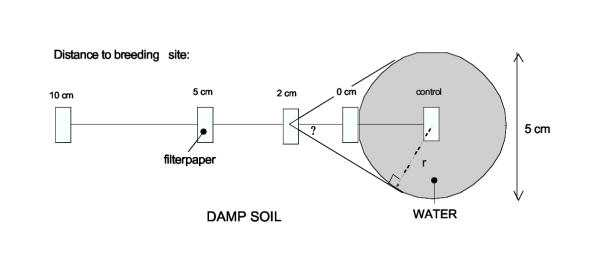
The effects of drying conditions were simulated by creating desiccated habitats, which consisted of trays filled with damp soil. Experiments were performed in these trays to (i) test the ability of An. gambiae sensu stricto eggs to hatch on damp soil and for larvae to reach an artificial breeding site at different distances of the site of hatching and (ii) to record survival of the four larval stages of An. gambiae s.s. when placed on damp soil.
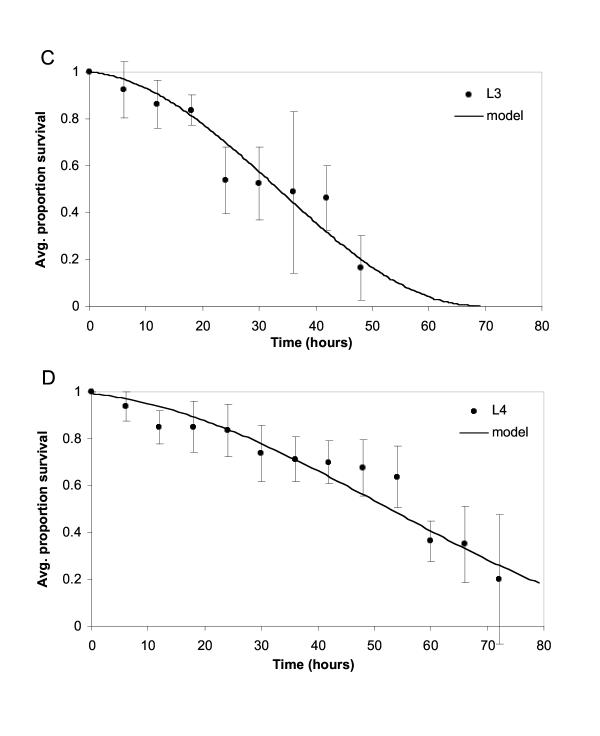
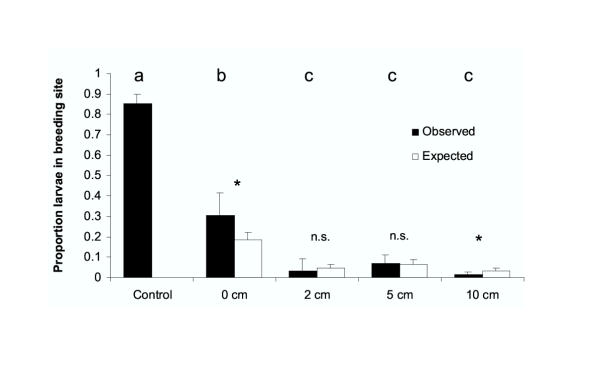
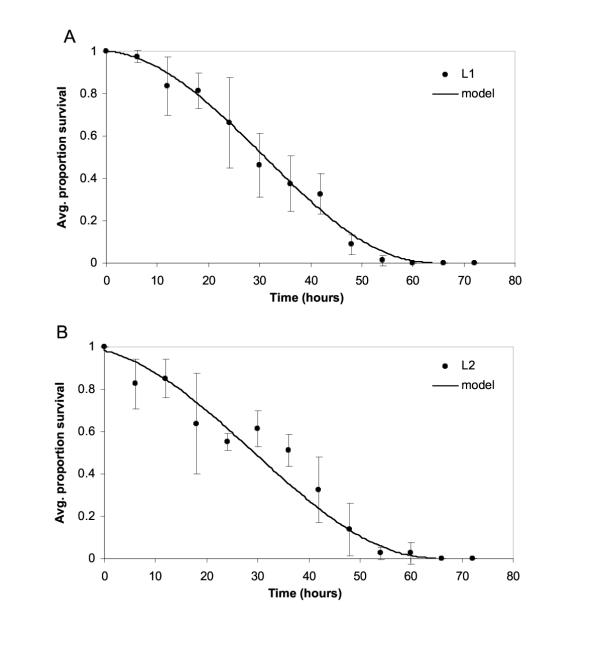
Eggs of An. gambiae s.s. hatched on damp soil and emerging larvae were capable of covering a distance of up to 10 cm to reach surface water enabling further development. However, proportions of larvae reaching the site decreased rapidly with increasing distance. First, second and third-instar larvae survived on damp soil for an estimated period of 64, 65 and 69 hrs, respectively. Fourth-instar larvae survived significantly longer and we estimated that the maximum survival time was 113 hrs.
Short-term survival of aquatic stages of An. gambiae on wet soil may be important and adaptive when considering the transient nature of breeding sites of this species in sub-Saharan Africa. In addition, the results suggest that, for larval vector control methods to be effective, habitats should remain drained for at least 5 days to kill all larvae (e.g. in rice fields) and habitats that recently dried up should be treated as well, if larvicidal agents are applied.
尽管降雨对疟疾媒介冈比亚按蚊种群动态的影响已得到详细研究,但干旱期对其生存的影响仍不太清楚。
通过创建干燥栖息地来模拟干燥条件,干燥栖息地由装满潮湿土壤的托盘组成。在这些托盘中进行实验,以(i)测试冈比亚按蚊指名亚种的卵在潮湿土壤上孵化的能力以及幼虫在距孵化地点不同距离处到达人工繁殖地点的能力,(ii)记录冈比亚按蚊指名亚种四个幼虫阶段放置在潮湿土壤上时的存活率。
冈比亚按蚊指名亚种的卵在潮湿土壤上孵化,孵化出的幼虫能够爬行多达10厘米的距离到达地表水以实现进一步发育。然而,随着距离增加,到达该地点的幼虫比例迅速下降。一龄、二龄和三龄幼虫在潮湿土壤上的存活时间估计分别为64、65和69小时。四龄幼虫存活时间明显更长,我们估计其最长存活时间为113小时。
考虑到撒哈拉以南非洲该物种繁殖地点的短暂性,冈比亚按蚊水生阶段在潮湿土壤上的短期生存可能很重要且具有适应性。此外,结果表明,为使幼虫控制方法有效,栖息地应至少排水5天以杀死所有幼虫(如稻田),并且如果使用杀幼虫剂,最近干涸的栖息地也应进行处理。