Columbia University, Mailman School of Public Health, New York, New York, United States of America.
PLoS Comput Biol. 2022 Jun 9;18(6):e1010161. doi: 10.1371/journal.pcbi.1010161. eCollection 2022 Jun.
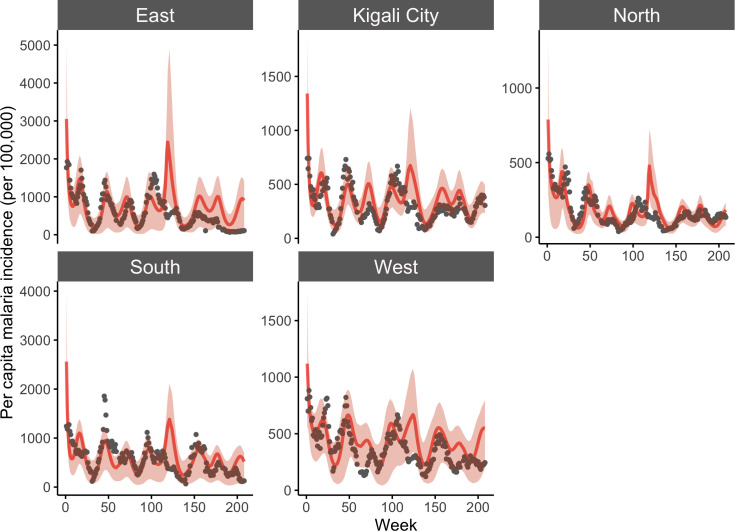
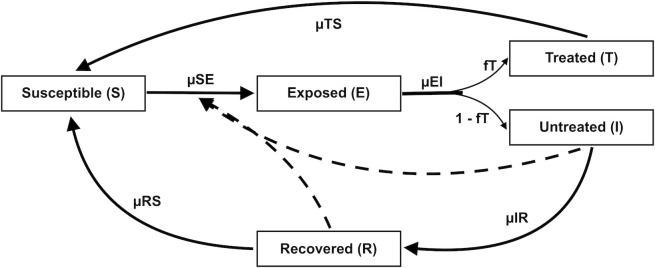
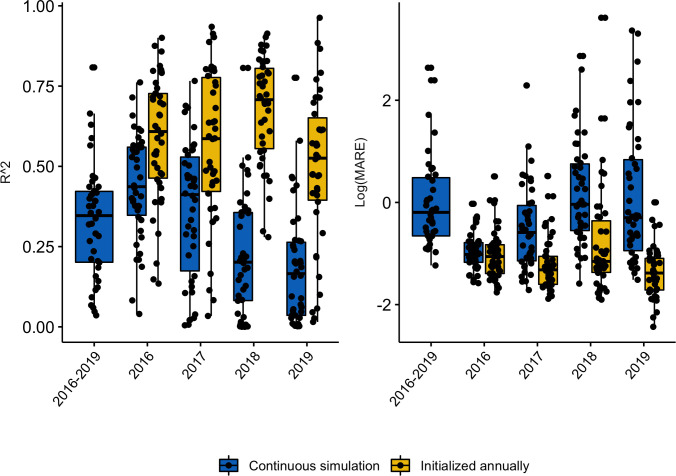
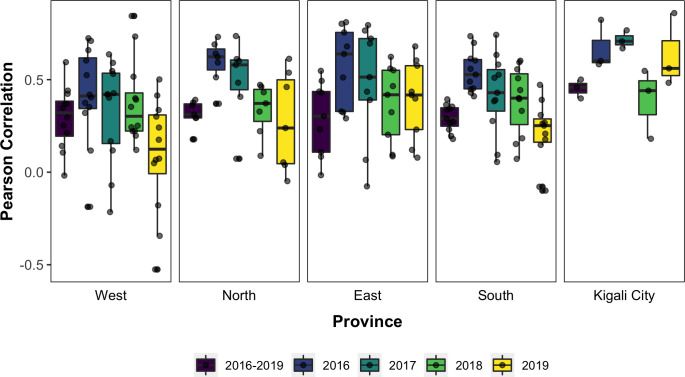
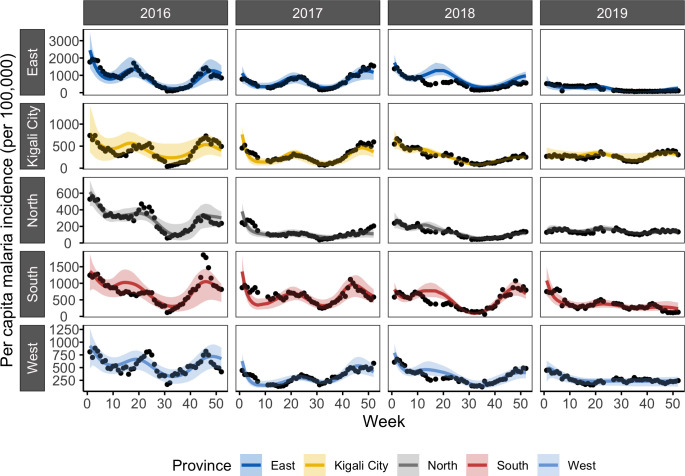
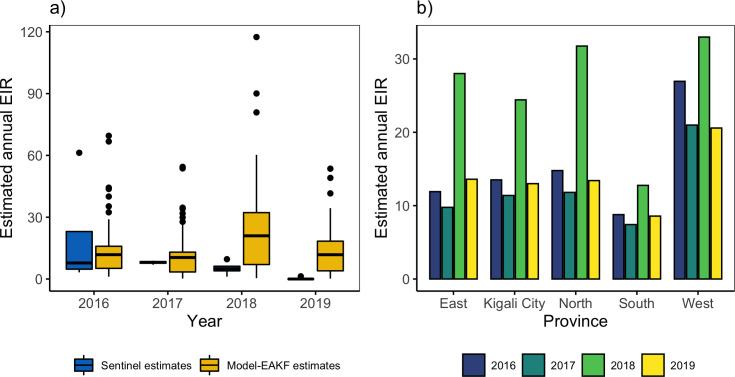
Given the crucial role of climate in malaria transmission, many mechanistic models of malaria represent vector biology and the parasite lifecycle as functions of climate variables in order to accurately capture malaria transmission dynamics. Lower dimension mechanistic models that utilize implicit vector dynamics have relied on indirect climate modulation of transmission processes, which compromises investigation of the ecological role played by climate in malaria transmission. In this study, we develop an implicit process-based malaria model with direct climate-mediated modulation of transmission pressure borne through the Entomological Inoculation Rate (EIR). The EIR, a measure of the number of infectious bites per person per unit time, includes the effects of vector dynamics, resulting from mosquito development, survivorship, feeding activity and parasite development, all of which are moderated by climate. We combine this EIR-model framework, which is driven by rainfall and temperature, with Bayesian inference methods, and evaluate the model's ability to simulate local transmission across 42 regions in Rwanda over four years. Our findings indicate that the biologically-motivated, EIR-model framework is capable of accurately simulating seasonal malaria dynamics and capturing of some of the inter-annual variation in malaria incidence. However, the model unsurprisingly failed to reproduce large declines in malaria transmission during 2018 and 2019 due to elevated anti-malaria measures, which were not accounted for in the model structure. The climate-driven transmission model also captured regional variation in malaria incidence across Rwanda's diverse climate, while identifying key entomological and epidemiological parameters important to seasonal malaria dynamics. In general, this new model construct advances the capabilities of implicitly-forced lower dimension dynamical malaria models by leveraging climate drivers of malaria ecology and transmission.
鉴于气候在疟疾传播中起着至关重要的作用,许多疟疾的机制模型将媒介生物学和寄生虫生命周期表示为气候变量的函数,以准确捕捉疟疾传播动态。利用隐含媒介动态的低维机制模型依赖于对传播过程的间接气候调节,这影响了对气候在疟疾传播中所起生态作用的研究。在这项研究中,我们开发了一个具有直接气候介导的疟疾模型,通过媒介传播率(EIR)来调节传播压力。EIR 是指每人每单位时间内的感染叮咬数,包括由蚊子发育、存活、摄食活动和寄生虫发育等因素引起的媒介动态的影响,所有这些因素都受到气候的调节。我们将这个由降雨和温度驱动的 EIR 模型框架与贝叶斯推理方法相结合,并评估了该模型在四年内模拟卢旺达 42 个地区的局部传播的能力。我们的研究结果表明,基于生物学的 EIR 模型框架能够准确模拟季节性疟疾动态,并捕捉到疟疾发病率的一些年际变化。然而,由于抗疟措施的提高,该模型未能再现 2018 年和 2019 年疟疾传播的大幅下降,这是模型结构中未考虑的因素。该气候驱动的传播模型还捕捉到了卢旺达多样化气候下疟疾发病率的区域差异,同时确定了对季节性疟疾动态重要的关键昆虫学和流行病学参数。总的来说,这种新的模型构建通过利用疟疾生态学和传播的气候驱动因素,提高了隐含强制的低维动力疟疾模型的能力。