Collaco Anne M, Geusz Michael E
Department of Biological Sciences and J, P, Scott Center for Neuroscience, Behavior and Mind, 217 Life Science Building, Bowling Green State University, Bowling Green, OH 43403-0212, USA.
BMC Physiol. 2003 Aug 19;3:8. doi: 10.1186/1472-6793-3-8.
Gene promoters fused to the firefly luciferase gene (luc) are useful for examining gene regulation in live transgenic mice and they provide unique views of functioning organs. The dynamics of gene expression in cells and tissues expressing luciferase can be observed by imaging this enzyme's bioluminescent oxidation of luciferin. Neural pathways involved in specific behaviors have been identified by localizing expression of immediate-early genes such as c-fos. A transgenic mouse line with luc controlled by the human c-fos promoter (fos::luc) has enabled gene expression imaging in brain slice cultures. To optimize imaging of immediate-early gene expression throughout intact mice, the present study examined fos::luc mice and a second transgenic mouse containing luc controlled by the human cytomegalovirus immediate-early gene 1 promoter and enhancer (CMV::luc). Because skin pigments and hair can significantly scatter light from underlying structures, the two transgenic lines were crossed with a hairless albino mouse (HRS/J) to explore which deep structures could be imaged. Furthermore, live anesthetized mice were compared with overdosed mice.
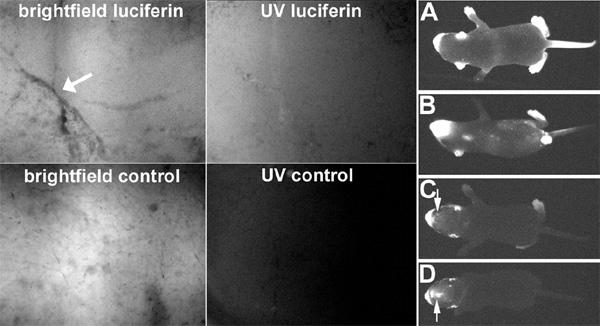
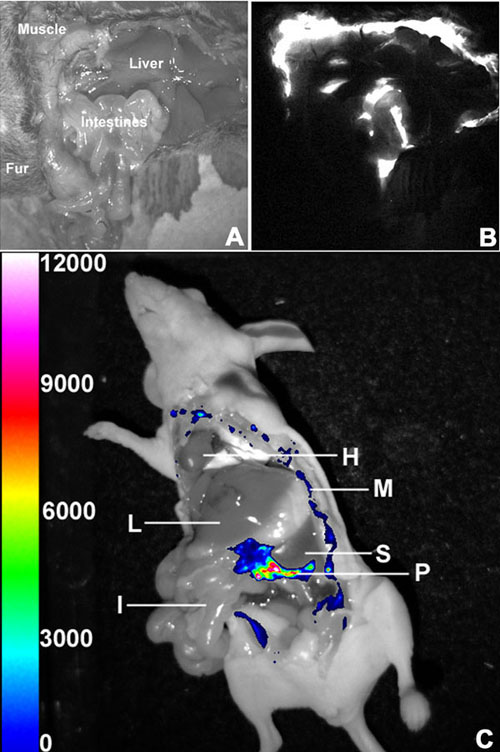
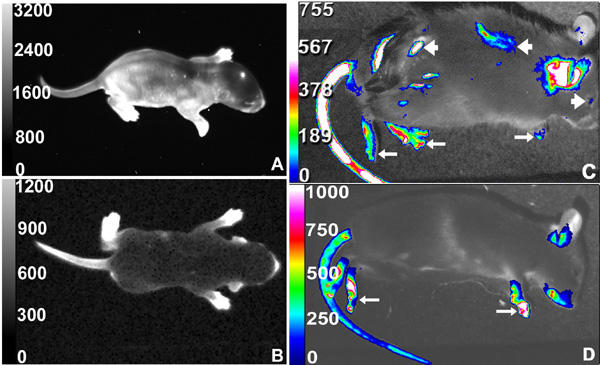
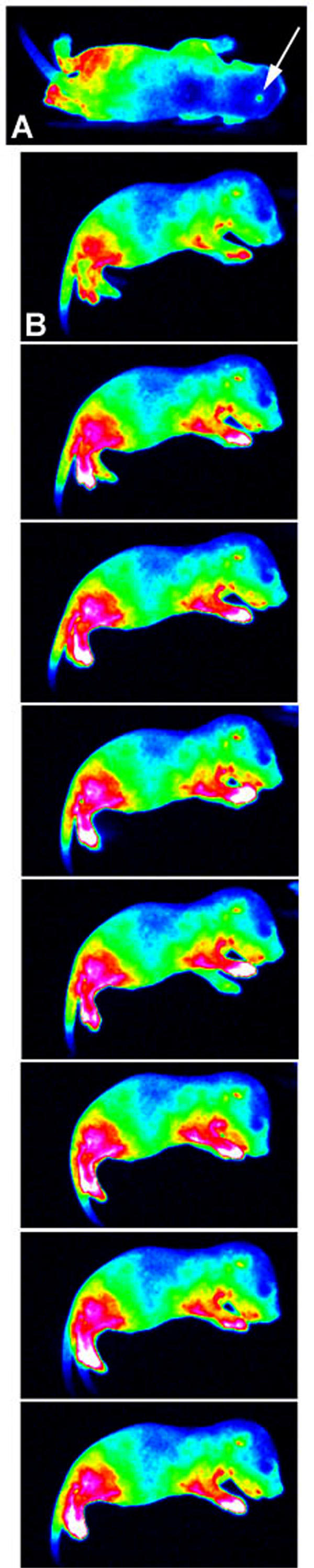
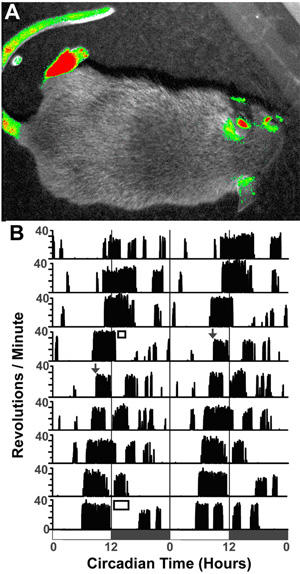
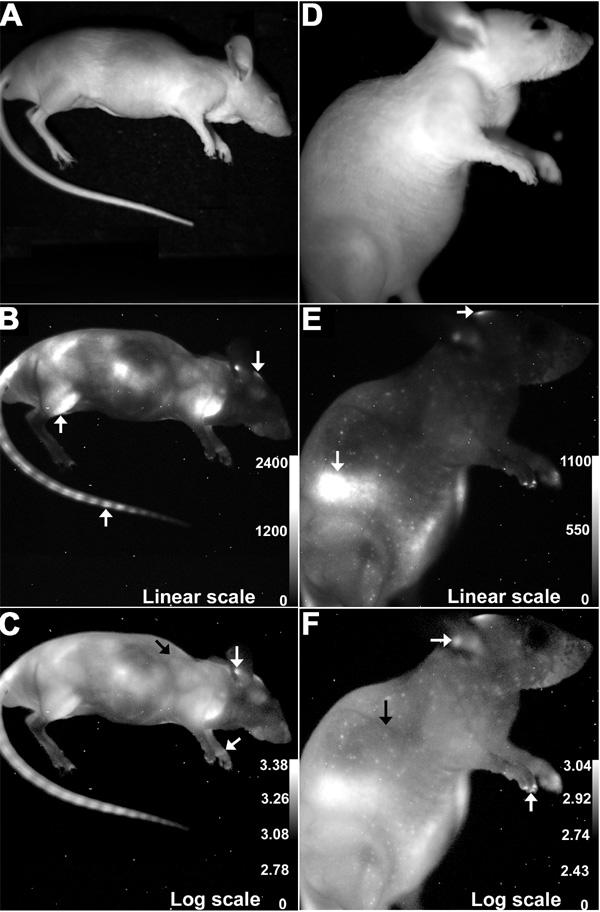
Bioluminescence imaging of anesthetized mice over several weeks corresponded with expression patterns in mice imaged rapidly after a lethal overdose. Both fos::luc and CMV::luc mice showed quantifiable bright bioluminescence in ear, nose, paws, and tail whether they were anesthetized or overdosed. CMV::luc and fos::luc neonates had bioluminescence patterns similar to those of adults, although intensity was significantly higher in neonates. CMV::luc mice crossed with HRS/J mice had high expression in bone, claws, head, pancreas, and skeletal muscle, but less in extremities than haired CMV::luc mice. Imaging of brain bioluminescence through the neonatal skull was also practical. By imaging luciferin autofluorescence it was clear that substrate distribution did not restrict bioluminescence imaging to capillaries after injection. Luciferin treatment and anesthesia during imaging did not adversely affect circadian rhythms in locomotor activity.
Imaging of gene expression patterns with luciferase can be extended from studies of live animals to rapid imaging of mice following a pentobarbital overdose before significant effects from postmortem changes occurs. Bioluminescent transgenic mice crossed with HRS/J mice are valuable for examining gene expression in deep tissues.
与萤火虫荧光素酶基因(luc)融合的基因启动子可用于研究活体转基因小鼠中的基因调控,并且能提供有关功能器官的独特见解。通过对荧光素酶生物发光氧化荧光素的成像,可以观察到表达荧光素酶的细胞和组织中的基因表达动态。通过定位即刻早期基因(如c-fos)的表达,已确定了参与特定行为的神经通路。一种由人c-fos启动子控制luc的转基因小鼠品系(fos::luc)已实现脑片培养中的基因表达成像。为了优化对完整小鼠体内即刻早期基因表达的成像,本研究对fos::luc小鼠和另一种转基因小鼠进行了检测,该转基因小鼠含有由人巨细胞病毒即刻早期基因1启动子和增强子控制的luc(CMV::luc)。由于皮肤色素和毛发会显著散射来自深层结构的光,因此将这两个转基因品系与无毛白化小鼠(HRS/J)杂交,以探索哪些深层结构可以成像。此外,还对活体麻醉小鼠和过量给药小鼠进行了比较。
在数周内对麻醉小鼠进行的生物发光成像与戊巴比妥过量给药后快速成像的小鼠的表达模式一致。无论是麻醉还是过量给药,fos::luc和CMV::luc小鼠在耳朵、鼻子、爪子和尾巴中均显示出可量化的明亮生物发光。CMV::luc和fos::luc新生小鼠的生物发光模式与成年小鼠相似,尽管新生小鼠的强度明显更高。与HRS/J小鼠杂交的CMV::luc小鼠在骨骼、爪子、头部、胰腺和骨骼肌中有高表达,但与有毛的CMV::luc小鼠相比,四肢中的表达较少。通过新生小鼠颅骨对脑生物发光进行成像也是可行的。通过对荧光素自体荧光成像清楚地表明,注射后底物分布不会将生物发光成像限制于毛细血管。成像期间的荧光素处理和麻醉对运动活动的昼夜节律没有不利影响。
利用荧光素酶对基因表达模式进行成像可以从活体动物研究扩展到在戊巴比妥过量给药后、在死后变化产生显著影响之前对小鼠进行快速成像。与HRS/J小鼠杂交的生物发光转基因小鼠对于研究深层组织中的基因表达很有价值。