Wesley Ronald D, Lager Kelly M
Virus and Prion Diseases of Livestock Research Unit, National Animal Disease Center, USDA, Agricultural Research Service, P.O. Box 70, Ames, IA 50010, USA.
Vet Microbiol. 2003 Sep 1;95(3):175-86. doi: 10.1016/s0378-1135(03)00150-0.
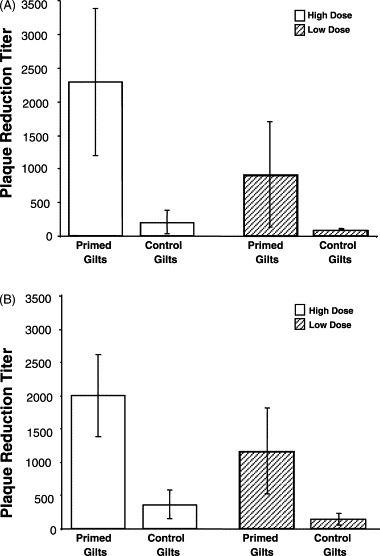
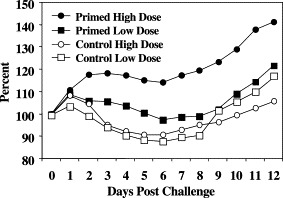
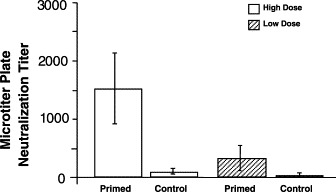
Establishing immunological memory in female piglets at a young age with PRCV was effective in inducing a secondary immune response to a limiting dose of virulent TGEV given orally 13-18 days prior to farrowing. Subsequently, because of passive antibody transfer, the offspring of these primed gilts were more efficient in surviving a lethal TGEV challenge. An average survival rate of 89% occurred in 6 litters of piglets from primed gilts that were boosted with 2.8 x 10(6) plaque forming units (PFU) of TGEV whereas 76% of the piglets survived in three litters that suckled primed gilts boosted with 3.0 x 10(5)PFU of TGEV. Non-primed gilts given identical pre-farrowing doses of TGEV had litter survival rates of 63 and 55%, respectively. Moreover, both groups of litters from primed gilts suffered less clinical illness (as measured by the extent of weight loss post-challenge) than control litters. Priming of the piglets as neonates and boosting the pregnant gilts produced an anamnestic systemic immune response and correspondingly higher milk titers in the primed gilts compared to control animals. Thus, priming piglets with PRCV was beneficial in providing resistance to TGEV and could be incorporated into a vaccine strategy that yields better protection against TGEV.
在幼年雌性仔猪中用猪呼吸道冠状病毒(PRCV)建立免疫记忆,对于在分娩前13 - 18天口服给予致死剂量的猪传染性胃肠炎病毒(TGEV)时诱导二次免疫反应是有效的。随后,由于被动抗体转移,这些经免疫的后备母猪的后代在抵抗致死性TGEV攻击时更具生存能力。来自经免疫的后备母猪的6窝仔猪,在接种2.8×10⁶空斑形成单位(PFU)的TGEV后,平均存活率为89%;而在3窝由接种3.0×10⁵ PFU的TGEV的经免疫的后备母猪哺乳的仔猪中,76%存活。给予相同分娩前剂量TGEV的未免疫后备母猪的仔猪窝存活率分别为63%和55%。此外,与对照窝相比,来自经免疫的后备母猪的两组仔猪临床疾病症状较轻(通过攻击后体重减轻程度衡量)。与对照动物相比,新生仔猪免疫接种以及怀孕后备母猪再次接种产生了回忆性全身免疫反应,相应地经免疫的后备母猪乳汁中的抗体滴度更高。因此,用PRCV免疫仔猪有利于提供对TGEV的抵抗力,并且可以纳入一种能更好地预防TGEV的疫苗策略中。