Terada Yasuhiko, Uetake Yumi, Kuriyama Ryoko
Department of Genetics, Cell Biology, and Development, University of Minnesota, Minneapolis, MN 55455, USA.
J Cell Biol. 2003 Sep 1;162(5):757-63. doi: 10.1083/jcb.200305048. Epub 2003 Aug 25.
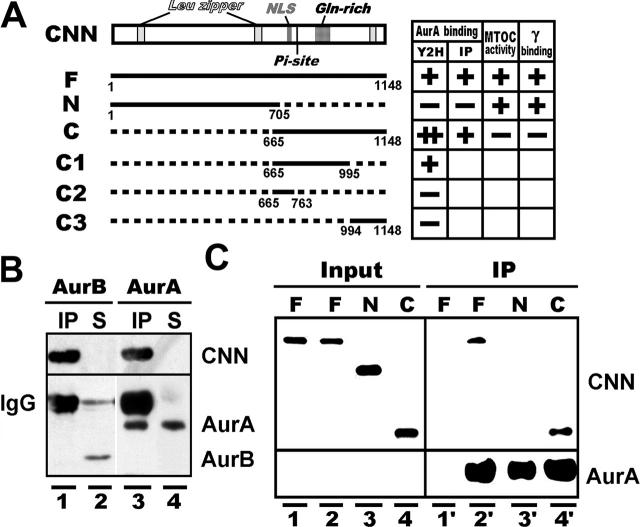
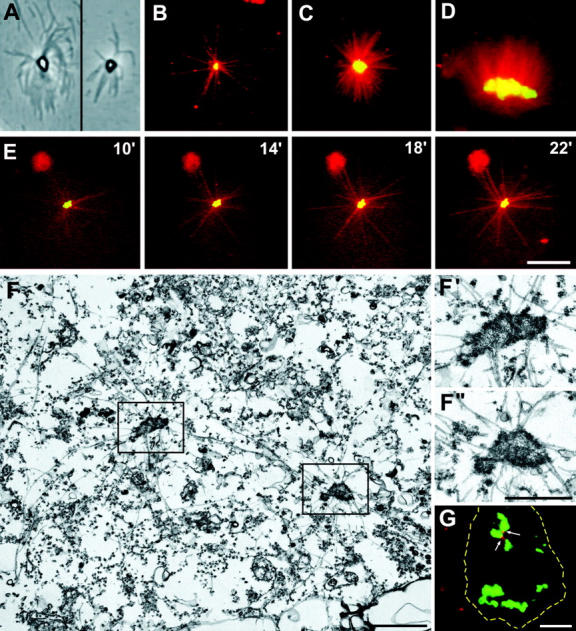
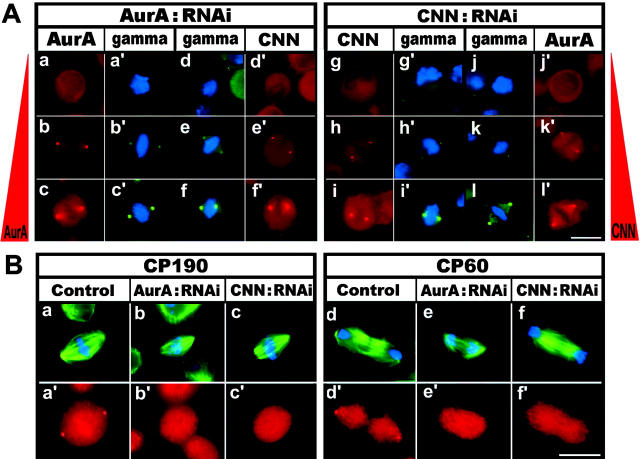
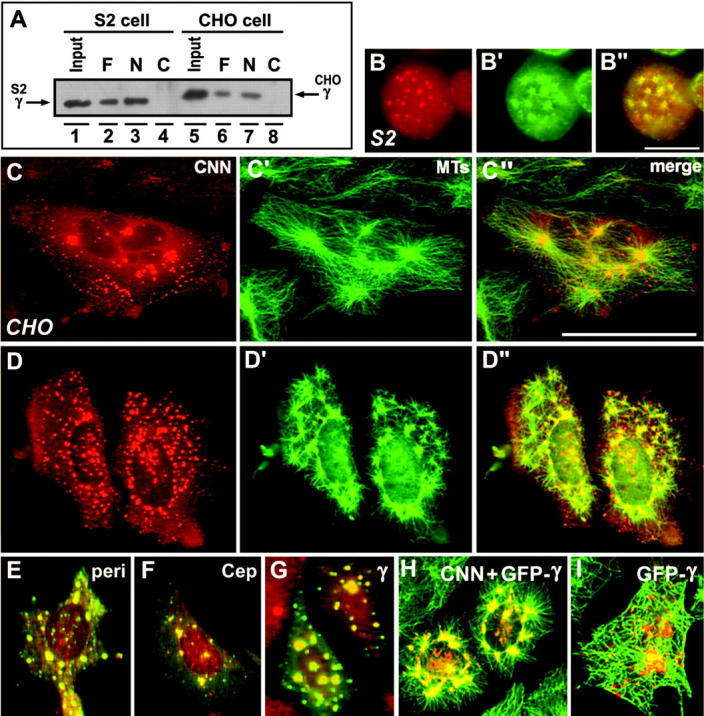
A mitosis-specific Aurora-A kinase has been implicated in microtubule organization and spindle assembly in diverse organisms. However, exactly how Aurora-A controls the microtubule nucleation onto centrosomes is unknown. Here, we show that Aurora-A specifically binds to the COOH-terminal domain of a Drosophila centrosomal protein, centrosomin (CNN), which has been shown to be important for assembly of mitotic spindles and spindle poles. Aurora-A and CNN are mutually dependent for localization at spindle poles, which is required for proper targeting of gamma-tubulin and other centrosomal components to the centrosome. The NH2-terminal half of CNN interacts with gamma-tubulin, and induces cytoplasmic foci that can initiate microtubule nucleation in vivo and in vitro in both Drosophila and mammalian cells. These results suggest that Aurora-A regulates centrosome assembly by controlling the CNN's ability to targeting and/or anchoring gamma-tubulin to the centrosome and organizing microtubule-nucleating sites via its interaction with the COOH-terminal sequence of CNN.
一种有丝分裂特异性的极光激酶A(Aurora-A kinase)在多种生物体的微管组织和纺锤体组装中发挥作用。然而,极光激酶A究竟如何控制微管在中心体上的成核尚不清楚。在此,我们表明极光激酶A特异性结合果蝇中心体蛋白中心体素(centrosomin,CNN)的COOH末端结构域,该蛋白已被证明对有丝分裂纺锤体和纺锤体极的组装很重要。极光激酶A和中心体素在纺锤体极的定位上相互依赖,这是γ-微管蛋白和其他中心体成分正确靶向到中心体所必需的。中心体素的NH2末端一半与γ-微管蛋白相互作用,并诱导细胞质焦点,该焦点可在果蝇和哺乳动物细胞的体内和体外启动微管成核。这些结果表明,极光激酶A通过控制中心体素将γ-微管蛋白靶向和/或锚定到中心体的能力,并通过其与中心体素COOH末端序列的相互作用来组织微管成核位点,从而调节中心体组装。