Vreken P, Raué H A
Faculty of Chemistry, Department of Biochemistry and Molecular Biology, Vrije Universiteit de Boelelaan, Amsterdam, The Netherlands.
Mol Cell Biol. 1992 Jul;12(7):2986-96. doi: 10.1128/mcb.12.7.2986-2996.1992.
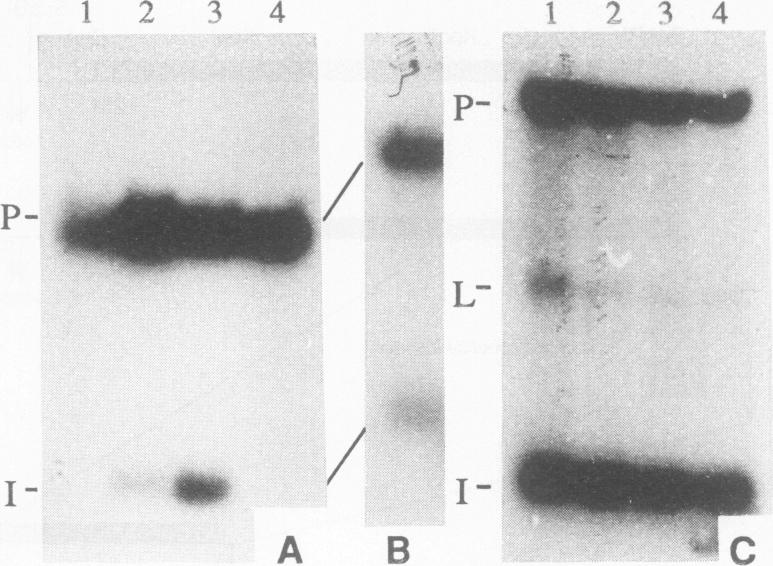
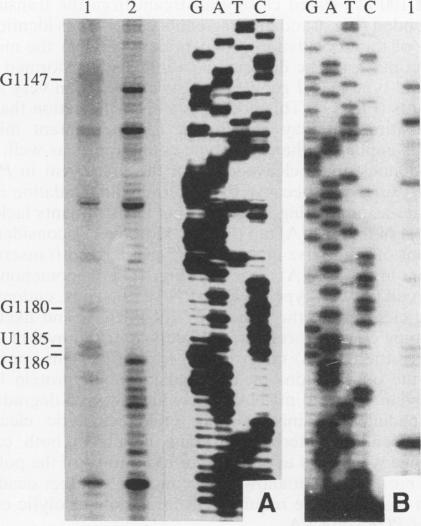
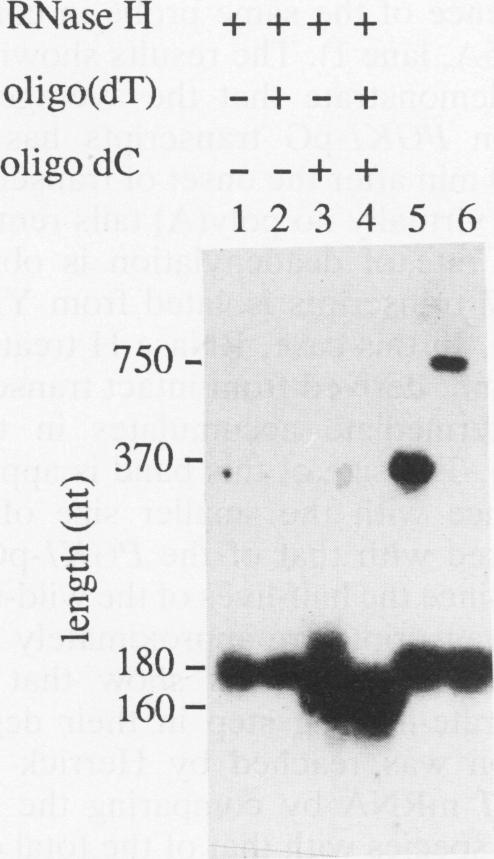
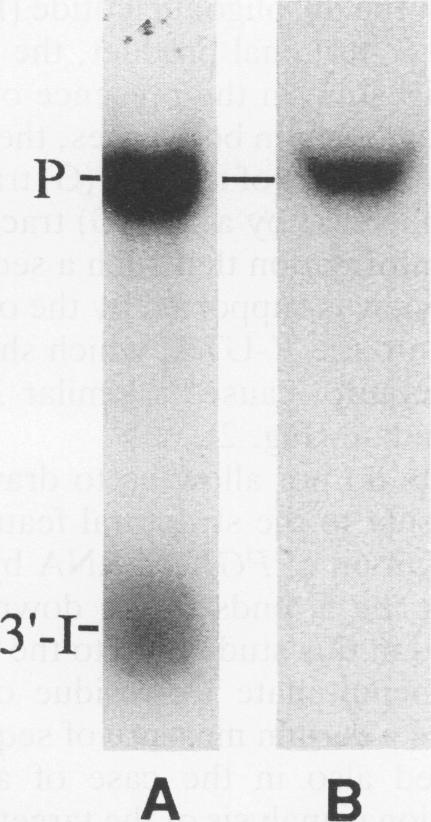
Insertion of an 18-nucleotide-long poly(G) tract into the 3'-terminal untranslated region of yeast phosphoglycerate kinase (PGK1) mRNA increases its chemical half-life by about a factor of 2 (P. Vreken, R. Van der Veen, V. C. H. F. de Regt, A. L. de Maat, R. J. Planta, and H. A. Raué, Biochimie 73:729-737, 1991). In this report, we show that this insertion also causes the accumulation of a degradation intermediate extending from the poly(G) sequence down to the transcription termination site. Reverse transcription and S1 nuclease mapping experiments demonstrated that this intermediate is the product of shorter-lived primary fragments resulting from endonucleolytic cleavage immediately downstream from the U residue of either of two 5'-GGUG-3' sequences present between positions 1100 and 1200 close to the 3' terminus (position 1251) of the coding sequence. Similar endonucleolytic cleavages appear to initiate degradation of wild-type PGK1 mRNA. Insertion of a poly(G) tract just upstream from the AUG start codon resulted in the accumulation of a 5'-terminal degradation intermediate extending from the insertion to the 1100-1200 region. RNase H degradation in the presence of oligo(dT) demonstrated that the wild-type and mutant PGK1 mRNAs are deadenylated prior to endonucleolytic cleavage and that the half-life of the poly(A) tail is three- to sixfold lower than that of the remainder of the mRNA. Thus, the endonucleolytic cleavage constitutes the rate-limiting step in degradation of both wild-type and mutant PGK1 transcripts, and the resulting fragments are degraded by a 5'----3' exonuclease, which appears to be severely retarded by a poly(G) sequence.
在酵母磷酸甘油酸激酶(PGK1)mRNA的3'末端非翻译区插入一段18个核苷酸长的聚(G)序列,可使其化学半衰期延长约2倍(P. 弗雷肯、R. 范德维恩、V. C. H. F. 德雷格特、A. L. 德马特、R. J. 普兰特和H. A. 劳埃,《生物化学》73:729 - 737,1991)。在本报告中,我们表明这种插入还会导致一种降解中间体的积累,该中间体从聚(G)序列一直延伸到转录终止位点。逆转录和S1核酸酶图谱实验表明,这种中间体是较短寿命的初级片段的产物,这些初级片段是由位于编码序列3'末端(位置1251)附近1100至1200位之间的两个5'-GGUG-3'序列中任意一个的U残基下游立即发生的内切核酸酶切割产生的。类似的内切核酸酶切割似乎启动了野生型PGK1 mRNA的降解。在AUG起始密码子上游紧邻处插入一段聚(G)序列,导致积累了一种5'末端降解中间体,该中间体从插入位点延伸到1100 - 1200区域。在寡聚(dT)存在下进行的RNase H降解表明,野生型和突变型PGK1 mRNA在进行内切核酸酶切割之前会发生去腺苷酸化,并且聚(A)尾的半衰期比mRNA其余部分的半衰期低三至六倍。因此,内切核酸酶切割是野生型和突变型PGK1转录本降解的限速步骤,产生的片段由5'→3'外切核酸酶降解,聚(G)序列似乎严重阻碍了这种外切核酸酶的作用。