Colberg-Poley A M, Santomenna L D, Harlow P P, Benfield P A, Tenney D J
Du Pont Merck Pharmaceutical Co., Wilmington, Delaware 19880-0328.
J Virol. 1992 Jan;66(1):95-105. doi: 10.1128/JVI.66.1.95-105.1992.
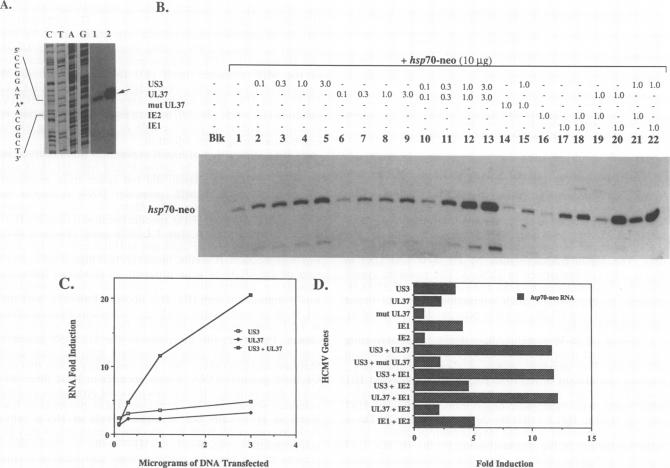
We have established the ability of the human cytomegalovirus (HCMV) UL36-38 and US3 immediate-early (IE) gene products to alter gene expression in human cells by using transient transfection assays. The cellular heat shock protein 70 (hsp70) promoter was transactivated following cotransfection with the HCMV IE regions in nonpermissive HeLa cells by UL36-38, US3, or IE1 and in permissive human diploid fibroblasts (HFF) by IE1 or IE2. Moreover, hsp70 expression was synergistically increased in HeLa cells cotransfected with US3 and UL36, with US3 and UL37, or with US3 and UL37x1. The synergistic transactivation of hsp70 expression by US3 and UL36-38 was not observed in HFF cells. Synergy was also not observed in HeLa cells between US3 and UL38, an early gene product encoded by the UL36-38 IE locus. Synergistic transactivation of hsp70 expression in HeLa cells required the syntheses of UL36-38 and US3 IE proteins, since nonsense mutants were not functional. hsp70 expression increased with increasing amounts of transfected US3 and UL37 DNA and occurred at the level of stable hsp70-promoted RNA. In contrast to the broad hsp70 response, promoters from the HCMV UL112 early gene and another cellular gene, brain creatine kinase, both responded strongly only to singly transfected IE2 in HeLa cells. Nevertheless, IE2 transactivation of the UL112 promoter was further stimulated by cotransfection of IE1 or of UL36-38 in both HeLa and HFF cells. Thus, different patterns of promoter transactivation and interactions between HCMV IE gene products in transactivation were found in HFF cells and in HeLa cells. These results establish the ability of the HCMV US3 and UL36-38 proteins to alter cellular and viral gene expression and are consistent with involvement of cellular transcription factors in HCMV IE regulation of gene expression.
我们利用瞬时转染试验,证实了人巨细胞病毒(HCMV)UL36 - 38和US3立即早期(IE)基因产物改变人细胞中基因表达的能力。在非允许性的HeLa细胞中,与HCMV IE区域共转染后,UL36 - 38、US3或IE1可激活细胞热休克蛋白70(hsp70)启动子;在允许性的人二倍体成纤维细胞(HFF)中,IE1或IE2可激活该启动子。此外,在与US3和UL36、US3和UL37或US3和UL37x1共转染的HeLa细胞中,hsp70表达协同增加。在HFF细胞中未观察到US3和UL36 - 38对hsp70表达的协同反式激活作用。在HeLa细胞中,US3与UL38(UL36 - 38 IE基因座编码的一种早期基因产物)之间也未观察到协同作用。HeLa细胞中hsp70表达的协同反式激活需要合成UL36 - 38和US3 IE蛋白,因为无义突变体无功能。hsp70表达随转染的US3和UL37 DNA量增加而增加,且发生在稳定的hsp70启动的RNA水平。与广泛的hsp70反应不同,HCMV UL112早期基因启动子和另一个细胞基因脑肌酸激酶启动子,在HeLa细胞中仅对单独转染的IE2有强烈反应。然而,在HeLa细胞和HFF细胞中,共转染IE1或UL36 - 38可进一步刺激IE2对UL112启动子的反式激活。因此,在HFF细胞和HeLa细胞中发现了不同的启动子反式激活模式以及HCMV IE基因产物在反式激活中的相互作用。这些结果证实了HCMV US3和UL36 - 38蛋白改变细胞和病毒基因表达的能力,并且与细胞转录因子参与HCMV IE基因表达调控一致。