Teitelbaum D, Milo R, Arnon R, Sela M
Department of Chemical Immunology, Weizmann Institute of Science, Rehovot, Israel.
Proc Natl Acad Sci U S A. 1992 Jan 1;89(1):137-41. doi: 10.1073/pnas.89.1.137.
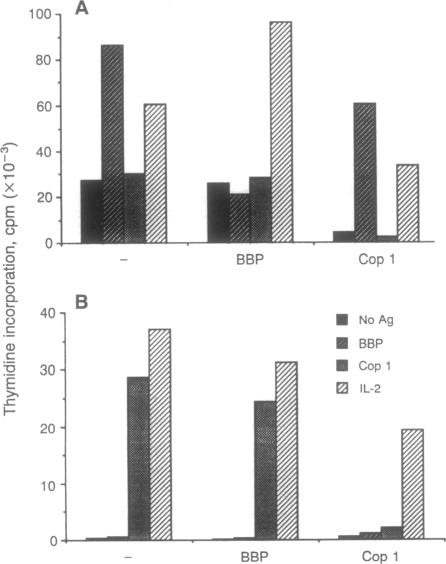
Copolymer 1 (Cop 1) is a synthetic basic random copolymer of amino acids that has been shown to be effective in suppression of experimental allergic encephalomyelitis and has been proposed as a candidate drug for multiple sclerosis. Cop 1 is immunologically cross reactive with myelin basic protein (BP) and was shown to inhibit murine BP-specific T-cell lines of various H-2 restrictions. In the present study these findings were extended to include human T-cell lines. Cop 1 competitively inhibited the proliferative responses and interleukin 2 secretion of six BP-specific T-cell lines and 13 clones with several DR restrictions and epitope specificities. Conversely, BP inhibited--albeit to a lesser extent--the response of all the Cop 1-specific T-cell lines and clones, irrespective of their DR restrictions. Another random copolymer of tyrosine, glutamic acid, and alanine, denoted TGA, had no effect on these lines. Neither Cop 1 nor BP inhibited the response of lines and clones specific for purified protein derivative. Cop 1 and BP exerted their cross-inhibitory effects only in the presence of antigen-presenting cells. These results suggest that Cop 1 can compete with BP for the binding to human major histocompatibility complex molecules. In view of recent studies implicating BP reactivity in multiple sclerosis, these findings suggest a possible mechanism for the beneficial effect of Cop 1 in this disease.
共聚体1(Cop 1)是一种合成的碱性氨基酸随机共聚物,已被证明在抑制实验性变应性脑脊髓炎方面有效,并被提议作为治疗多发性硬化症的候选药物。Cop 1与髓鞘碱性蛋白(BP)具有免疫交叉反应性,并被证明能抑制各种H-2限制型的小鼠BP特异性T细胞系。在本研究中,这些发现扩展到了人类T细胞系。Cop 1竞争性抑制了6个BP特异性T细胞系和13个具有多种DR限制和表位特异性的克隆的增殖反应及白细胞介素2分泌。相反,BP对所有Cop 1特异性T细胞系和克隆的反应也有抑制作用,尽管程度较小,且与它们的DR限制无关。另一种由酪氨酸、谷氨酸和丙氨酸组成的随机共聚物,称为TGA,对这些细胞系没有影响。Cop 1和BP都不抑制对纯化蛋白衍生物特异性的细胞系和克隆的反应。Cop 1和BP仅在存在抗原呈递细胞的情况下发挥交叉抑制作用。这些结果表明,Cop 1可以与BP竞争与人主要组织相容性复合体分子的结合。鉴于最近的研究表明BP反应性与多发性硬化症有关,这些发现提示了Cop 1在该疾病中产生有益作用的一种可能机制。