Weaver D R, Rivkees S A, Reppert S M
Laboratory of Developmental Chronobiology, Massachusetts General Hospital, Boston 02114.
Proc Natl Acad Sci U S A. 1992 Oct 1;89(19):9201-4. doi: 10.1073/pnas.89.19.9201.
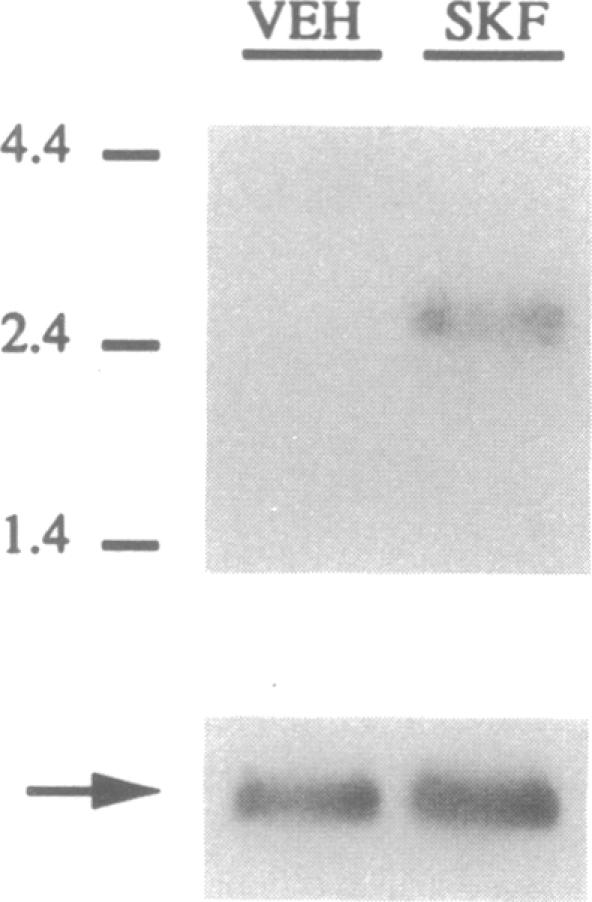
The existence of an activatable dopamine system within the hypothalamic suprachiasmatic nuclei (SCN), the site of a biological clock, was investigated in rats during fetal life. In situ hybridization studies revealed that D1-dopamine receptor mRNA was highly expressed in the fetal SCN and not expressed in other hypothalamic regions. Cocaine injected into pregnant rats or directly into rat fetuses on day 20 of gestation selectively activated c-fos gene expression in the fetal SCN; cocaine did not induce c-fos expression elsewhere in the fetal brain or in the maternal SCN. This cocaine-induced activation of c-fos expression in fetal SCN was mediated in part through D1-dopamine receptors, as the cocaine-induced activation was partially blocked by the D1-dopamine receptor antagonist SCH 23390. In addition, the selective D1-dopamine receptor agonist SKF 38393 induced high levels of c-fos expression in the fetal SCN. The presence of an activatable dopamine system within the fetal SCN provides a mechanism through which maternal signals could entrain the fetal biological clock and through which maternally administered psychotropic drugs could alter normal development of the circadian timing system.
在胎儿期的大鼠中,对下丘脑视交叉上核(SCN)(生物钟所在部位)内可激活的多巴胺系统的存在情况进行了研究。原位杂交研究显示,D1-多巴胺受体mRNA在胎儿SCN中高度表达,而在下丘脑其他区域不表达。在妊娠第20天给怀孕大鼠注射可卡因或直接给大鼠胎儿注射可卡因,可选择性激活胎儿SCN中的c-fos基因表达;可卡因未在胎儿脑的其他部位或母体SCN中诱导c-fos表达。胎儿SCN中这种可卡因诱导的c-fos表达激活部分是通过D1-多巴胺受体介导的,因为D1-多巴胺受体拮抗剂SCH 23390可部分阻断可卡因诱导的激活。此外,选择性D1-多巴胺受体激动剂SKF 38393可诱导胎儿SCN中高水平的c-fos表达。胎儿SCN内可激活的多巴胺系统的存在提供了一种机制,通过该机制母体信号可调节胎儿生物钟,且母体给予的精神药物可改变昼夜节律系统的正常发育。