Smit J, Engelhardt H, Volker S, Smith S H, Baumeister W
Max-Planck-Institut für Biochemie, Martinsreid bei Munich, Germany.
J Bacteriol. 1992 Oct;174(20):6527-38. doi: 10.1128/jb.174.20.6527-6538.1992.
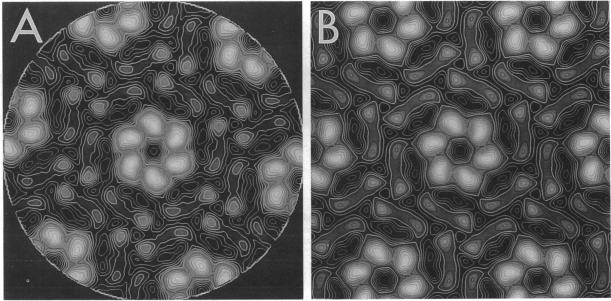
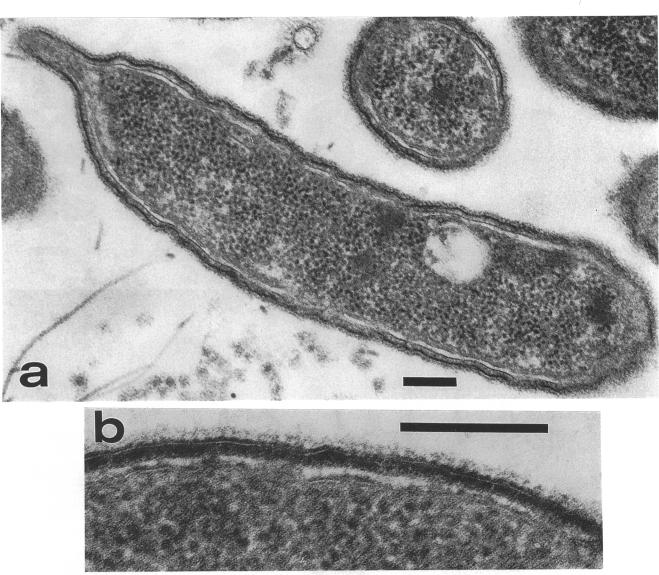
The regular surface protein structure (S-layer) of Caulobacter crescentus was analyzed by electron microscopy and three-dimensional image reconstruction to a resolution of 2 nm. Projections showed that the S-layer is an array of ring structures, each composed of six subunits that are arranged on a lattice with p6 symmetry. Three-dimensional reconstructions showed that the ring subunits were approximately rod-shaped structures and were perpendicular to the plane of the array, with a linker arm emanating from approximately the middle of the rod, accounting for the connections between the rings. The calculated subunit mass was ca. 100 kDa, very close to the size of RsaA (the protein known to be at least the predominant species in the S-layer) predicted from the DNA sequence of the rsaA gene. The core region of the rings creates an open pore 2.5 to 3.5 nm in diameter. The size of the gaps between the neighboring unit cells is in the same range, suggesting a uniform porosity predicted to exclude molecules larger than ca. 17 kDa. Attempts to remove membrane material from S-layer preparations with detergents revealed that the structure spontaneously rearranged into a mirror-image double layer. Negative-stain and thin-section electron microscopy examination of colonies of C. crescentus strains with a mutation in a surface molecule involved in the attachment of the S-layer showed that shed RsaA protein organized into large sheets. The sheets in turn organized into stacks that tended to accumulate near the upper surface of the colony. Image reconstruction indicated that these sheets were also precise mirror-image double layers, and thickness measurements obtained from thin sections were consistent with this finding. The sheets were absent when these mutant strains were grown without calcium, supporting other data that calcium is involved in attachment of the S-layer to a surface molecule and perhaps in subunit-subunit interactions. We propose that when the membrane is removed from S-layer fragments by detergents or the attachment-related surface molecule is absent, the attachment sites of the S-layer align precisely to form a double layer via a calcium interaction.
通过电子显微镜和三维图像重建技术对新月柄杆菌的规则表面蛋白结构(S层)进行了分析,分辨率达到2纳米。投影显示S层是由环状结构组成的阵列,每个环状结构由六个亚基组成,这些亚基以p6对称排列在晶格上。三维重建显示环状亚基近似为杆状结构,垂直于阵列平面,从杆的大约中间位置伸出一个连接臂,这解释了环之间的连接。计算得出的亚基质量约为100 kDa,与根据rsaA基因的DNA序列预测的RsaA(已知至少是S层中主要成分的蛋白质)大小非常接近。环的核心区域形成了一个直径为2.5至3.5纳米的开放孔。相邻晶胞之间的间隙大小在同一范围内,表明存在均匀的孔隙率,预计可排除大于约17 kDa的分子。用去污剂从S层制剂中去除膜材料的尝试表明,该结构会自发重排成镜像双层。对涉及S层附着的表面分子发生突变的新月柄杆菌菌株菌落进行的负染和超薄切片电子显微镜检查显示,脱落的RsaA蛋白组织成大片。这些片层进而组织成堆叠,倾向于在菌落的上表面附近积累。图像重建表明这些片层也是精确的镜像双层,从超薄切片获得的厚度测量结果与这一发现一致。当这些突变菌株在无钙条件下生长时,片层不存在,这支持了其他数据,即钙参与S层与表面分子的附着,也许还参与亚基 - 亚基相互作用。我们提出,当通过去污剂从S层片段中去除膜或不存在与附着相关的表面分子时,S层的附着位点会精确对齐,通过钙相互作用形成双层。