Mann C, Micouin J Y, Chiannilkulchai N, Treich I, Buhler J M, Sentenac A
Service de Biochimie et Génétique Moléculaire, Centre d'Etudes de Saclay, Gif-sur-Yvette, France.
Mol Cell Biol. 1992 Oct;12(10):4314-26. doi: 10.1128/mcb.12.10.4314-4326.1992.
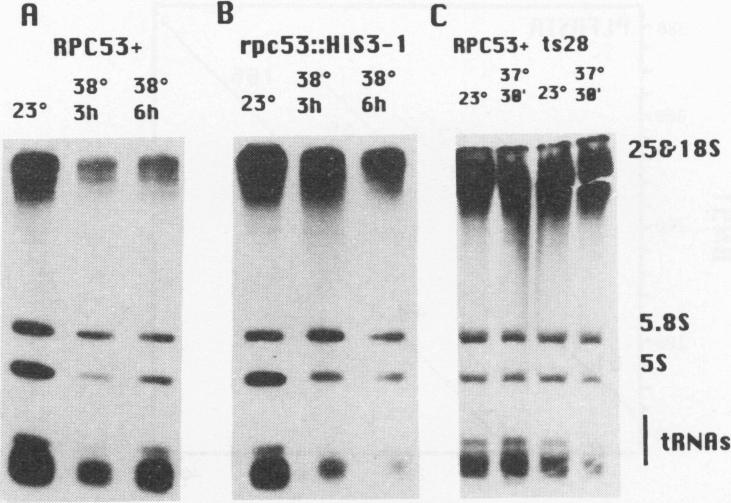
RPC53 is shown to be an essential gene encoding the C53 subunit specifically associated with yeast RNA polymerase C (III). Temperature-sensitive rpc53 mutants were generated and showed a rapid inhibition of tRNA synthesis after transfer to the restrictive temperature. Unexpectedly, the rpc53 mutants preferentially arrested their cell division in the G1 phase as large, round, unbudded cells. The RPC53 DNA sequence is predicted to code for a hydrophilic M(r)-46,916 protein enriched in charged amino acid residues. The carboxy-terminal 136 amino acids of C53 are significantly similar (25% identical amino acid residues) to the same region of the human BN51 protein. The BN51 cDNA was originally isolated by its ability to complement a temperature-sensitive hamster cell mutant that undergoes a G1 cell division arrest, as is true for the rpc53 mutants.
RPC53被证明是一个必需基因,编码与酵母RNA聚合酶C(III)特异性相关的C53亚基。构建了温度敏感型rpc53突变体,将其转移到限制温度后,tRNA合成迅速受到抑制。出乎意料的是,rpc53突变体优先在G1期将其细胞分裂阻滞,形成大的、圆形的、未出芽的细胞。预测RPC53 DNA序列编码一种富含带电荷氨基酸残基的亲水性M(r)-46,916蛋白。C53的羧基末端136个氨基酸与人类BN51蛋白的同一区域显著相似(25%的氨基酸残基相同)。BN51 cDNA最初是因其能够互补一个温度敏感型仓鼠细胞突变体而被分离出来的,该突变体与rpc53突变体一样,会发生G1期细胞分裂阻滞。