Lehmann L E, Eberle W, Krull S, Prill V, Schmidt B, Sander C, von Figura K, Peters C
Universität Göttingen, Germany.
EMBO J. 1992 Dec;11(12):4391-9. doi: 10.1002/j.1460-2075.1992.tb05539.x.
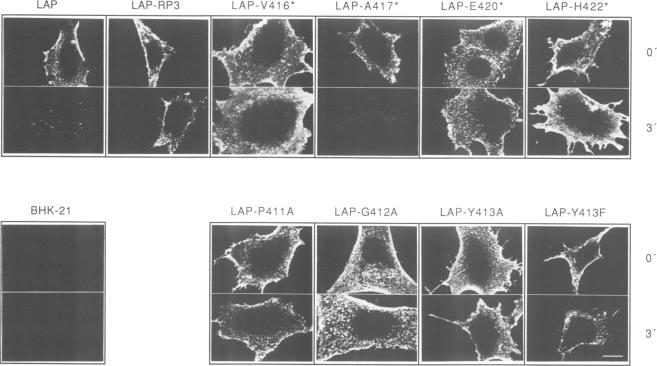
Lysosomal acid phosphatase (LAP) is rapidly internalized from the cell surface due to a tyrosine-containing internalization signal in its 19 amino acid cytoplasmic tail. Measuring the internalization of a series of LAP cytoplasmic tail truncation and substitution mutants revealed that the N-terminal 12 amino acids of the cytoplasmic tail are sufficient for rapid endocytosis and that the hexapeptide 411-PGYRHV-416 is the tyrosine-containing internalization signal. Truncation and substitution mutants of amino acid residues following Val416 can prevent internalization even though these residues do not belong to the internalization signal. It was shown recently that part of the LAP cytoplasmic tail peptide corresponding to 410-PPGY-413 forms a well-ordered beta turn structure in solution. Two-dimensional NMR spectroscopy of two modified LAP tail peptides, in which the single tyrosine was substituted either by phenylalanine or by alanine, revealed that the tendency to form a beta turn is reduced by 25% in the phenylalanine-containing peptide and by approximately 50% in the alanine-containing mutant peptide. Our results suggest, that in the short cytoplasmic tail of LAP tyrosine is required for stabilization of the right turn and that the aromatic ring system of the tyrosine residue is a contact point to the putative cytoplasmic receptor.
溶酶体酸性磷酸酶(LAP)因其19个氨基酸的细胞质尾部中含酪氨酸的内化信号而迅速从细胞表面内化。对一系列LAP细胞质尾部截短和取代突变体的内化进行测量显示,细胞质尾部的N端12个氨基酸足以实现快速内吞作用,并且六肽411 - PGYRHV - 416是含酪氨酸的内化信号。Val416之后氨基酸残基的截短和取代突变体可以阻止内化,尽管这些残基不属于内化信号。最近研究表明,LAP细胞质尾部肽段中对应于410 - PPGY - 413的部分在溶液中形成了有序的β转角结构。对两个修饰的LAP尾部肽段进行二维核磁共振光谱分析,其中单个酪氨酸分别被苯丙氨酸或丙氨酸取代,结果显示含苯丙氨酸的肽段中形成β转角的倾向降低了25%,而含丙氨酸的突变肽段中降低了约50%。我们的结果表明,在LAP的短细胞质尾部中,酪氨酸对于正确转角的稳定是必需的,并且酪氨酸残基的芳香环系统是与假定的细胞质受体的接触点。