Maurin M, Benoliel A M, Bongrand P, Raoult D
Centre National de Référence des Rickettsioses, CHU La Timone, Marseille.
Infect Immun. 1992 Dec;60(12):5013-6. doi: 10.1128/iai.60.12.5013-5016.1992.
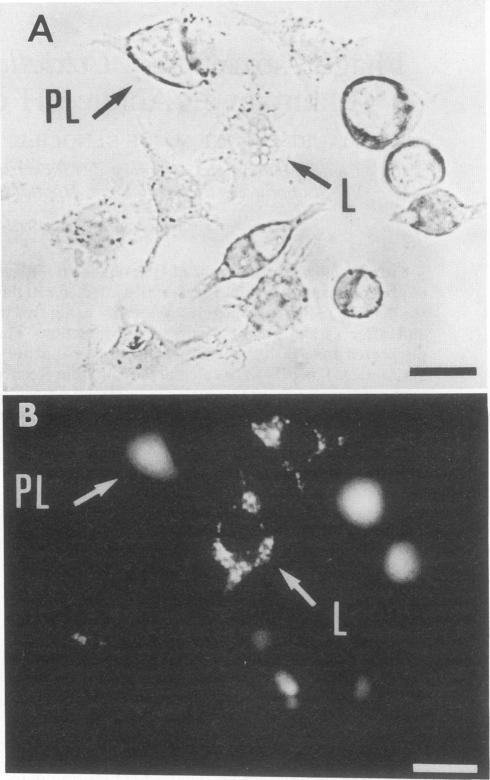
Coxiella burnetii, the agent of Q fever, is an obligate intracellular bacterium that multiples within vacuoles of phagolysosomal origin. Persistently infected cell lines were maintained in continuous culture for months. We studied the pH of the phagolysosomes by using two murine cell lines during early propagation of the bacteria and after establishment of persistent infection. Three strains of C. burnetii were studied because of the purported propensity of each strain to cause acute or chronic disease and to be resistant or susceptible to antibiotics. The pHs were calculated from fluorescence experiments with fluoresceinated dextran as a lysosomal probe. Phagolysosomal vacuoles maintained an acidic pH during a 36-day infection. Minimal variation of the pH occurred over the duration of the experiment with strains that caused either acute or chronic disease. Phagolysosomal pH remained stable for as long as 153 days with the Nine Mile phase II isolate. Thus, neither the course of C. burnetti infection nor the diversity of antibiotic susceptibility of the strains is related to variations in the phagolysosomal pH.
伯纳特立克次体是Q热的病原体,是一种专性细胞内细菌,在吞噬溶酶体来源的液泡内繁殖。持续感染的细胞系在连续培养中维持数月。我们在细菌早期繁殖期间以及持续感染建立后,使用两种小鼠细胞系研究了吞噬溶酶体的pH值。研究了三株伯纳特立克次体,因为据称每株菌株都有引起急性或慢性疾病以及对抗生素耐药或敏感的倾向。pH值是通过用荧光葡聚糖作为溶酶体探针的荧光实验计算得出的。在36天的感染过程中,吞噬溶酶体液泡保持酸性pH值。在实验过程中,引起急性或慢性疾病的菌株的pH值变化最小。九英里II期分离株的吞噬溶酶体pH值长达153天保持稳定。因此,伯纳特立克次体感染的病程和菌株对抗生素敏感性的多样性均与吞噬溶酶体pH值的变化无关。