Khan A U, Di Mascio P, Medeiros M H, Wilson T
Department of Pathology, Harvard Medical School, Boston, MA 02115.
Proc Natl Acad Sci U S A. 1992 Dec 1;89(23):11428-30. doi: 10.1073/pnas.89.23.11428.
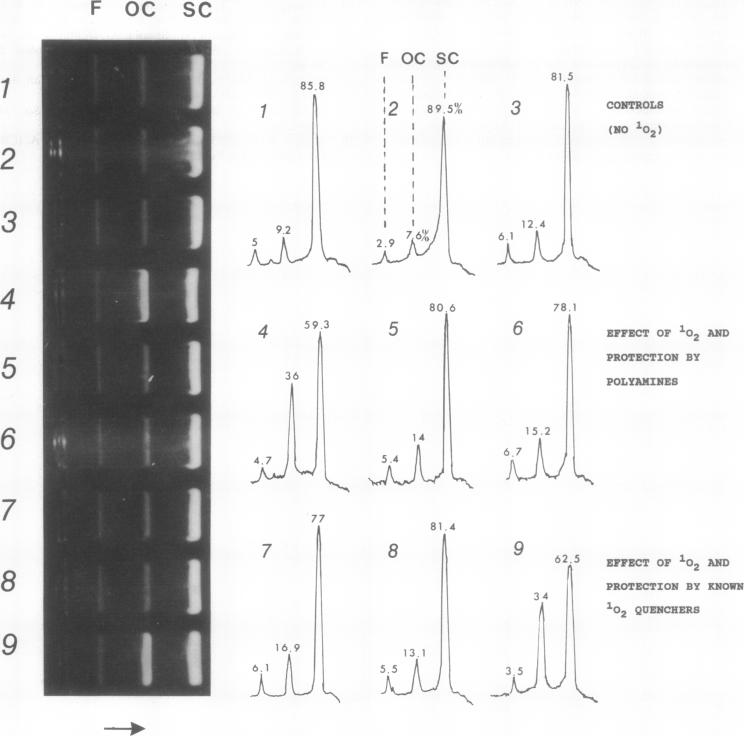
Oxidative damage to DNA induced by singlet molecular oxygen (1O2*) includes single-strand breaks, which the biologically occurring 1O2* quenchers spermine and spermidine are shown to prevent. These polyamines at a physiological concentration (10 mM) reduce the percentage of the open circular form of pBR322 plasmid DNA, which is generated at the expense of the native supercoiled form when the plasmids are incubated with a chemical source of 1O2*, the water-soluble endoperoxide of 3,3'-(1,4-naphthylidene)dipropionate. Spermine and spermidine can be expected to protect DNA against other damaging effects of 1O2*.
单线态分子氧(1O2*)诱导的DNA氧化损伤包括单链断裂,生物体内存在的1O2淬灭剂精胺和亚精胺可防止这种损伤。在生理浓度(10 mM)下,这些多胺会降低pBR322质粒DNA开环形式的百分比,当质粒与1O2的化学来源——3,3'-(1,4-萘叉基)二丙酸的水溶性内过氧化物一起孵育时,开环形式的DNA是以天然超螺旋形式为代价生成的。可以预期精胺和亚精胺能够保护DNA免受1O2*的其他破坏作用。