Zheng Liangbiao, Wang Shuang, Romans Patricia, Zhao Hongyu, Luna Coralia, Benedict Mark Q
Yale University School of Medicine, Department of Epidemiology and Public Health, 60 College Street, New Haven, CT 06520, USA.
BMC Genet. 2003 Oct 24;4:16. doi: 10.1186/1471-2156-4-16.
Anopheles gambiae females are the world's most successful vectors of human malaria. However, a fraction of these mosquitoes is refractory to Plasmodium development. L3-5, a laboratory selected refractory strain, encapsulates transforming ookinetes/early oocysts of a wide variety of Plasmodium species. Previous studies on these mosquitoes showed that one major (Pen1) and two minor (Pen2, Pen3) autosomal dominant quantitative trait loci (QTLs) control the melanotic encapsulation response against P. cynomolgi B, a simian malaria originating in Malaysia.
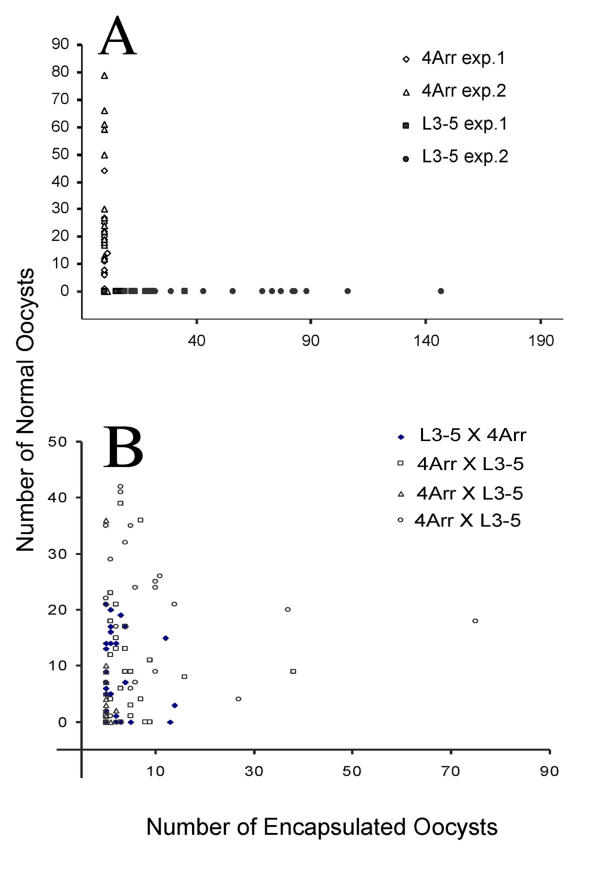
We have investigated the response of L3-5 to infection with P. cynomolgi Ceylon, a different but related parasite species, in crosses with the susceptible strain 4Arr. Refractoriness to this parasite is incompletely recessive. Infection and genotyping of F2 intercross females at genome-spanning microsatellite loci revealed that 3 autosomal QTLs control encapsulation of this species. Two loci map to the regions containing Pen2 and Pen3. The novel QTL maps to chromosome 3R, probably to polytene division 32 or 33. Thus the relative contribution of any QTL to oocyst encapsulation varies with the species of parasite. Further, different QTLs were most readily identified in different F2 families. This, like the F1 data, suggests that L3-5 is not genetically homogeneous and that somewhat different pathways may be used to achieve an encapsulation response.
We have shown here that different QTLs are involved in responses against different Plasmodium parasites.
冈比亚按蚊雌蚊是全球传播人类疟疾最成功的病媒。然而,这些蚊子中有一部分对疟原虫的发育具有抗性。L3 - 5是一个实验室选育的抗性品系,能包被多种疟原虫物种正在转化的动合子/早期卵囊。此前对这些蚊子的研究表明,一个主要的(Pen1)和两个次要的(Pen2、Pen3)常染色体显性数量性状基因座(QTL)控制着针对食蟹猴疟原虫B(一种源自马来西亚的猴疟原虫)的黑化包被反应。
我们研究了L3 - 5与易感品系4Arr杂交后对锡兰食蟹猴疟原虫(一种不同但相关的寄生虫物种)感染的反应。对这种寄生虫的抗性是不完全隐性的。在全基因组微卫星位点对F2代杂交雌蚊进行感染和基因分型后发现,有3个常染色体QTL控制着对该物种的包被反应。两个基因座定位于包含Pen2和Pen3的区域。新的QTL定位于3R染色体,可能位于多线期分裂32或33处。因此,任何QTL对卵囊包被的相对贡献随寄生虫物种的不同而变化。此外,在不同的F2家系中最容易鉴定出不同的QTL。这与F1代的数据一样,表明L3 - 5在遗传上并非同质,并且可能使用了略有不同的途径来实现包被反应。
我们在此表明,不同的QTL参与了针对不同疟原虫寄生虫的反应。