Vickers Andrew J
Integrative Medicine Service, Biostatistics Service, Memorial Sloan Kettering Cancer Center, Howard 13, 1275 York Avenue NY, NY 10021, USA.
BMC Med Res Methodol. 2003 Oct 27;3:22. doi: 10.1186/1471-2288-3-22.
In many randomized and non-randomized comparative trials, researchers measure a continuous endpoint repeatedly in order to decrease intra-patient variability and thus increase statistical power. There has been little guidance in the literature as to selecting the optimal number of repeated measures.
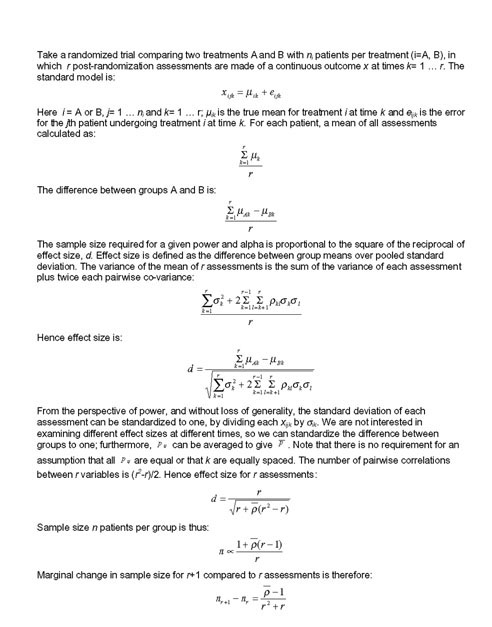
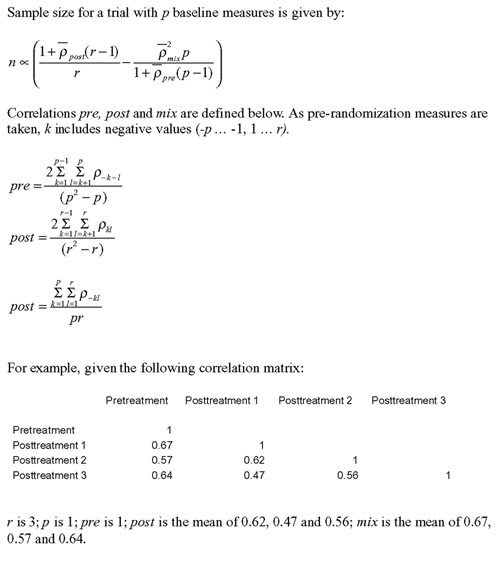
The degree to which adding a further measure increases statistical power can be derived from simple formulae. This "marginal benefit" can be used to inform the optimal number of repeat assessments.
Although repeating assessments can have dramatic effects on power, marginal benefit of an additional measure rapidly decreases as the number of measures rises. There is little value in increasing the number of either baseline or post-treatment assessments beyond four, or seven where baseline assessments are taken. An exception is when correlations between measures are low, for instance, episodic conditions such as headache.
The proposed method offers a rational basis for determining the number of repeat measures in repeat measures designs.
在许多随机和非随机对照试验中,研究人员会多次测量连续终点,以降低患者内变异性,从而提高统计效能。关于选择重复测量的最佳次数,文献中几乎没有相关指导。
增加一次测量所提高的统计效能程度可从简单公式推导得出。这种“边际效益”可用于确定重复评估的最佳次数。
尽管重复评估对效能可能有显著影响,但随着测量次数的增加,额外一次测量的边际效益会迅速下降。将基线或治疗后评估的次数增加到四次以上,或在进行基线评估时增加到七次以上,几乎没有价值。一个例外是测量之间的相关性较低时,例如头痛等发作性疾病。
所提出的方法为确定重复测量设计中重复测量的次数提供了合理依据。