Campbell L, Gumbleton M, Griffiths D F R
Pharmaceutical Cell Biology, Welsh School of Pharmacy, Cardiff University, Cardiff, CF10 3XF, UK.
Br J Cancer. 2003 Nov 17;89(10):1909-13. doi: 10.1038/sj.bjc.6601359.
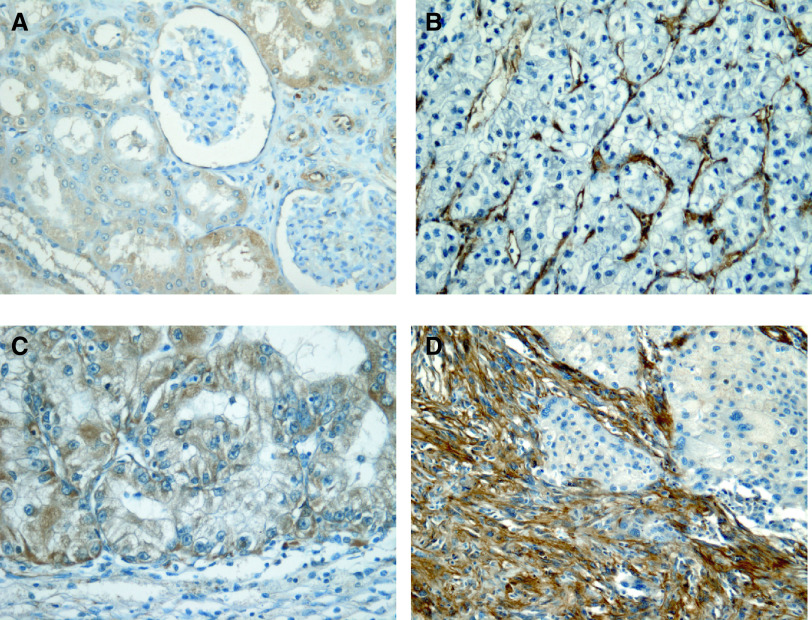
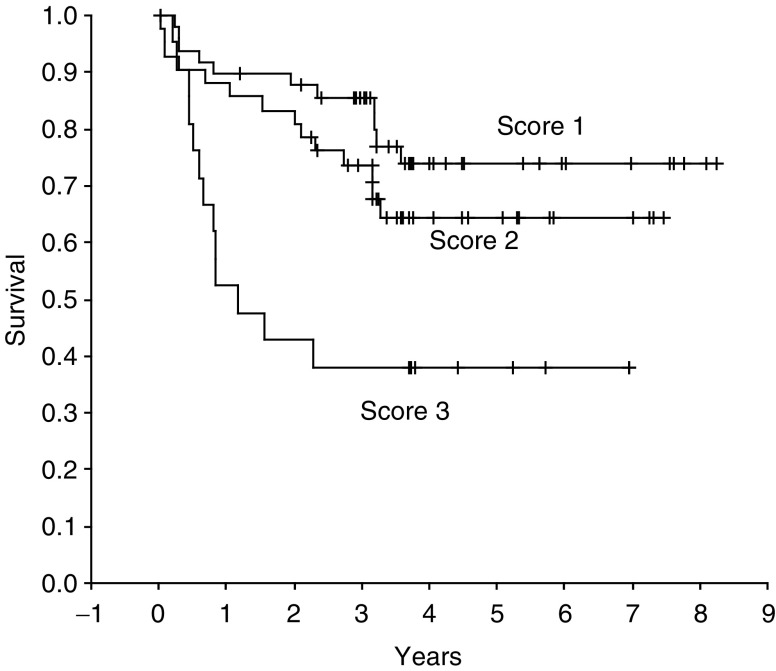
Renal cell carcinomas, although usually apparently fully resected at surgery, commonly recur as distant metastasis. New markers are needed to predict which patients may relapse especially as novel methods of treatment (e.g. laproscopic resection) may make it impossible to assess conventional pathological prognostic markers. The caveolins are a family of proteins that represent the major structural components of caveolae; recent work suggests that these may have influence on several signalling pathways and they are thus potential prognostic markers. Immunohistochemistry for caveolin-1 was performed on sections of peripheral tumour from 114 consecutative nonmetastatic RCCs. Cytoplasmic caveolin-1 immunohistochemical (ICC) reaction was scored on a semiquantative scale of 1-3. Immunohistochemical score was tested for impact on disease-free survival by Kaplan-Meier and Cox regression methods. A total of 50 tumours had ICC score 1; 43 had score 2 and 21 score 3. Larger, higher grade and tumours with vascular invasion had significantly higher scores. On univariate survival analysis (Kaplan-Meier), patients with tumours scoring 1 had a mean disease-free survival of 6.61 years (95% CI 5.76-7.46) compared with 5.4 years (4.53-6.30) and 3.15 years (1.87-4.44) for scores 2 and 3, respectively. This is a significant difference (P=0.0017 log rank test). On multivariate analysis with size, grade and caveolin ICC score as independent covariates, caveolin ICC score 3 was an influential predictor of poor disease-free survival with a hazard ratio of 2.6 (P=0.03). We conclude that cytoplasmic overexpression of caveolin-1 predicts a poor prognosis in RCC; that this is likely to be a useful prognostic marker and that it may have importance in tumour progression.
肾细胞癌虽然通常在手术时看似已完全切除,但常以远处转移的形式复发。需要新的标志物来预测哪些患者可能复发,尤其是因为新的治疗方法(如腹腔镜切除术)可能使评估传统病理预后标志物变得不可能。小窝蛋白是一类蛋白质,代表小窝的主要结构成分;最近的研究表明,这些蛋白可能对多种信号通路有影响,因此它们是潜在的预后标志物。对114例连续的非转移性肾细胞癌外周肿瘤切片进行了小窝蛋白-1的免疫组织化学检测。细胞质小窝蛋白-1免疫组织化学(ICC)反应按1-3的半定量评分。通过Kaplan-Meier和Cox回归方法测试免疫组织化学评分对无病生存期的影响。共有50个肿瘤的ICC评分为1;43个评分为2,21个评分为3。体积较大、分级较高且有血管侵犯的肿瘤评分明显更高。在单因素生存分析(Kaplan-Meier)中,评分为1的肿瘤患者的平均无病生存期为6.61年(95%可信区间5.76-7.46),而评分为2和3的患者分别为5.4年(4.53-6.30)和3.15年(1.87-4.44)。这是一个显著差异(P=0.0017,对数秩检验)。在以肿瘤大小、分级和小窝蛋白ICC评分为独立协变量的多因素分析中,小窝蛋白ICC评分为3是无病生存期差的一个有影响的预测因素,风险比为2.6(P=0.03)。我们得出结论,小窝蛋白-1的细胞质过表达预示着肾细胞癌预后不良;这可能是一个有用的预后标志物,并且它可能在肿瘤进展中具有重要意义。