Campbell L, Jasani B, Edwards K, Gumbleton M, Griffiths D F R
Experimental Cancer Therapeutics, School Of Pharmacy, Department of Pathology, Cardiff University, Cardiff CF10 3XF, UK.
Br J Cancer. 2008 Mar 11;98(5):931-40. doi: 10.1038/sj.bjc.6604243. Epub 2008 Feb 19.
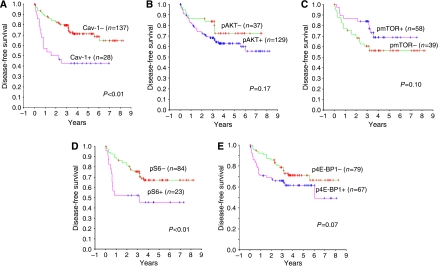
We previously reported that tumour-associated caveolin-1 is a potential biomarker in renal cell carcinoma (RCC), whose overexpression predicts metastasis following surgical resection for clinically confined disease. Much attention has recently focused on the AKT/mTOR pathway in a number of malignancies, including RCC. Since caveolin-1 and the AKT/mTOR signalling cascade are independently shown to be important regulators of tumour angiogenesis, we hypothesised that caveolin-1 interacts with the AKT/mTOR pathway to drive disease progression and metastasis in RCC. The aims of this study were to determine (i) the expression status of the activated AKT/mTOR pathway components (phosphorylated forms) in RCC and (ii) their prognostic value when combined with caveolin-1. Immunohistochemistry for caveolin-1, pAKT, pmTOR, pS6 and p4E-BP1 was performed on tissue microarrays from 174 clinically confined RCCs. Significantly decreased mean disease-free survival was observed when caveolin-1 was coexpressed with either pAKT (2.95 vs 6.14 years), pmTOR (3.17 vs 6.28 years), pS6 (1.45 vs 6.62 years) or p4E-BP1 (2.07 vs 6.09 years) than when neither or any one single biomarker was expressed alone. On multivariate analysis, the covariate of 'caveolin-1/AKT' (neither alone were influential covariates) was a significant influential indicator of poor disease-free survival with a hazard ratio of 2.13 (95% CI: 1.15-3.92), higher than that for vascular invasion. Tumours that coexpressed caveolin-1 and activated mTOR components were more likely to be larger, higher grade and to show vascular invasion. Our results provide the first clinical evidence that caveolin-1 cooperates with an activated AKT/mTOR pathway in cancer and may play an important role in disease progression. We conclude that evaluation of the 'caveolin-1/AKT/mTOR axis' in primary kidney tumours will identify subsets of RCC patients who require greater postoperative surveillance and more intensive treatment.
我们之前报道过,肿瘤相关的小窝蛋白-1是肾细胞癌(RCC)的一种潜在生物标志物,其过表达预示着临床局限性疾病手术切除后会发生转移。最近,包括RCC在内的许多恶性肿瘤都将大量注意力集中在AKT/mTOR信号通路。由于小窝蛋白-1和AKT/mTOR信号级联反应已被独立证明是肿瘤血管生成的重要调节因子,我们推测小窝蛋白-1与AKT/mTOR信号通路相互作用,从而推动RCC的疾病进展和转移。本研究的目的是确定:(i)RCC中活化的AKT/mTOR信号通路成分(磷酸化形式)的表达状态;(ii)它们与小窝蛋白-1联合时的预后价值。对来自174例临床局限性RCC的组织芯片进行了小窝蛋白-1、pAKT、pmTOR、pS6和p4E-BP1的免疫组化检测。当小窝蛋白-1与pAKT(2.95年对6.14年)、pmTOR(3.17年对6.28年)、pS6(1.45年对6.62年)或p4E-BP1(2.07年对6.09年)共表达时,观察到无病生存期的平均显著缩短,而单独表达这两种生物标志物中的任何一种或均不表达时则无此现象。多因素分析显示,“小窝蛋白-1/AKT”协变量(单独均无影响)是无病生存期不良的显著影响指标,风险比为2.13(95%CI:1.15 - 3.92),高于血管侵犯。共表达小窝蛋白-1和活化的mTOR成分的肿瘤更可能更大、分级更高且有血管侵犯。我们的结果提供了首个临床证据,表明小窝蛋白-1在癌症中与活化的AKT/mTOR信号通路协同作用,并可能在疾病进展中起重要作用。我们得出结论,对原发性肾肿瘤中的“小窝蛋白-1/AKT/mTOR轴”进行评估,将识别出需要更密切术后监测和更强化治疗的RCC患者亚组。