Warburton P E, Willard H F
Department of Genetics, Stanford University, CA 94305.
Nucleic Acids Res. 1992 Nov 25;20(22):6033-42. doi: 10.1093/nar/20.22.6033.
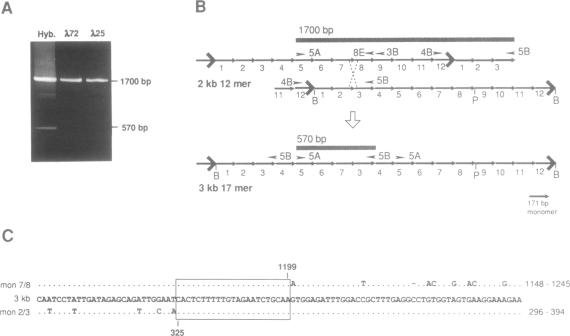
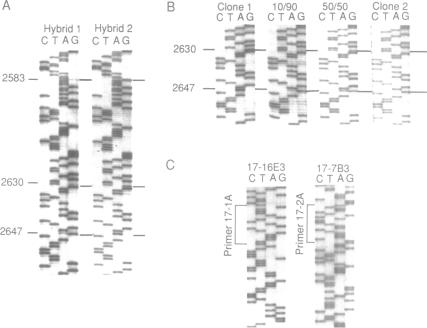
Tandemly repeated DNA can comprise several percent of total genomic DNA in complex organisms and, in some instances, may play a role in chromosome structure or function. Alpha satellite DNA is the major family of tandemly repeated DNA found at the centromeres of all human and primate chromosomes. Each centromere is characterized by a large contiguous array of up to several thousand kb which can contain several thousand highly homogeneous repeat units. By using a novel application of the polymerase chain reaction (repPCR), we are able to amplify a representative sampling of multiple repetitive units simultaneously, allowing rapid analysis of chromosomal subsets. Direct sequence analysis of repPCR amplified alpha satellite from chromosomes 17 and X reveals positions of sequence heterogeneity as two bands at a single nucleotide position on a sequencing ladder. The use of TdT in the sequencing reactions greatly reduces the background associated with polymerase pauses and stops, allowing visualization of heterogeneous bases found in as little as 10% of the repeat units. Confirmation of these heterogeneous positions was obtained by comparison to the sequence of multiple individual cloned copies obtained both by PCR and non-PCR based methods. PCR amplification of alpha satellite can also reveal multiple repeat units which differ in size. Analysis of repPCR products from chromosome 17 and X allows rapid determination of the molecular basis of these repeat unit length variants, which appear to be a result of unequal crossing-over. The application of repPCR to the study of tandemly repeated DNA should allow in-depth analysis of intra- and interchromosomal variation and unequal crossing-over, thus providing insight into the biology and genetics of these large families of DNA.
串联重复DNA在复杂生物体中可占基因组DNA总量的百分之几,在某些情况下,可能在染色体结构或功能中发挥作用。α卫星DNA是在所有人类和灵长类染色体着丝粒处发现的主要串联重复DNA家族。每个着丝粒的特征是有一个长达数千kb的连续大片段,其中可包含数千个高度同源的重复单元。通过聚合酶链反应(repPCR)的一种新应用,我们能够同时扩增多个重复单元的代表性样本,从而快速分析染色体亚群。对从17号和X染色体上repPCR扩增的α卫星进行直接序列分析,发现在测序梯上的单个核苷酸位置有两条带,这表明了序列异质性的位置。在测序反应中使用末端脱氧核苷酸转移酶(TdT)大大降低了与聚合酶停顿和终止相关的背景,使得在低至10%的重复单元中发现的异质碱基得以可视化。通过与基于PCR和非PCR方法获得的多个单个克隆拷贝的序列进行比较,证实了这些异质位置。α卫星的PCR扩增还可以揭示大小不同的多个重复单元。对17号和X染色体上repPCR产物的分析能够快速确定这些重复单元长度变异的分子基础,这些变异似乎是不等交换的结果。将repPCR应用于串联重复DNA的研究,应该能够深入分析染色体内和染色体间的变异以及不等交换,从而深入了解这些DNA大家族的生物学和遗传学。