Willard H F, Waye J S, Skolnick M H, Schwartz C E, Powers V E, England S B
Proc Natl Acad Sci U S A. 1986 Aug;83(15):5611-5. doi: 10.1073/pnas.83.15.5611.
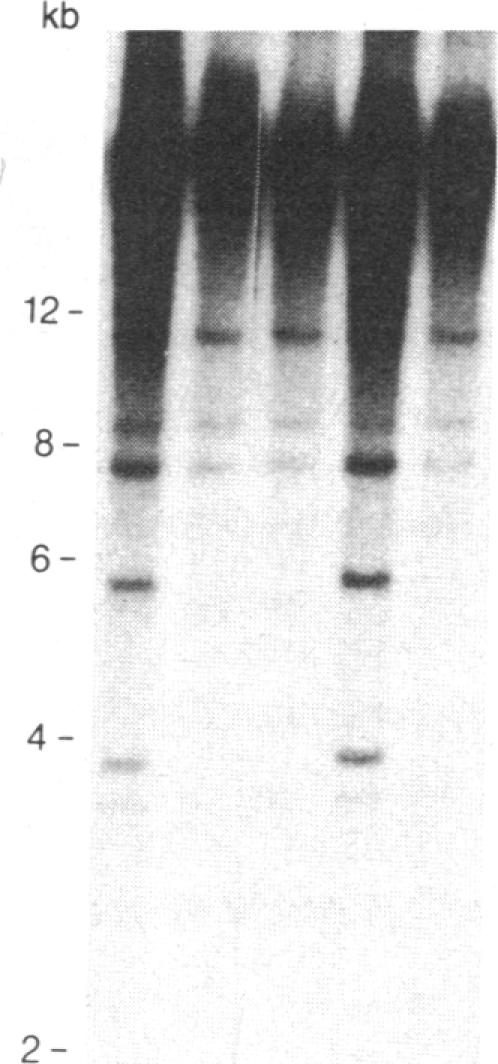
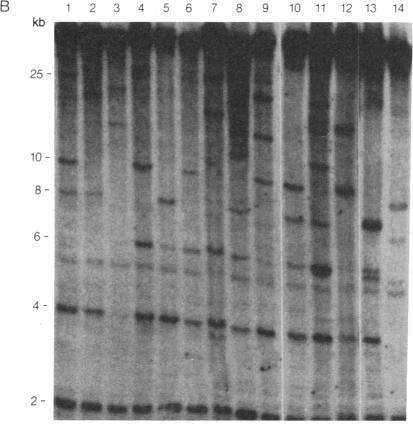
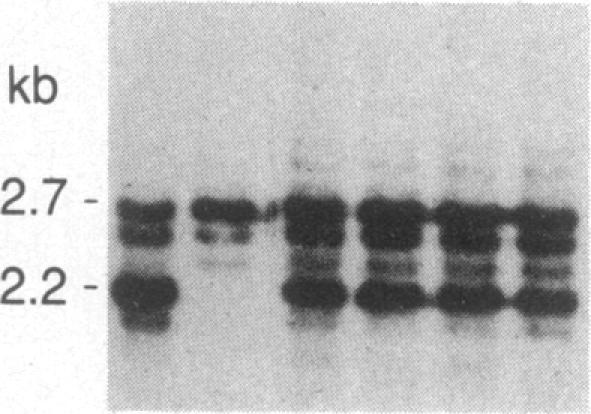
We describe a general strategy for the detection of high-frequency restriction fragment length polymorphisms in the centromeric regions of human chromosomes by molecular analysis of alpha satellite DNA, a diverse family of tandemly repeated DNA located near the centromeres of all human chromosomes. To illustrate this strategy, cloned alpha satellite repeats isolated from two human chromosomes, 17 and X, have been used under high-stringency conditions that take advantage of the chromosome-specific organization of this divergent repeated DNA family. Multiple high-frequency restriction fragment length polymorphisms are described for the centromeric region of both chromosome 17 and X chromosome. Mendelian inheritance of the variants is demonstrated. The X-linked alpha satellite polymorphisms in particular are highly informative and constitute a virtually unique centromeric DNA marker for each X chromosome examined. Since the strategy we describe is a general one, the alpha satellite family of DNA should provide a rich source of molecular variation in the human genome and should contribute to the development of centromere-based genetic linkage maps of human chromosomes.
我们描述了一种通过对α卫星DNA进行分子分析来检测人类染色体着丝粒区域高频限制性片段长度多态性的通用策略。α卫星DNA是一类多样的串联重复DNA家族,位于所有人类染色体着丝粒附近。为了说明这一策略,从两条人类染色体(17号和X染色体)分离出的克隆α卫星重复序列,已在高严格条件下使用,该条件利用了这个差异重复DNA家族的染色体特异性组织。本文描述了17号染色体和X染色体着丝粒区域的多个高频限制性片段长度多态性。证明了这些变异的孟德尔遗传。特别是X连锁的α卫星多态性信息丰富,对于所检测的每条X染色体而言,几乎构成了独特的着丝粒DNA标记。由于我们所描述的策略是通用的,α卫星DNA家族应该为人类基因组提供丰富的分子变异来源,并有助于构建基于着丝粒的人类染色体遗传连锁图谱。