Jensen Brenda A, Leeman Rebecca J, Schlezinger Jennifer J, Sherr David H
Department of Environmental Health, Boston University School of Public Health, 715 Albany Street, Boston, MA 02118, USA.
Environ Health. 2003 Dec 16;2(1):16. doi: 10.1186/1476-069X-2-16.
Bone marrow stromal cells produce cytokines required for the normal growth and development of all eight hematopoietic cell lineages. Aberrant cytokine production by stromal cells contributes to blood cell dyscrasias. Consequently, factors that alter stromal cell cytokine production may significantly compromise the development of normal blood cells. We have shown that environmental chemicals, such as aromatic hydrocarbon receptor (AhR) agonists, suppress B lymphopoiesis by modulating bone marrow stromal cell function. Here, we extend these studies to evaluate the potential for two prototypic AhR agonists, 7,12-dimethylbenz [a]anthracene (DMBA) and 2,3,7,8-tetrachlorodibenzo-p-dioxin (TCDD), to alter stromal cell cytokine responses.
Bone marrow stromal cells were treated with AhR agonists and bacterial lipopolysaccharide (LPS) to mimic innate inflammatory cytokine responses and to study the effects of AhR ligands on those responses. Steady state cytokine RNA levels were screened by RNAse protection assays (RPA) and quantified by real-time PCR. Cytokine (IL-6) protein production was measured by ELISA. NF-kappaB EMSAs were used to study IL-6 transcriptional regulation.
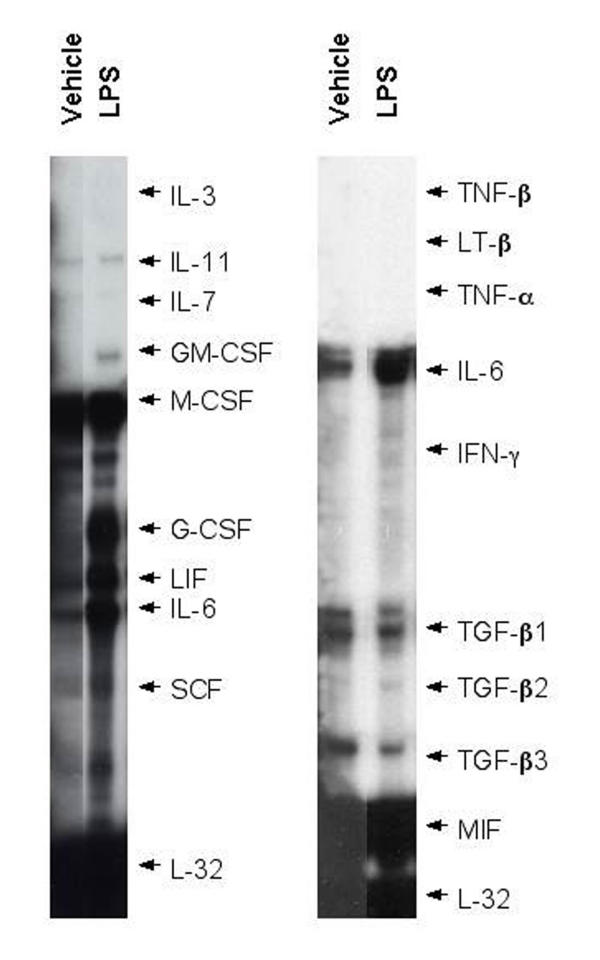
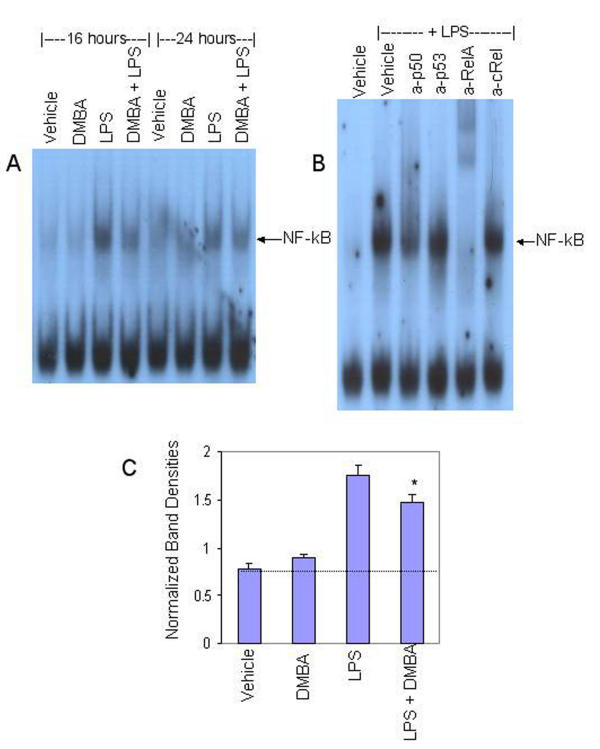
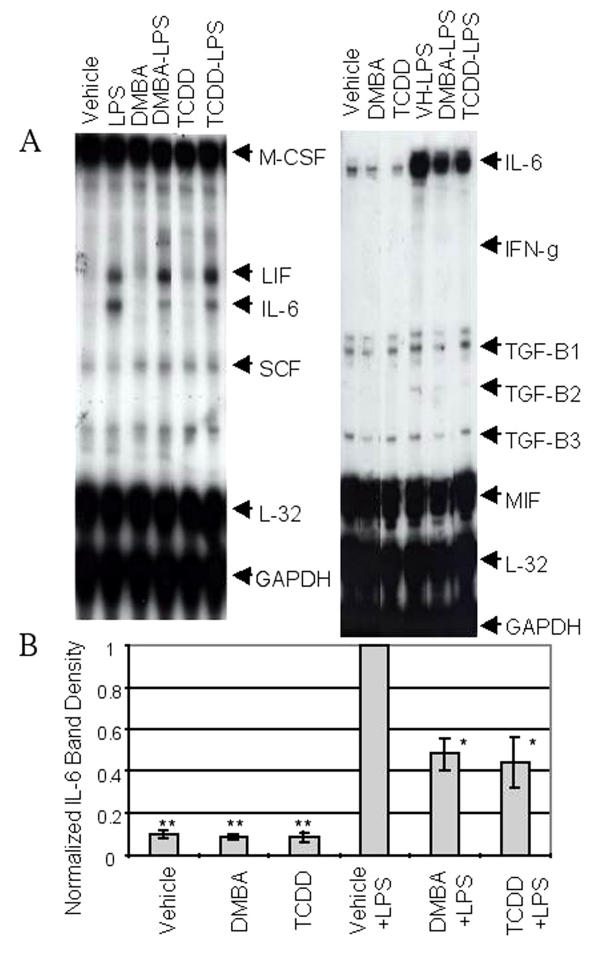
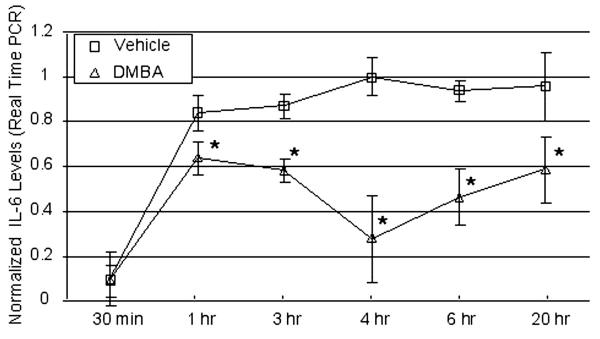
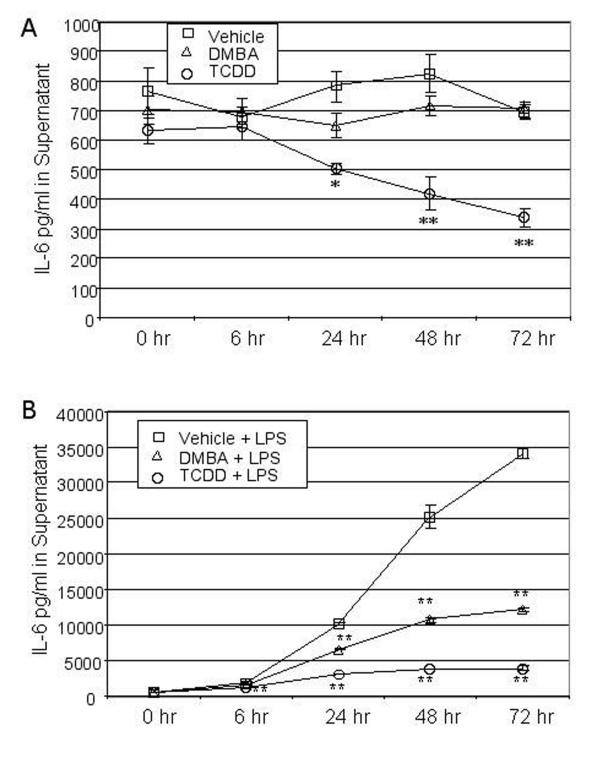
RPAs indicated that AhR+ bone marrow stromal cells consistently up-regulated genes encoding IL-6 and LIF in response to LPS, presumably through activation of Toll-like receptor 4. Pre-treatment with low doses of DMBA or TCDD selectively abrogated IL-6 gene induction but had no effect on LIF mRNA. Real-time-PCR indicated a significant inhibition of IL-6 mRNA by AhR ligands within 1 hour of LPS challenge which was reflected in a profound down-regulation of IL-6 protein induction, with DMBA and TCDD suppressing IL-6 levels as much as 65% and 88%, respectively. This potent inhibitory effect persisted for at least 72 hours. EMSAs measuring NF-kappaB binding to IL-6 promoter sequences, an event known to induce IL-6 transcription, indicated a significant decrease in the LPS-mediated induction of DNA-binding RelA/p50 and c-Rel/p50 heterodimers in the presence of DMBA.
Common environmental AhR agonists can suppress the response to bacterial lipopolysaccharide, a model for innate inflammatory responses, through down-regulation of IL-6, a cytokine critical to the growth of several hematopoietic cell subsets, including early B cells. This suppression occurs at least at the level of IL-6 gene transcription and may be regulated by NF-kappaB.
骨髓基质细胞产生所有八种造血细胞谱系正常生长和发育所需的细胞因子。基质细胞异常产生细胞因子会导致血细胞发育异常。因此,改变基质细胞细胞因子产生的因素可能会显著损害正常血细胞的发育。我们已经表明,环境化学物质,如芳烃受体(AhR)激动剂,通过调节骨髓基质细胞功能来抑制B淋巴细胞生成。在此,我们扩展这些研究以评估两种典型的AhR激动剂,7,12 - 二甲基苯并[a]蒽(DMBA)和2,3,7,8 - 四氯二苯并 - p - 二恶英(TCDD)改变基质细胞细胞因子反应的可能性。
用AhR激动剂和细菌脂多糖(LPS)处理骨髓基质细胞,以模拟先天性炎症细胞因子反应,并研究AhR配体对这些反应的影响。通过核糖核酸酶保护分析(RPA)筛选稳态细胞因子RNA水平,并通过实时PCR进行定量。通过酶联免疫吸附测定(ELISA)测量细胞因子(IL - 6)蛋白的产生。使用NF - κB电泳迁移率变动分析(EMSA)研究IL - 6的转录调控。
RPA表明,AhR + 骨髓基质细胞在响应LPS时持续上调编码IL - 6和白血病抑制因子(LIF)的基因,可能是通过Toll样受体4的激活。用低剂量的DMBA或TCDD预处理可选择性地消除IL - 6基因的诱导,但对LIF mRNA没有影响。实时PCR表明,在LPS刺激后1小时内,AhR配体对IL - 6 mRNA有显著抑制作用,这反映在IL - 6蛋白诱导的显著下调上,DMBA和TCDD分别将IL - 6水平抑制多达65%和88%。这种强效抑制作用持续至少72小时。测量NF - κB与IL - 6启动子序列结合的EMSA(已知该事件可诱导IL - 6转录)表明,在存在DMBA的情况下,LPS介导的DNA结合RelA / p50和c - Rel / p50异二聚体的诱导显著降低。
常见的环境AhR激动剂可通过下调IL - 6来抑制对细菌脂多糖的反应,细菌脂多糖是先天性炎症反应的模型,IL - 6是对包括早期B细胞在内的几个造血细胞亚群生长至关重要的细胞因子。这种抑制至少发生在IL - 6基因转录水平,并且可能受NF - κB调节。