Song Hun Ho, O Soon Ok, Kim Su Ho, Moon Sang Ho, Kim Jin Bong, Yoon Jong Woo, Koo Ja Ryong, Hong Kyung Sun, Lee Myung Goo, Kim Dong Joon, Shin Dong Hoon, Kang Sung Ha, Choi Moon Gi, Lee Kwang Hack
Department of Internal Medicine, Chuncheon Sacred Heart Hospital, College of Medicine, Hallym University, Chuncheon, Korea.
Korean J Intern Med. 2003 Dec;18(4):220-4. doi: 10.3904/kjim.2003.18.4.220.
Since its reemergence in 1993, a number of cases of Plasmodium vivax malaria have been reported in Korea. We analyzed the cases of malaria patients living in Chuncheon and its neighboring communities, to characterize its clinical manifestations and laboratory findings, and to identify any differences between our clinical findings and those of previous studies.
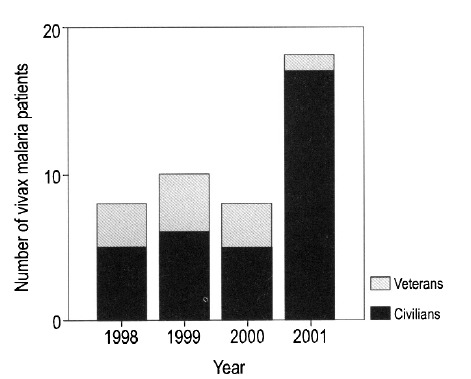
We reviewed the clinical records of cases that were confirmed as malaria by peripheral blood smear at Chuncheon Sacred Heart Hospital from July 1998 to September 2001.
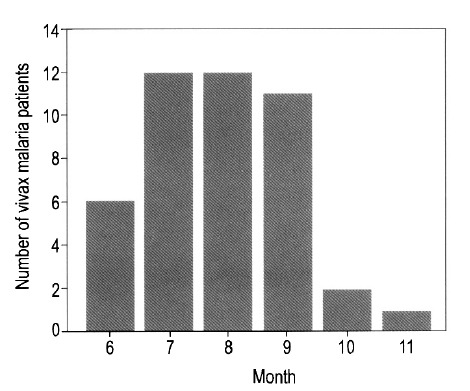
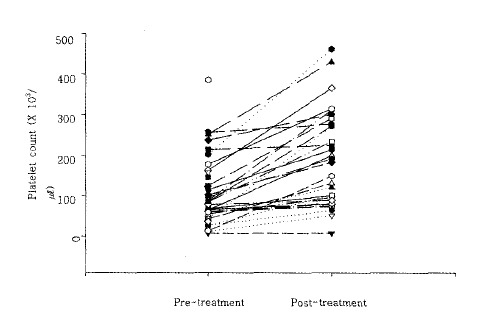
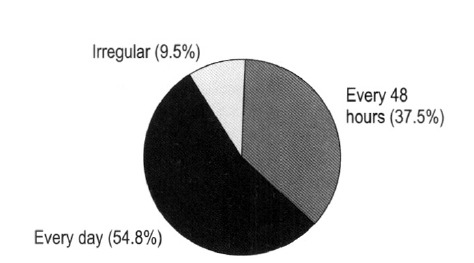
Forty-four cases were included in the study. All patients were infected with Plasmodium vivax, and presented with high fever; however, tertian fever developed in only 15 patients (35.7%). A number of cases showed various symptoms, which included headache, abdominal pain, nausea and vomiting. Of the 44 cases identified, 41 (93.2%) developed malaria between June and September. Thrombocytopenia was a prominent finding in 75% of the cases at diagnosis, but resolved during or after therapy. Other laboratory abnormalities such as, anemia, elevated transamines, coagulopathies, and elevated lactose dehydrogenase (LDH) were also noted. Cerebrospinal fluid (CSF) studies were performed in five cases, one of which showed pleocytosis in the CSF.
We noted only 15 patients (35.7%) with tertian fever; the other patients showed variable fever patterns. Thrombocytopenia was the most prominent laboratory finding. Therefore, we suggest that malaria should be included in the differential diagnosis of febrile diseases with an onset between June to and September, regardless of the pattern of the fever.
自1993年间日疟再度出现以来,韩国已报告了多例间日疟病例。我们分析了春川及其周边社区疟疾患者的病例,以描述其临床表现和实验室检查结果,并确定我们的临床发现与以往研究结果之间的差异。
我们回顾了1998年7月至2001年9月在春川圣心医院通过外周血涂片确诊为疟疾的病例的临床记录。
44例病例纳入研究。所有患者均感染间日疟原虫,并出现高热;然而,仅有15例患者(35.7%)出现隔日热。许多病例表现出各种症状,包括头痛、腹痛、恶心和呕吐。在确诊的44例病例中,41例(93.2%)在6月至9月期间感染疟疾。血小板减少是75%病例诊断时的突出表现,但在治疗期间或治疗后缓解。还注意到其他实验室异常,如贫血、转氨酶升高、凝血障碍和乳酸脱氢酶(LDH)升高。对5例患者进行了脑脊液(CSF)检查,其中1例脑脊液出现细胞增多。
我们仅注意到15例(35.7%)患者出现隔日热;其他患者发热模式各异。血小板减少是最突出的实验室检查结果。因此,我们建议,无论发热模式如何,对于6月至9月发病的发热性疾病进行鉴别诊断时均应考虑疟疾。