Goo Jin Mo, Lee Jeong Won, Lee Hyun Ju, Kim Seunghwan, Kim Jong Hyo, Im Jung-Gi
Department of Radiology, Seoul National University College of Medicine, and the Institute of Radiation Medicine, SNUMRC, Seoul, Korea.
Korean J Radiol. 2003 Oct-Dec;4(4):211-6. doi: 10.3348/kjr.2003.4.4.211.
To determine the usefulness of a computer-aided diagnosis (CAD) system for the automated detection of lung nodules at low-dose CT.
A CAD system developed for detecting lung nodules was used to process the data provided by 50 consecutive low-dose CT scans. The results of an initial report, a second look review by two chest radiologists, and those obtained by the CAD system were compared, and by reviewing all of these, a gold standard was established.
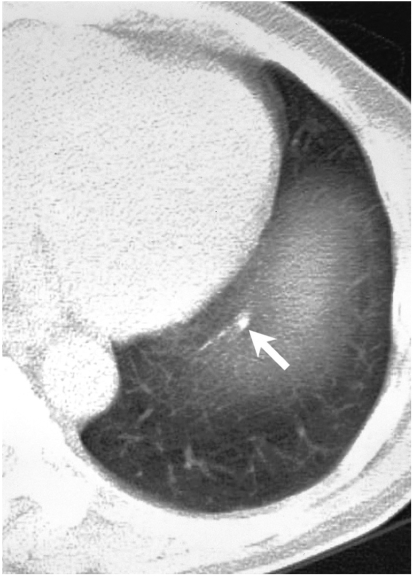
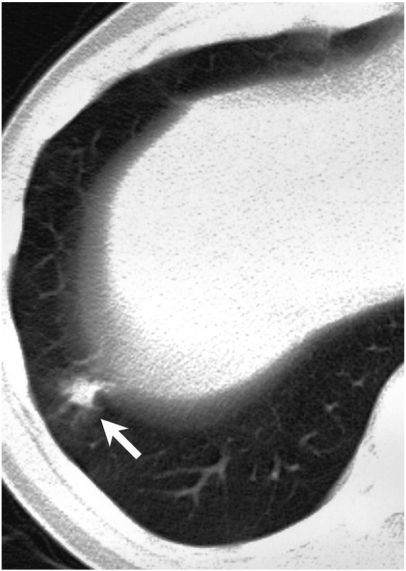
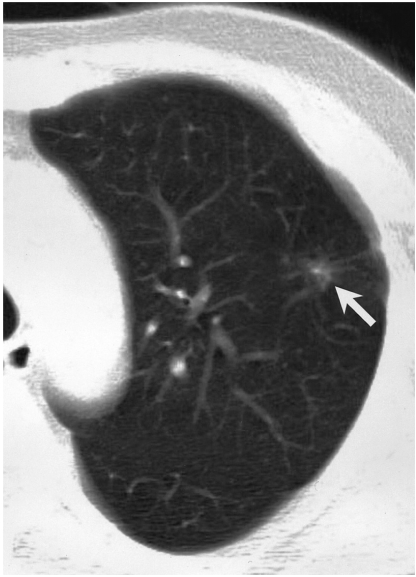
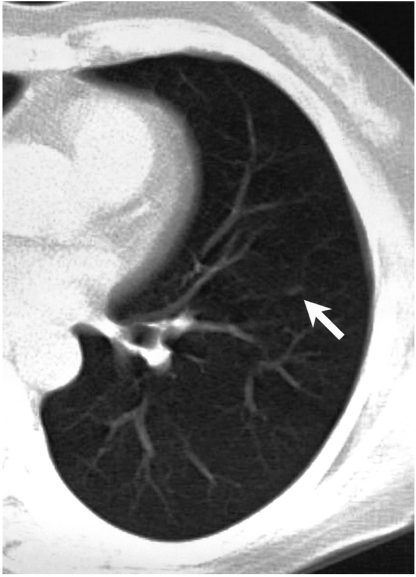
By applying the gold standard, a total of 52 nodules were identified (26 with a diameter < or = 5 mm; 26 with a diameter >5 mm). Compared to an initial report, four additional nodules were detected by the CAD system. Three of these, identified only at CAD, formed part of the data used to derive the gold standard. For the detection of nodules >5 mm in diameter, sensitivity was 77% for the initial report, 88% for the second look review, and 65% for the CAD system. There were 8.0+/-5.2 false-positive CAD results per CT study.
These preliminary results indicate that a CAD system may improve the detection of pulmonary nodules at low-dose CT.
确定计算机辅助诊断(CAD)系统在低剂量CT自动检测肺结节方面的实用性。
使用一个为检测肺结节而开发的CAD系统处理50例连续低剂量CT扫描提供的数据。比较初次报告结果、两位胸部放射科医生的二次阅片结果以及CAD系统获得的结果,并通过对所有这些结果的审查建立金标准。
应用金标准共识别出52个结节(26个直径≤5mm;26个直径>5mm)。与初次报告相比,CAD系统检测出另外4个结节。其中仅在CAD中识别出的3个结节构成了用于推导金标准的数据的一部分。对于直径>5mm结节的检测,初次报告的敏感性为77%,二次阅片为88%,CAD系统为65%。每个CT研究的CAD假阳性结果为8.0±5.2。
这些初步结果表明,CAD系统可能会改善低剂量CT对肺结节的检测。