Sevak Rajkumar J, France Charles P, Koek Wouter
Department of Pharmacology, The University of Texas Health Science Center at San Antonio, 7703 Floyd Curl Drive, San Antonio, TX 78229-3900, USA.
Eur J Pharmacol. 2004 Jan 12;483(2-3):289-93. doi: 10.1016/j.ejphar.2003.10.045.
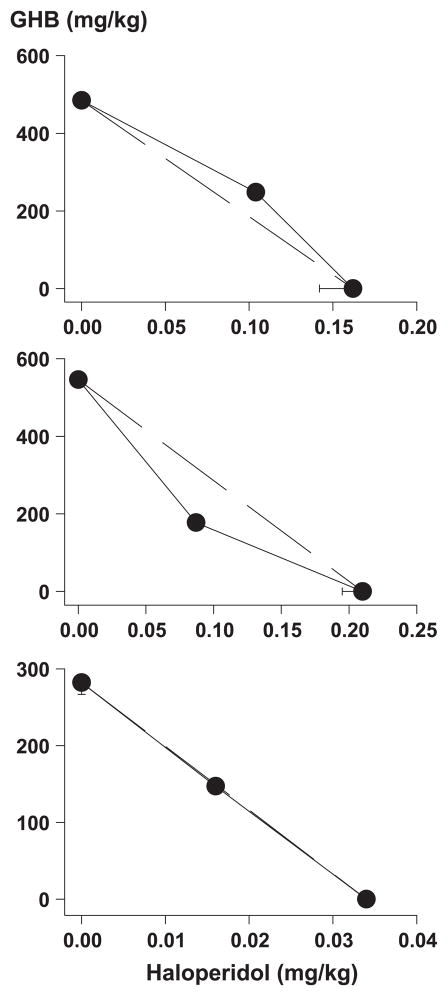
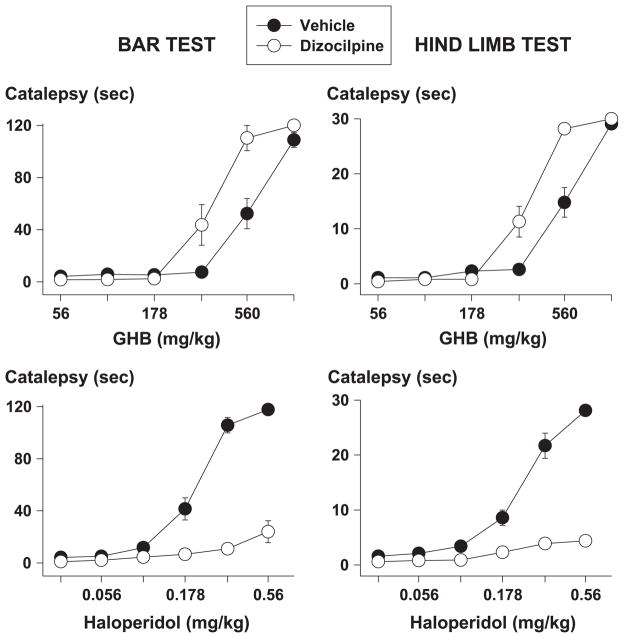
gamma-Hydroxybutyrate (GHB) is a drug of abuse with multiple mechanisms of action. Consistent with its ability to modulate dopaminergic systems, GHB reportedly shares behavioral effects with neuroleptics and interacts with them in a synergistic manner. Here, we examined the ability of GHB and haloperidol to induce catalepsy and to affect operant responding. When given alone, both compounds induced catalepsy and decreased response rate. When given together, however, they produced these effects in an additive manner. This is further evidence that GHB has neuroleptic-like effects, but suggests that GHB interacts additively, not synergistically, with neuroleptics. The mechanisms involved in GHB- and haloperidol-induced catalepsy are different because the N-methyl-D-aspartate (NMDA) receptor antagonist, dizocilpine (MK-801), attenuated the cataleptic effects of haloperidol, but enhanced those of GHB. The latter finding suggests that other NMDA receptor antagonists (e.g., the drugs of abuse--phencyclidine and ketamine) may also interact synergistically with GHB.
γ-羟基丁酸(GHB)是一种具有多种作用机制的滥用药物。与它调节多巴胺能系统的能力相一致,据报道GHB与抗精神病药物具有共同的行为效应,并与其产生协同作用。在此,我们研究了GHB和氟哌啶醇诱导僵住症以及影响操作性反应的能力。单独给药时,两种化合物均诱导僵住症并降低反应率。然而,当一起给药时,它们以相加的方式产生这些效应。这进一步证明GHB具有抗精神病样效应,但表明GHB与抗精神病药物是以相加而非协同的方式相互作用。GHB和氟哌啶醇诱导僵住症的机制不同,因为N-甲基-D-天冬氨酸(NMDA)受体拮抗剂地佐环平(MK-801)减弱了氟哌啶醇的僵住效应,但增强了GHB的僵住效应。后一发现表明其他NMDA受体拮抗剂(例如滥用药物——苯环己哌啶和氯胺酮)也可能与GHB产生协同作用。