Legault P, Herschlag D, Celander D W, Cech T R
Howard Hughes Medical Institute, Department of Chemistry and Biochemistry, University of Colorado, Boulder 80309-0215.
Nucleic Acids Res. 1992 Dec 25;20(24):6613-9. doi: 10.1093/nar/20.24.6613.
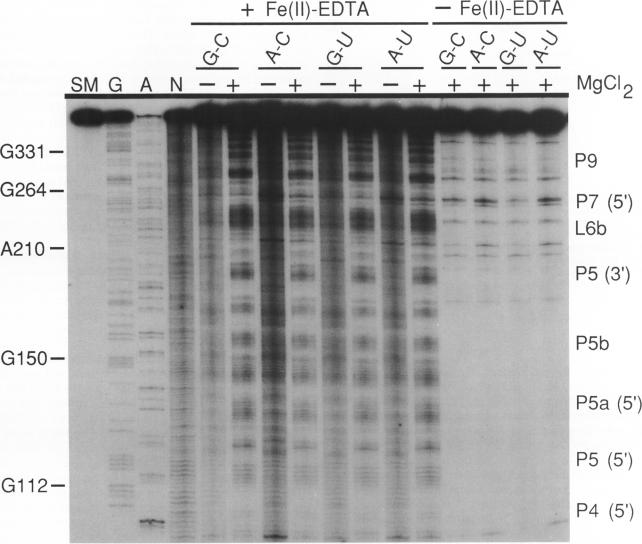
Self-splicing group I introns use guanosine as a nucleophile to cleave the 5' splice site. The guanosine-binding site has been localized to the G264-C311 base pair of the Tetrahymena intron on the basis of analysis of mutations that change the specificity of the nucleophile from G (guanosine) to 2AP (2-aminopurine ribonucleoside) (F. Michel et al. (1989) Nature 342, 391-395). We studied the effect of these mutations (G-U, A-C and A-U replacing G264-C311) in the L-21 ScaI version of the Tetrahymena ribozyme. In this enzymatic system (kcat/Km)G monitors the cleavage step. This kinetic parameter decreased by at least 5 x 10(3) when the G264-C311 base pair was mutated to an A-U pair, while (kcat/Km)2AP increased at least 40-fold. This amounted to an overall switch in specificity of at least 2 x 10(5). The nucleophile specificity (G > 2AP for the G-C and G-U pairs, 2AP > G for the A-U and A-C pairs) was consistent with the proposed hydrogen bond between the nucleotide at position 264 and N1 of the nucleophile. Unexpectedly, the A-U and A-C mutants showed a decrease of an order of magnitude in the rate of ribozyme-catalyzed hydrolysis of RNA, in which H2O or OH- replaces G as the nucleophile, whereas the G-U mutant showed a decrease of only 2-fold. The low hydrolysis rates were not restored by raising the Mg2+ concentration or lowering the temperature. In addition, the mutant ribozymes exhibited a pattern of cleavage by Fe(II)-EDTA indistinguishable from that of the wild type, and the [Mg2+]1/2 for folding of the A-U mutant ribozyme was the same as that of the wild type. Therefore the guanosine-binding site mutations do not appear to have a major effect on RNA folding or stability. Because changing G264 affects the hydrolysis reaction without perturbing the global folding of the RNA, we conclude that the catalytic role of this conserved nucleotide is not limited to guanosine binding.
自我剪接的I组内含子利用鸟苷作为亲核试剂来切割5'剪接位点。基于对将亲核试剂特异性从G(鸟苷)改变为2AP(2-氨基嘌呤核糖核苷)的突变的分析,鸟苷结合位点已定位到嗜热四膜虫内含子的G264-C311碱基对(F. Michel等人(1989年)《自然》342卷,391 - 395页)。我们研究了这些突变(用G-U、A-C和A-U取代G264-C311)在嗜热四膜虫核酶的L-21 ScaI版本中的作用。在这个酶促系统中,(kcat/Km)G监测切割步骤。当G264-C311碱基对突变为A-U对时,这个动力学参数至少降低了5×10³,而(kcat/Km)2AP至少增加了40倍。这相当于特异性总体上至少切换了2×10⁵。亲核试剂特异性(对于G-C和G-U对,G > 2AP;对于A-U和A-C对,2AP > G)与264位核苷酸与亲核试剂的N1之间提出的氢键一致。出乎意料的是,A-U和A-C突变体在核酶催化的RNA水解速率上降低了一个数量级,其中H₂O或OH⁻取代G作为亲核试剂,而G-U突变体仅降低了2倍。通过提高Mg²⁺浓度或降低温度并不能恢复低水解速率。此外,突变核酶表现出与野生型难以区分的Fe(II)-EDTA切割模式,并且A-U突变核酶折叠的[Mg²⁺]1/2与野生型相同。因此,鸟苷结合位点突变似乎对RNA折叠或稳定性没有主要影响。因为改变G264会影响水解反应而不干扰RNA的整体折叠,我们得出结论,这个保守核苷酸的催化作用不限于鸟苷结合。