Nam Taek Keun, Ahn Sung Ja
Department of Radiation Oncology, Chonnam National University Medical School, 8 Hak-dong, Dong-gu, Gwangju 501-757, Korea.
J Korean Med Sci. 2004 Feb;19(1):87-94. doi: 10.3346/jkms.2004.19.1.87.
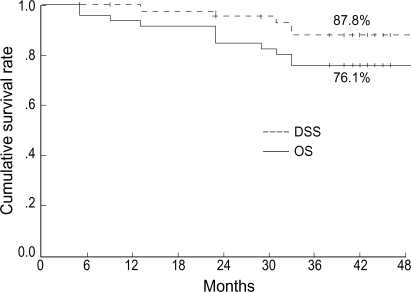
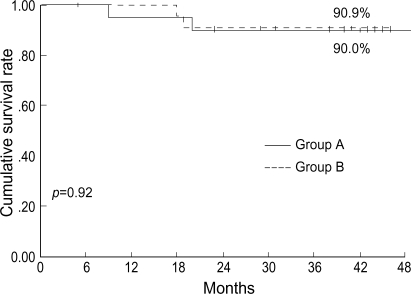
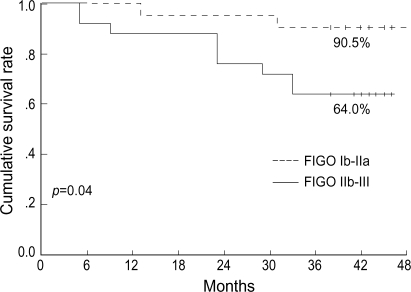
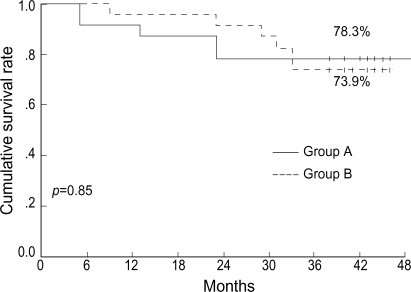
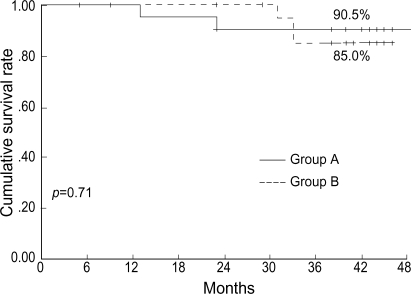
To evaluate the toxicities and efficacies of two fractionation regimens of high-dose-rate brachytherapy in uterine cervical cancer, patients were stratified by stage Ib-IIa versus IIb-IVa, and randomly assigned to receive 3 Gy fractions (group A) or 5 Gy fractions (group B). External radiotherapy was performed using a 10 MV radiography with a daily 1.8 Gy up to 30.6 Gy to the whole pelvis, and then with a midline shield up to 45.0 Gy. Brachytherapy was performed with 3 Gy x 10 times or 5 Gy x 5 times, and this was followed by booster brachytherapy of a smaller fraction to the residual tumor. Between August 1999 to July 2000, 46 patients were eligible. Median follow-up period was 42 months (5-49). The range of age was 37-83 yr (median, 58). The three-year disease-specific survival rates of group A (n=23) and B (n=23) were 90.5%, 84.9%, respectively (p=0.64). The three-year pelvic control rates of group A and B were 90.0% and 90.9%, respectively (p=0.92). The incidences of late complications of the rectum or bladder of grade 2 or greater in groups A and B were 23.8% and 9.1%, respectively (p=0.24). Our study showed that the results of two regimens were comparable. Fractionation regimen using 5 Gy fractions seems to be safe and effective, and offers shorter treatment duration.
为评估高剂量率近距离放射治疗的两种分割方案对子宫颈癌的毒性和疗效,患者按Ib-IIa期与IIb-IVa期进行分层,并随机分配接受3Gy分割(A组)或5Gy分割(B组)。外照射放疗采用10MV射线,全盆腔每天照射1.8Gy,直至30.6Gy,然后使用中线屏蔽直至45.0Gy。近距离放射治疗采用3Gy×10次或5Gy×5次,随后对残留肿瘤进行较小分割的追加近距离放射治疗。1999年8月至2000年7月期间,46例患者符合条件。中位随访期为42个月(5 - 49个月)。年龄范围为37 - 83岁(中位年龄58岁)。A组(n = 23)和B组(n = 23)的三年疾病特异性生存率分别为90.5%和84.9%(p = 0.64)。A组和B组的三年盆腔控制率分别为90.0%和90.9%(p = 0.92)。A组和B组2级及以上直肠或膀胱晚期并发症的发生率分别为23.8%和9.1%(p = 0.24)。我们的研究表明,两种方案的结果具有可比性。采用5Gy分割的分割方案似乎安全有效,且治疗持续时间较短。