Haselow Nancy J, Akame Julie, Evini Cyrille, Akongo Serge
Helen Keller International, B,P, 14227, Yaoundé, Cameroon.
Filaria J. 2003 Oct 24;2 Suppl 1(Suppl 1):S10. doi: 10.1186/1475-2883-2-S1-S10.
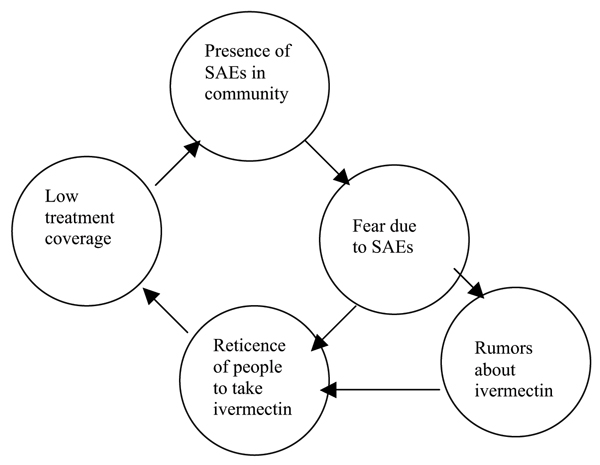
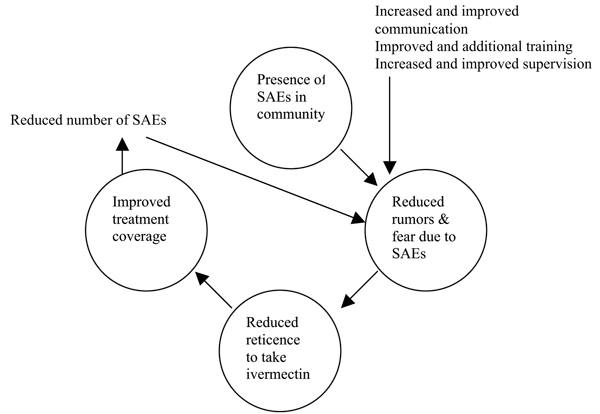
In areas co-endemic for loiasis and onchocerciasis, the classic Community-Directed Treatment using ivermectin (Mectizan(R)) must be adapted as additional program activities, better communication and tighter control of ivermectin stocks are required to minimize risk and manage serious adverse events following ivermectin treatment in patients co-infected with Loa loa. The importance of these serious adverse events on community participation in onchocerciasis control efforts has not been adequately studied. Program implementers do not as of yet fully understand the psychological impact of serious adverse events on communities and therefore have not designed communication strategies that adequately address the real concerns of community members. It is clear, however, that along with an effective case detection and management strategy, a reinforced communication strategy will be required to motivate at least 65% of the total population in onchocerciasis and loiasis co-endemic areas to participate in the treatment program and to take ivermectin over an extended period. This strategy must be based on research undertaken at the community level in order to address the concerns, fears and issues associated with adverse events due to ivermectin - to ensure that communities believe that the benefits of taking ivermectin outweigh the risks. In addition to an overall increase in the time required to sustain onchocerciasis control programs in co-endemic areas, each aspect of the reinforced program and communication strategy - rapid epidemiological assessments, materials development, training, advocacy, community sensitization and mobilization, case management and counselling, supervision, monitoring and evaluation will require additional resources and support from all stakeholders concerned.
在同时流行罗阿丝虫病和盘尾丝虫病的地区,经典的使用伊维菌素(美迪善®)的社区导向治疗必须做出调整,因为需要开展更多项目活动、加强沟通并更严格地控制伊维菌素库存,以将感染罗阿丝虫的患者在接受伊维菌素治疗后出现严重不良事件的风险降至最低并加以管理。这些严重不良事件对社区参与盘尾丝虫病防治工作的影响尚未得到充分研究。项目实施者目前尚未完全理解严重不良事件对社区造成的心理影响,因此尚未制定出能够充分解决社区成员实际担忧的沟通策略。然而,很明显,除了有效的病例检测和管理策略外,还需要加强沟通策略,以促使盘尾丝虫病和罗阿丝虫病共同流行地区至少65%的总人口参与治疗项目并在较长时期内服用伊维菌素。这一策略必须基于在社区层面开展的研究,以解决与伊维菌素所致不良事件相关的担忧、恐惧和问题,确保社区相信服用伊维菌素的益处大于风险。除了在共同流行地区维持盘尾丝虫病防治项目所需的时间总体增加外,强化项目和沟通策略的各个方面——快速流行病学评估、材料开发、培训、宣传、社区宣传和动员、病例管理与咨询、监督、监测和评价——都将需要所有相关利益攸关方提供更多资源和支持。