Guix Susana, Bosch Albert, Ribes Enric, Dora Martínez L, Pintó Rosa M
Department of Microbiology, University of Barcelona, Spain.
Virology. 2004 Feb 20;319(2):249-61. doi: 10.1016/j.virol.2003.10.036.
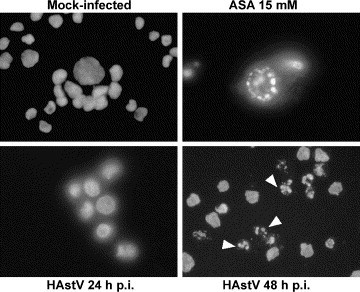
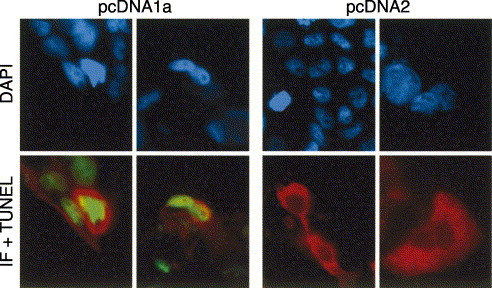
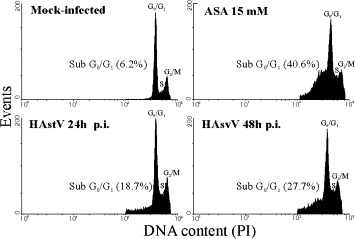
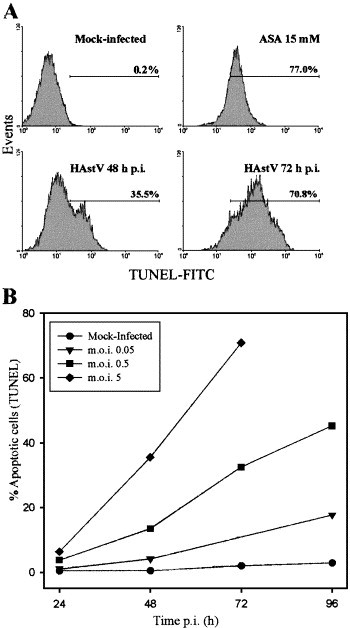
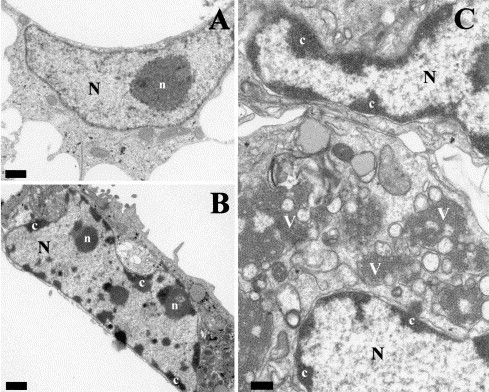
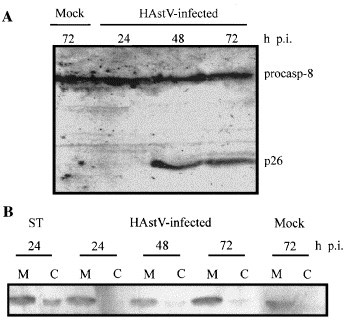
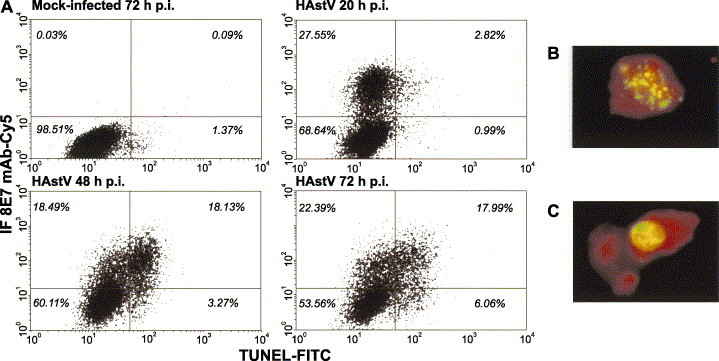
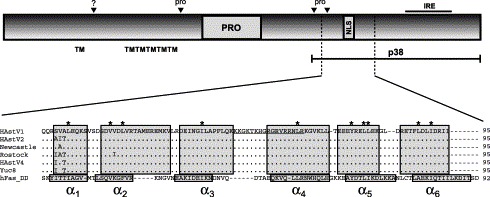
Cell death processes during human astrovirus replication in CaCo-2 cells and their underlying mechanisms were investigated. Morphological and biochemical alterations typical of apoptosis were analyzed in infected cells using a combination of techniques, including DAPI staining, the sub-G(0)/G(1) technique and the TUNEL assay. The onset of apoptosis was directly proportional to the virus multiplicity of infection. Transient expression experiments showed a direct link between astrovirus ORF1a encoded proteins and apoptosis induction. A computer analysis of the astrovirus genome revealed the presence of a death domain in the nonstructural protein p38 of unknown function, encoded in ORF1a. Apoptosis inhibition experiments suggested the involvement of caspase 8 in the apoptotic response, and led to a reduction in the infectivity of the virus progeny released to the supernatant. We conclude that apoptotic death of host cells seems necessary for efficient human astrovirus replication and particle maturation.
研究了人星状病毒在CaCo-2细胞中复制期间的细胞死亡过程及其潜在机制。使用包括DAPI染色、亚G(0)/G(1)技术和TUNEL检测在内的多种技术组合,分析了感染细胞中典型的凋亡形态学和生化改变。凋亡的发生与病毒感染复数直接相关。瞬时表达实验表明星状病毒ORF1a编码的蛋白与凋亡诱导之间存在直接联系。对星状病毒基因组的计算机分析揭示,在ORF1a中编码的功能未知的非结构蛋白p38中存在一个死亡结构域。凋亡抑制实验表明半胱天冬酶8参与了凋亡反应,并导致释放到上清液中的子代病毒的感染性降低。我们得出结论,宿主细胞的凋亡性死亡似乎是高效人星状病毒复制和颗粒成熟所必需的。