Guix Susana, Pérez-Bosque Anna, Miró Lluïsa, Moretó Miquel, Bosch Albert, Pintó Rosa M
Enteric Virus Group, Department of Microbiology, University of Barcelona, Barcelona, Spain; Nutrition and Food Safety Research Institute (INSA-UB), University of Barcelona, Santa Coloma de Gramanet, Spain.
Nutrition and Food Safety Research Institute (INSA-UB), University of Barcelona, Santa Coloma de Gramanet, Spain; Digestive Physiology and Nutritional Adaptations Group, Department of Physiology, University of Barcelona, Barcelona, Spain.
PLoS One. 2015 Apr 2;10(4):e0123087. doi: 10.1371/journal.pone.0123087. eCollection 2015.
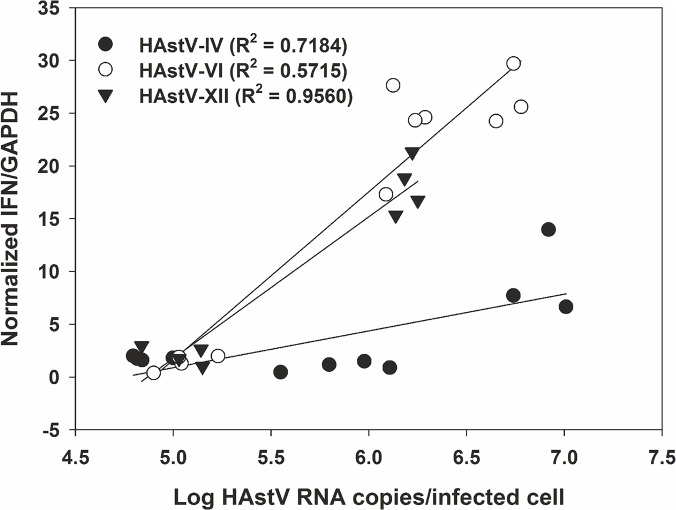
Type I interferon (IFN) activation and its subsequent effects are important in the response to viral infections. Here we show that human astroviruses (HAstVs), which are important agents of acute gastroenteritis in children, induce a mild and delayed IFN response upon infecting CaCo-2 cells. Although IFN-β mRNA is detected within infected cells and supernatant from infected cells show antiviral activity against the replication of other well-known IFN-sensitive viruses, these responses occur at late stages of infection once genome replication has taken place. On the other hand, HAstV replication can be partially reduced by the addition of exogenous IFN, and inhibition of IFN activation by BX795 enhances viral replication, indicating that HAstVs are IFN-sensitive viruses. Finally, different levels of IFN response were observed in cells infected with different HAstV mutants with changes in the hypervariable region of nsP1a/4, suggesting that nsP1a/4 genotype may potentially have clinical implications due to its correlation with the viral replication phenotype and the antiviral responses induced within infected cells.
I型干扰素(IFN)的激活及其后续效应在病毒感染的应答中很重要。在此我们表明,人星状病毒(HAstV)是儿童急性胃肠炎的重要病原体,在感染CaCo-2细胞时会诱导轻微且延迟的IFN应答。尽管在受感染细胞内可检测到IFN-β mRNA,且受感染细胞的上清液对其他知名的IFN敏感病毒的复制具有抗病毒活性,但这些应答在感染后期基因组复制发生后才出现。另一方面,添加外源性IFN可部分降低HAstV的复制,而BX795对IFN激活的抑制会增强病毒复制,这表明HAstV是IFN敏感病毒。最后,在感染了nsP1a/4高变区发生变化的不同HAstV突变体的细胞中观察到了不同水平的IFN应答,这表明nsP1a/4基因型可能因其与病毒复制表型以及受感染细胞内诱导的抗病毒应答的相关性而具有潜在的临床意义。