Plsková Jarmila, Holán Vladimír, Filipec Martin, Forrester John V
Department of Ophthalmology, University of Aberdeen, Aberdeen, AB25 2ZD, Scotland UK.
BMC Ophthalmol. 2004 Mar 23;4:3. doi: 10.1186/1471-2415-4-3.
As shown previously, the submandibular (SM) lymph node (LN) is required for priming the immune response during corneal graft rejection. In this study, we wished to determine whether corneal grafts at "high-risk" of rejection were also protected after selective SM LN removal and if so to investigate whether this improved corneal graft survival was due to induction of specific regulatory/suppressor cells or was due to immunological "ignorance".
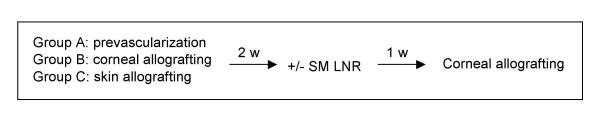
Two sets of experiments were performed. (1) Adoptive transfer of possible regulatory splenocytes from mice with long-term accepted corneal graft after SM LN removal. (2) SM LN removal and corneal grafts in "high-risk" hosts, which had been (A) subjected to corneal trauma with vascularization or (B) allosensitized by previous corneal graft or (C) allosensitized by previous skin graft.
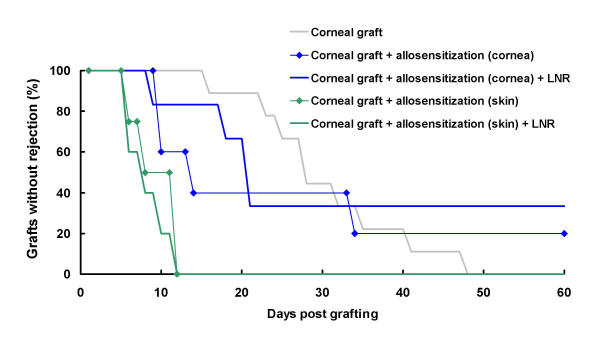
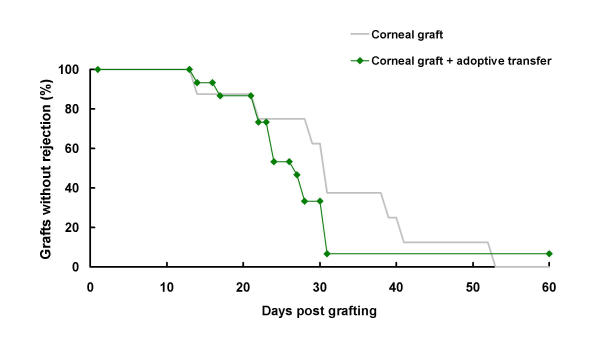
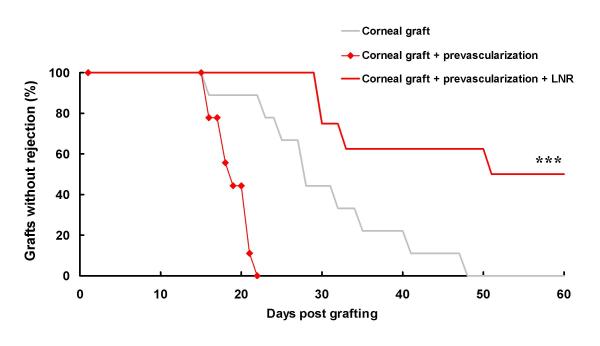
Adoptive transfer of splenocytes from tolerant mice after SM LN removal did not enhance corneal graft survival in naive recipients (p > 0.05). SM LN removal in mice with corneal vascularization enhanced corneal allograft survival compared to grafted controls with/without vascularization (p < 0.0001). The removal of the SM LN in mice, who had already been allosensitized by a previous corneal graft, did not statistically prolong corneal graft survival (p > 0.05). SM LN removal procedure did not delay rejection of corneal grafts in mice allosensitized by a previous skin transplant with the same strain combination (p > 0.05).
The results suggest that removal of the SM LN in "high-risk" mice prevents rejection by mechanisms involving immune "ignorance", since prior allosensitization prevents graft acceptance after LN removal. In allosensitized recipients the stronger the allosensitization (skin- vs. corneal graft-presensitization) the greater the possibility of priming for rejection at alternative draining LN sites.
如先前所示,在角膜移植排斥反应期间启动免疫反应需要下颌下(SM)淋巴结(LN)。在本研究中,我们希望确定在选择性切除SM淋巴结后,处于“高风险”排斥状态的角膜移植是否也受到保护,如果是这样,则研究这种改善的角膜移植存活率是由于诱导了特定的调节/抑制细胞,还是由于免疫“忽视”。
进行了两组实验。(1)从小鼠中分离出可能具有调节作用的脾细胞,这些小鼠在切除SM淋巴结后角膜移植已被长期接受,然后进行过继性转移。(2)在“高风险”宿主中切除SM淋巴结并进行角膜移植,这些宿主曾(A)经历过角膜创伤并伴有血管化,或(B)先前已通过角膜移植进行过同种致敏,或(C)先前已通过皮肤移植进行过同种致敏。
切除SM淋巴结后,来自耐受小鼠的脾细胞过继性转移并未提高未致敏受体的角膜移植存活率(p>0.05)。与有/无血管化的移植对照组相比,切除有角膜血管化小鼠的SM淋巴结可提高角膜同种异体移植的存活率(p<0.0001)。先前已通过角膜移植进行过同种致敏的小鼠,切除SM淋巴结在统计学上并未延长角膜移植的存活时间(p>0.05)。对于先前已通过相同品系组合的皮肤移植进行过同种致敏的小鼠,切除SM淋巴结的操作并未延迟角膜移植的排斥反应(p>0.05)。
结果表明,在“高风险”小鼠中切除SM淋巴结可通过涉及免疫“忽视”的机制预防排斥反应,因为先前的同种致敏会阻止切除淋巴结后移植的接受。在同种致敏的受体中,同种致敏越强(皮肤与角膜移植预致敏),在其他引流淋巴结部位引发排斥反应的可能性就越大。