Sjöwall Christopher, Bengtsson Anders A, Sturfelt Gunnar, Skogh Thomas
Division of Rheumatology, Department of Molecular and Clinical Medicine, Faculty of Health Sciences, Linköping University, Sweden.
Arthritis Res Ther. 2004;6(2):R87-94. doi: 10.1186/ar1032. Epub 2003 Dec 5.
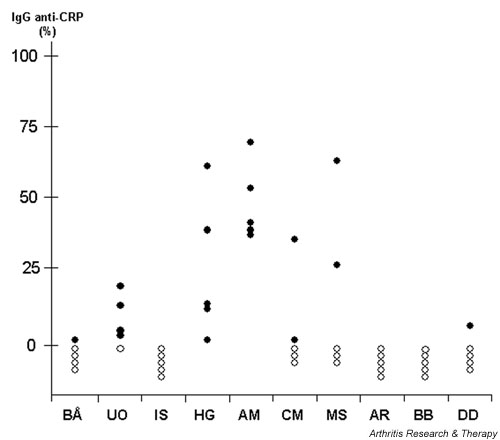
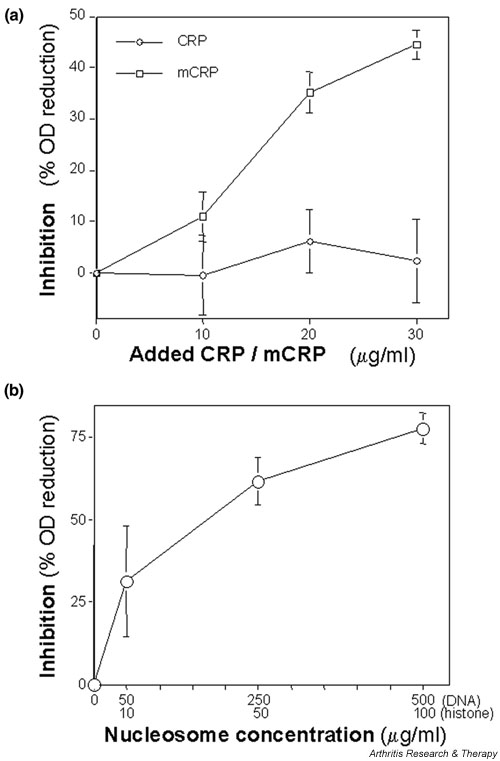
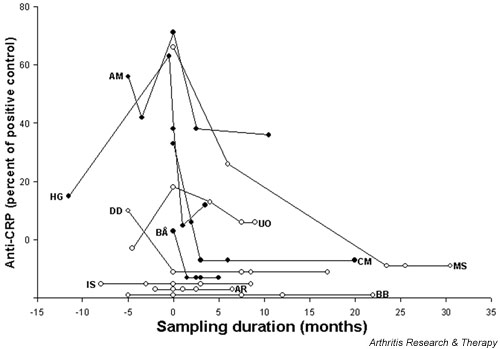
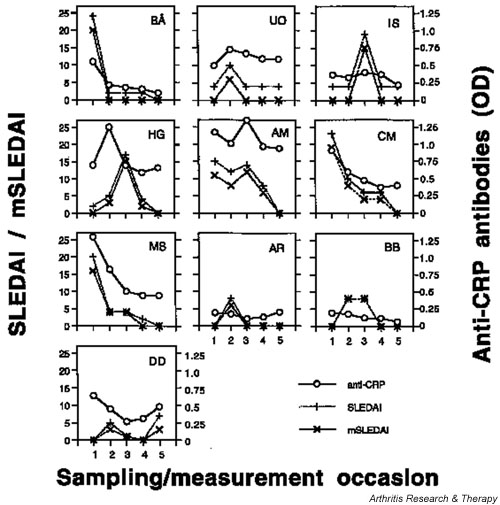
This study was performed to investigate the relation between IgG autoantibodies against human C-reactive protein (anti-CRP) and disease activity measures in serial serum samples from 10 patients with systemic lupus erythematosus (SLE), of whom four had active kidney involvement during the study period. The presence of anti-CRP was analysed by enzyme-linked immunosorbent assay. The cut-off for positive anti-CRP test was set at the 95th centile of 100 healthy blood donor sera. Specificity of the anti-CRP antibody binding was evaluated by preincubating patient sera with either native or monomeric CRP. Disease activity was determined by the SLE disease activity index (SLEDAI), serum levels of CRP, anti-DNA antibodies, complement components and blood cell counts. Of 50 serum samples, 20 (40%) contained antibodies reactive with monomeric CRP, and 7 of 10 patients were positive on at least one occasion during the study. All patients with active lupus nephritis were positive for anti-CRP at flare. Frequent correlations between anti-CRP levels and disease activity measures were observed in anti-CRP-positive individuals. Accumulated anti-CRP data from all patients were positively correlated with SLEDAI scores and anti-DNA antibody levels, whereas significant inverse relationships were noted for complement factors C1q, C3 and C4, and for lymphocyte counts. This study confirms the high prevalence of anti-CRP autoantibodies in SLE and that the antibody levels are correlated with clinical and laboratory disease activity measures. This indicates that anti-CRP antibodies might have biological functions of pathogenetic interest in SLE. Further prospective clinical studies and experimental studies on effects mediated by anti-CRP antibodies are warranted.
本研究旨在调查10例系统性红斑狼疮(SLE)患者系列血清样本中抗人C反应蛋白IgG自身抗体(抗CRP)与疾病活动指标之间的关系,其中4例在研究期间有活动性肾脏受累。采用酶联免疫吸附测定法分析抗CRP的存在情况。抗CRP检测阳性的临界值设定为100份健康献血者血清的第95百分位数。通过将患者血清与天然或单体CRP预孵育来评估抗CRP抗体结合的特异性。通过SLE疾病活动指数(SLEDAI)、CRP血清水平、抗DNA抗体、补体成分和血细胞计数来确定疾病活动度。在50份血清样本中,20份(40%)含有与单体CRP反应的抗体,10例患者中有7例在研究期间至少有一次检测呈阳性。所有活动性狼疮性肾炎患者在病情发作时抗CRP均为阳性。在抗CRP阳性个体中观察到抗CRP水平与疾病活动指标之间频繁相关。所有患者累积的抗CRP数据与SLEDAI评分和抗DNA抗体水平呈正相关,而补体因子C1q、C3和C4以及淋巴细胞计数则呈显著负相关。本研究证实了SLE中抗CRP自身抗体的高患病率,且抗体水平与临床和实验室疾病活动指标相关。这表明抗CRP抗体可能在SLE中具有致病相关的生物学功能。有必要进一步开展关于抗CRP抗体介导作用的前瞻性临床研究和实验研究。