Kruzich Paul J, Grandy David K
Department of Physiology and Pharmacology, L 334, Oregon Health & Science University, 3181 SW Sam Jackson Park Road, 97239, Portland, Oregon, USA.
BMC Neurosci. 2004 Apr 2;5:12. doi: 10.1186/1471-2202-5-12.
Dopamine modulation of neuronal signaling in the frontal cortex, midbrain, and striatum is essential for processing and integrating diverse external sensory stimuli and attaching salience to environmental cues that signal causal relationships, thereby guiding goal-directed, adaptable behaviors. At the cellular level, dopamine signaling is mediated through D1-like or D2-like receptors. Although a role for D1-like receptors in a variety of goal-directed behaviors has been identified, an explicit involvement of D2 receptors has not been clearly established. To determine whether dopamine D2 receptor-mediated signaling contributes to associative and reversal learning, we compared C57Bl/6J mice that completely lack functional dopamine D2 receptors to wild-type mice with respect to their ability to attach appropriate salience to external stimuli (stimulus discrimination) and disengage from inappropriate behavioral strategies when reinforcement contingencies change (e.g. reversal learning).
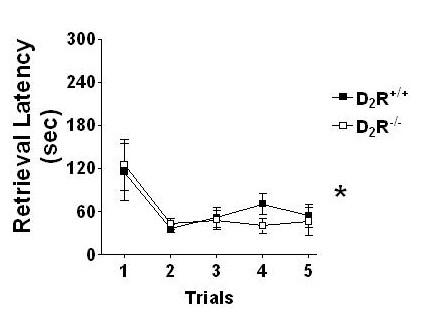
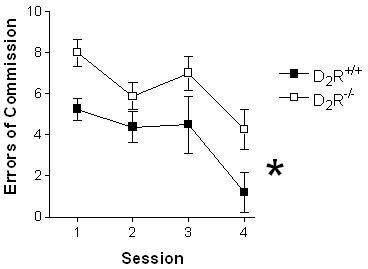
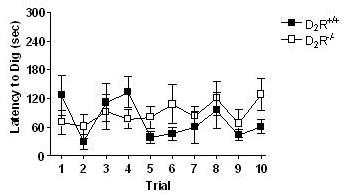
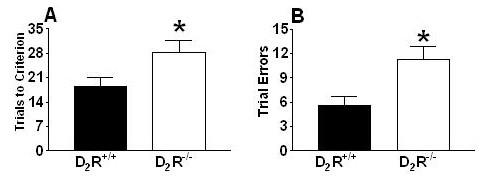
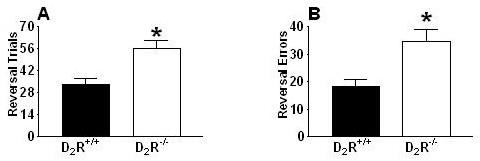
Mildly food-deprived female wild-type and dopamine D2 receptor deficient mice rapidly learned to retrieve and consume visible food reinforcers from a small plastic dish. Furthermore, both genotypes readily learned to dig through the same dish filled with sterile sand in order to locate a buried food pellet. However, the dopamine D2 receptor deficient mice required significantly more trials than wild-type mice to discriminate between two dishes, each filled with a different scented sand, and to associate one of the two odors with the presence of a reinforcer (food). In addition, the dopamine D2 receptor deficient mice repeatedly fail to alter their response patterns during reversal trials where the reinforcement rules were inverted.
Inbred C57Bl/6J mice that develop in the complete absence of functional dopamine D2 receptors are capable of olfaction but display an impaired ability to acquire odor-driven reinforcement contingencies. Furthermore, the ability of dopamine D2 receptor deficient mice to adjust their responding to a previously reinforced stimulus when unexpected outcomes are encountered is significantly impaired. These findings suggest that signaling mediated by the dopamine D2 receptor is important for regulating associative and reversal learning and may have implications for the treatment of human attention disorders.
多巴胺对额叶皮质、中脑和纹状体中神经元信号的调节,对于处理和整合各种外部感觉刺激以及赋予指示因果关系的环境线索以显著性至关重要,从而指导目标导向的适应性行为。在细胞水平上,多巴胺信号通过D1样或D2样受体介导。虽然已确定D1样受体在多种目标导向行为中起作用,但D2受体的明确参与尚未明确确立。为了确定多巴胺D2受体介导的信号是否有助于联想学习和逆向学习,我们比较了完全缺乏功能性多巴胺D2受体的C57Bl/6J小鼠和野生型小鼠在赋予外部刺激适当显著性(刺激辨别)以及当强化条件改变时(例如逆向学习)从不适当行为策略中脱离的能力。
轻度食物剥夺的雌性野生型和多巴胺D2受体缺陷型小鼠迅速学会从小塑料盘中取回并食用可见的食物强化物。此外,两种基因型的小鼠都很容易学会在装满无菌沙子的同一盘子中挖掘,以找到埋在其中的食物颗粒。然而,多巴胺D2受体缺陷型小鼠在区分两个分别装有不同香味沙子的盘子并将两种气味之一与强化物(食物)的存在联系起来时,所需的试验次数明显多于野生型小鼠。此外,多巴胺D2受体缺陷型小鼠在强化规则颠倒的逆向试验中反复未能改变其反应模式。
在完全缺乏功能性多巴胺D2受体的情况下发育的近交C57Bl/6J小鼠能够嗅觉,但在获得气味驱动的强化条件方面表现出受损能力。此外,多巴胺D2受体缺陷型小鼠在遇到意外结果时调整其对先前强化刺激的反应的能力明显受损。这些发现表明,多巴胺D2受体介导的信号对于调节联想学习和逆向学习很重要,可能对人类注意力障碍的治疗有影响。