Gaina Alexandru, Sekine Michikazu, Chen Xiaoli, Hamanishi Shimako, Kagamimori Sadanobu
Department of Welfare Promotion and Epidemiology, Faculty of Medicine, Toyama Medical and Pharmaceutical University, 2630 Sugitani, Toyama 930-0194, Japan.
J Epidemiol. 2004 Jan;14(1):1-4. doi: 10.2188/jea.14.1.
The validity of sleep quality and quantity indices as reported by schoolchildren has not been established. The purpose of this study is to evaluate the relationship between subjective sleep habits estimation and objective measurement data in schoolchildren.
The study consisted of 42 healthy junior high school children aged 13-14. Sleep log information was gathered over 7 consecutive days, using a sleep-monitoring device (Actiwatch) and a questionnaire which covered the following aspects for sleep quality and quantity: bed time, sleep latency, sleep start, sleep end, wake up and assumed sleep length. The means of the sleep indices for 5 weekdays were used for analysis. Pearson's correlation coefficients and paired t-tests were used to evaluate the correlation and difference between subjective and objective sleep parameters.
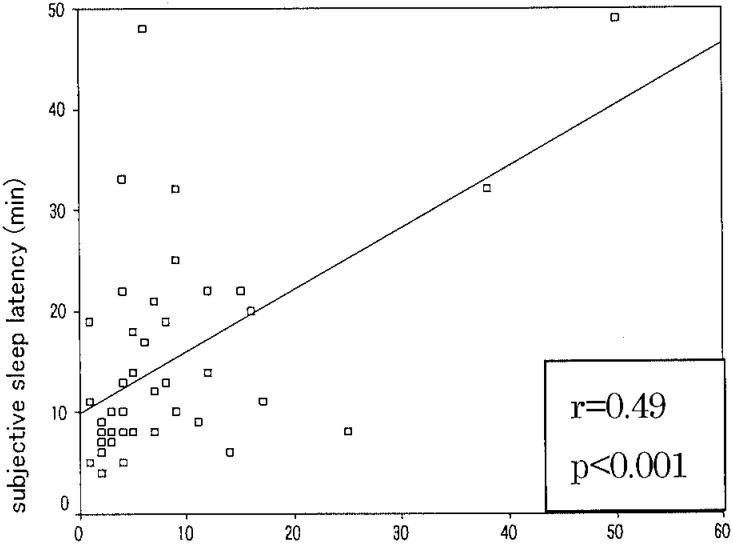
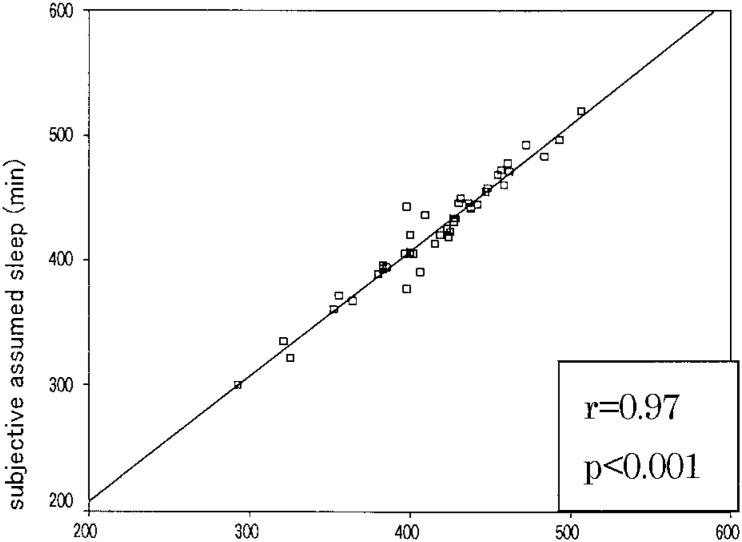
The correlation coefficient between subjective and objective records was 0.49 (p < 0.001) for sleep latency, 0.99 (p < 0.001) for sleep start time, 0.99 (p < 0.001) for sleep end time, and 0.97 (p < 0.001) for assumed sleep length. The difference between subjective and objective records was 7.67 min (95% confidence interval [CI]: 4.64-10.71) for sleep latency, and 0:02 min (95% CI: -0:01-0:05) for sleep start time, 0:02 min (95% CI: 0:01-0:03) for sleep end time, and 8.19 min (95% CI: 4.93-11.45) for assumed sleep length.
Although children tended to overestimate sleeping hours, the correlation between subjective and objective sleep indices except sleep latency was quite high. Thus, children's sleep questionnaire can be applied to surveys for sleep habits screening.
学童所报告的睡眠质量和数量指标的有效性尚未确定。本研究的目的是评估学童主观睡眠习惯估计与客观测量数据之间的关系。
该研究包括42名年龄在13 - 14岁的健康初中学生。使用睡眠监测设备(活动记录仪)和一份涵盖睡眠质量和数量以下方面的问卷,连续7天收集睡眠日志信息:就寝时间、入睡潜伏期、开始睡眠、结束睡眠、醒来以及假定的睡眠时间。分析使用5个工作日的睡眠指标均值。采用Pearson相关系数和配对t检验来评估主观和客观睡眠参数之间的相关性和差异。
入睡潜伏期主观与客观记录的相关系数为0.49(p < 0.001),开始睡眠时间为0.99(p < 0.001),结束睡眠时间为0.99(p < 0.001),假定睡眠时间为0.97(p < 0.001)。入睡潜伏期主观与客观记录的差异为7.67分钟(95%置信区间[CI]:4.64 - 10.71),开始睡眠时间为0.02分钟(95% CI: - 0.01 - 0.05),结束睡眠时间为0.02分钟(95% CI:0.01 - 0.03),假定睡眠时间为8.19分钟(95% CI:4.93 - 11.45)。
尽管儿童往往高估睡眠时间,但除入睡潜伏期外,主观和客观睡眠指标之间的相关性相当高。因此,儿童睡眠问卷可应用于睡眠习惯筛查调查。