Tovey Sian M, Witton Caroline J, Bartlett John M S, Stanton Peter D, Reeves Jonathan R, Cooke Timothy G
Endocrine Cancer Group, Division of Cancer Sciences and Molecular Biology, University Department of Surgery, Glasgow Royal Infirmary, Glasgow G31 2ER, UK.
Breast Cancer Res. 2004;6(3):R246-51. doi: 10.1186/bcr783. Epub 2004 Mar 23.
We have shown previously that whereas overexpression of human epidermal growth factor receptor (HER)1, HER2 and HER3 is associated with poor prognosis in breast cancer, HER4 is associated with a good prognosis. Cell proliferation is a key component of aggressive cancers and is driven by growth factors. In this study, bromodeoxyuridine (BrdU)-derived proliferation indices are correlated with clinical outcome and HER1-4 status for further clarification of the differing roles for the HER family at a biological level.
Seventy-eight invasive breast cancers had BrdU labelling in vivo to determine the BrdU labelling index (BLI) and the potential tumour doubling time (Tpot). Long-term clinical follow-up was available for these patients. We used immunohistochemistry to establish the HER1-4 status in 55 patients from the BrdU cohort.
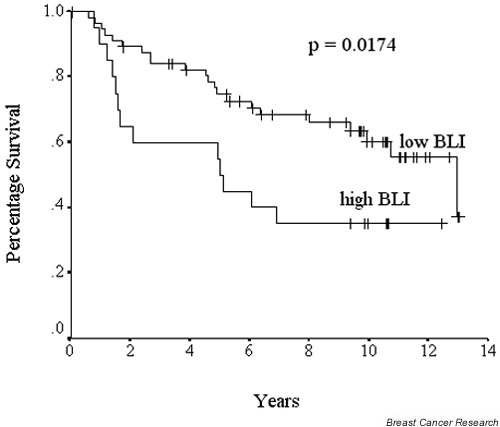
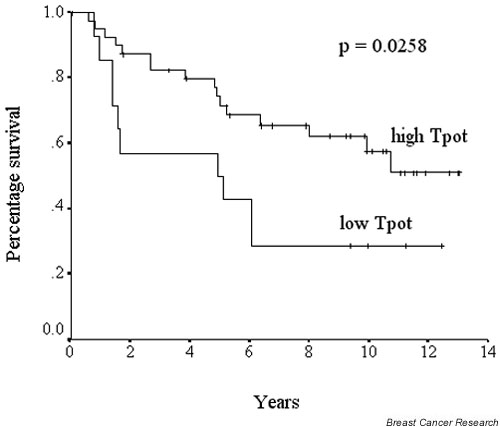
We demonstrate a significant correlation between high BLI values and breast cancer-specific death (P = 0.0174). Low Tpot times were also significantly correlated with breast cancer-specific death (P = 0.0258). However, BLI did not independently predict survival in Cox's multiple regression analysis when combined with other prognostic factors such as size, grade and nodal status. Tumours found to be positive for HER1, HER2 or HER3 had significantly (P = 0.041) higher labelling indices, with HER1 also showing significantly higher indices when considered independently (P = 0.024). Conversely, HER4 positivity was significantly correlated (P = 0.013) with low BLI values, in line with previous data associating this receptor with good prognosis tumours.
These results support the hypothesis that HER1-3 are associated with driving tumour proliferation, whereas HER4 is involved in a non-proliferative or even protective role.
我们之前已经表明,虽然人类表皮生长因子受体(HER)1、HER2和HER3的过表达与乳腺癌的不良预后相关,但HER4与良好预后相关。细胞增殖是侵袭性癌症的关键组成部分,由生长因子驱动。在本研究中,溴脱氧尿苷(BrdU)衍生的增殖指数与临床结局及HER1-4状态相关,以在生物学水平上进一步阐明HER家族的不同作用。
78例浸润性乳腺癌在体内进行BrdU标记,以确定BrdU标记指数(BLI)和潜在肿瘤倍增时间(Tpot)。这些患者有长期临床随访数据。我们使用免疫组织化学方法确定了来自BrdU队列的55例患者的HER1-4状态。
我们证明高BLI值与乳腺癌特异性死亡之间存在显著相关性(P = 0.0174)。低Tpot时间也与乳腺癌特异性死亡显著相关(P = 0.0258)。然而,在Cox多元回归分析中,当与其他预后因素如大小、分级和淋巴结状态相结合时,BLI并不能独立预测生存情况。发现HER1、HER2或HER3呈阳性的肿瘤具有显著更高(P = 0.041)的标记指数,单独考虑时HER1也显示出显著更高的指数(P = 0.024)。相反,HER4阳性与低BLI值显著相关(P = 0.013),这与之前将该受体与预后良好的肿瘤相关联的数据一致。
这些结果支持以下假设,即HER1-3与驱动肿瘤增殖相关,而HER4参与非增殖甚至保护作用。