Wake Forest Graduate School of Biomedical Sciences, Wake Forest University School of Medicine, Winston-Salem, NC 27101, USA.
Department of Neurosurgery, McGovern Medical School, University of Texas Health Science Center at Houston, MSE R162, 6431 Fannin Street, Houston, TX 77030, USA.
Genes (Basel). 2022 Nov 8;13(11):2065. doi: 10.3390/genes13112065.
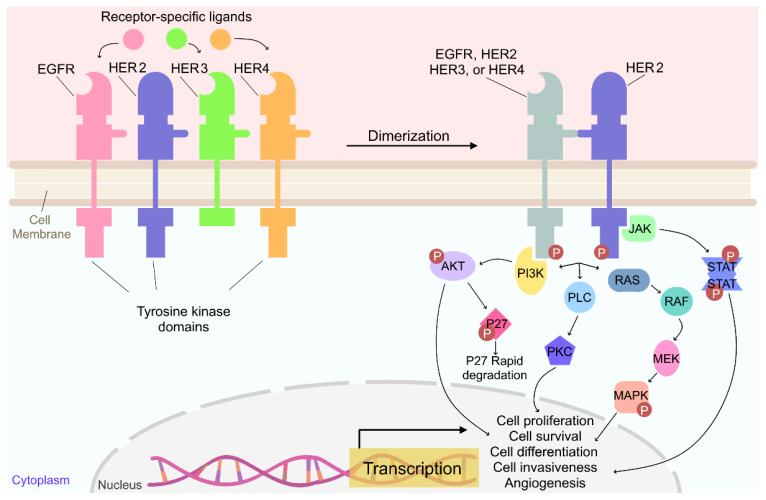
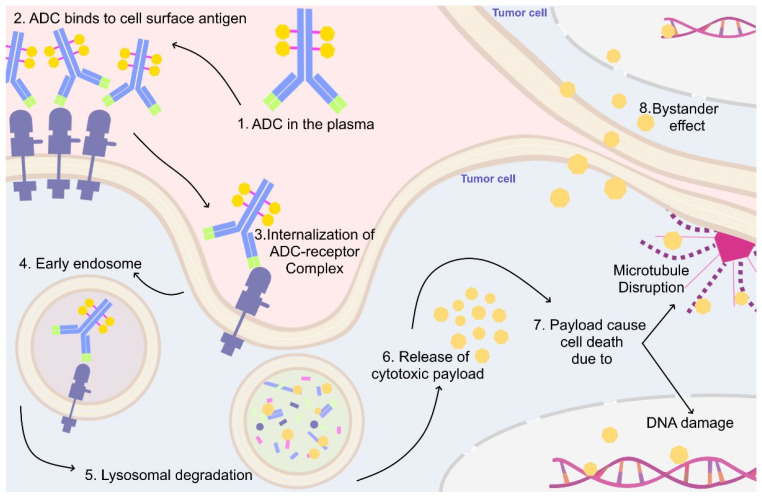
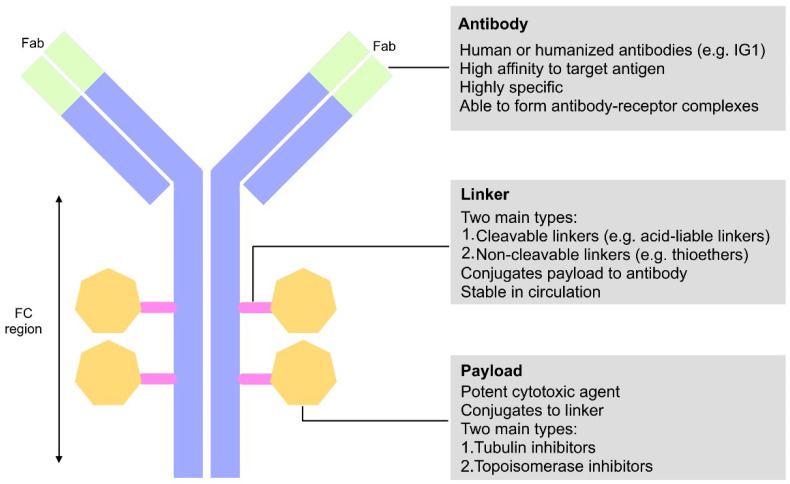
Human epidermal growth factor receptor 2 (HER2) receptor tyrosine kinase is overexpressed in 20-30% of breast cancers and is associated with poor prognosis and worse overall patient survival. Most women with HER2-positive breast cancer receive neoadjuvant chemotherapy plus HER2-targeted therapies. The development of HER2-directed therapeutics is an important advancement in targeting invasive breast cancer. Despite the efficacy of anti-HER2 monoclonal antibodies, they are still being combined with adjuvant chemotherapy to improve overall patient outcomes. Recently, significant progress has been made towards the development of a class of therapeutics known as antibody-drug conjugates (ADCs), which leverage the high specificity of HER2-targeted monoclonal antibodies with the potent cytotoxic effects of various small molecules, such as tubulin inhibitors and topoisomerase inhibitors. To date, two HER2-targeting ADCs have been approved by the FDA for the treatment of HER2-positive breast cancer: Ado-trastuzumab emtansine (T-DM1; Kadcyla) and fam-trastuzumab deruxtecan-nxki (T-Dxd; Enhertu). Kadcyla and Enhertu are approved for use as a second-line treatment after trastuzumab-taxane-based therapy in patients with HER2-positive breast cancer. The success of ADCs in the treatment of HER2-positive breast cancer provides novel therapeutic advancements in the management of the disease. In this review, we discuss the basic biology of HER2, its downstream signaling pathways, currently available anti-HER2 therapeutic modalities and their mechanisms of action, and the latest clinical and safety characteristics of ADCs used for the treatment of HER2-positive breast cancer.
人表皮生长因子受体 2(HER2)受体酪氨酸激酶在 20-30%的乳腺癌中过度表达,与不良预后和患者总体生存较差相关。大多数 HER2 阳性乳腺癌患者接受新辅助化疗加 HER2 靶向治疗。HER2 定向治疗的发展是靶向侵袭性乳腺癌的重要进展。尽管抗 HER2 单克隆抗体有效,但它们仍与辅助化疗联合使用,以改善患者总体预后。最近,在开发一类称为抗体药物偶联物(ADC)的治疗方法方面取得了重大进展,该方法利用了 HER2 靶向单克隆抗体的高度特异性和各种小分子的强大细胞毒性作用,如微管抑制剂和拓扑异构酶抑制剂。迄今为止,FDA 已批准两种用于治疗 HER2 阳性乳腺癌的 HER2 靶向 ADC:曲妥珠单抗-美坦新偶联物(T-DM1;Kadcyla)和fam-trastuzumab deruxtecan-nxki(T-Dxd;Enhertu)。Kadcyla 和 Enhertu 获批用于曲妥珠单抗-紫杉烷类治疗后二线治疗 HER2 阳性乳腺癌患者。ADC 在治疗 HER2 阳性乳腺癌方面的成功为该疾病的治疗提供了新的治疗进展。在这篇综述中,我们讨论了 HER2 的基本生物学、其下游信号通路、目前可用的抗 HER2 治疗方法及其作用机制,以及用于治疗 HER2 阳性乳腺癌的 ADC 的最新临床和安全性特征。