Eggink Laura L, LoBrutto Russell, Brune Daniel C, Brusslan Judy, Yamasato Akihiro, Tanaka Ayumi, Hoober J Kenneth
School of Life Sciences, Arizona State University, Tempe, Arizona 85287-4501, USA.
BMC Plant Biol. 2004 Apr 15;4:5. doi: 10.1186/1471-2229-4-5.
Assembly of stable light-harvesting complexes (LHCs) in the chloroplast of green algae and plants requires synthesis of chlorophyll (Chl) b, a reaction that involves oxygenation of the 7-methyl group of Chl a to a formyl group. This reaction uses molecular oxygen and is catalyzed by chlorophyllide a oxygenase (CAO). The amino acid sequence of CAO predicts mononuclear iron and Rieske iron-sulfur centers in the protein. The mechanism of synthesis of Chl b and localization of this reaction in the chloroplast are essential steps toward understanding LHC assembly.
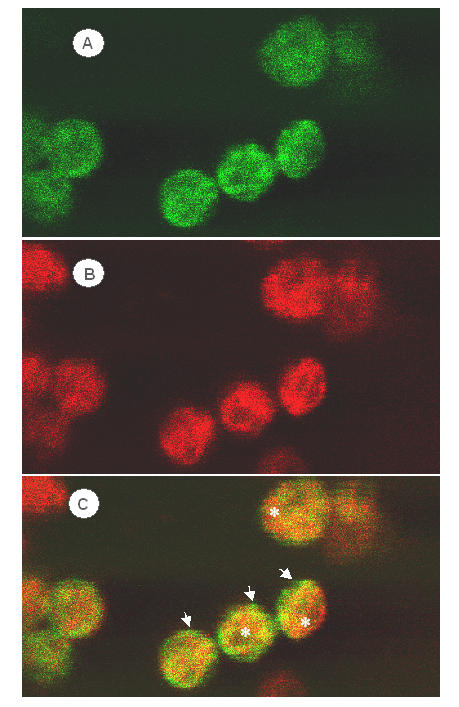
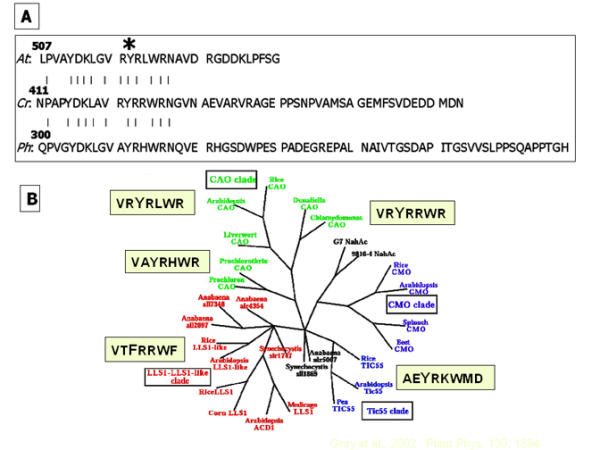
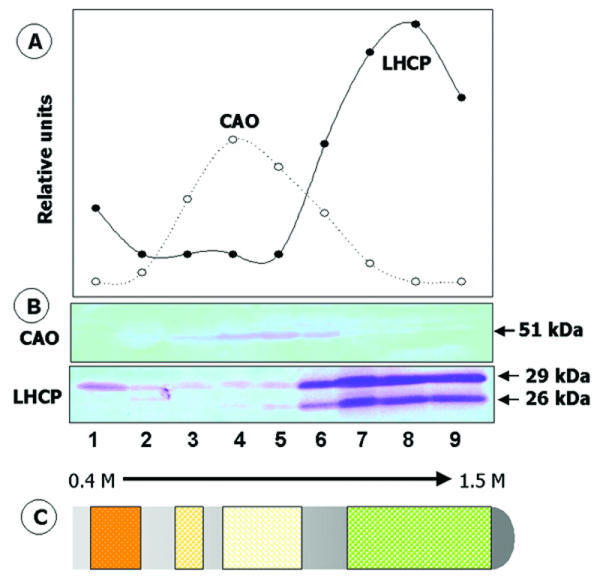
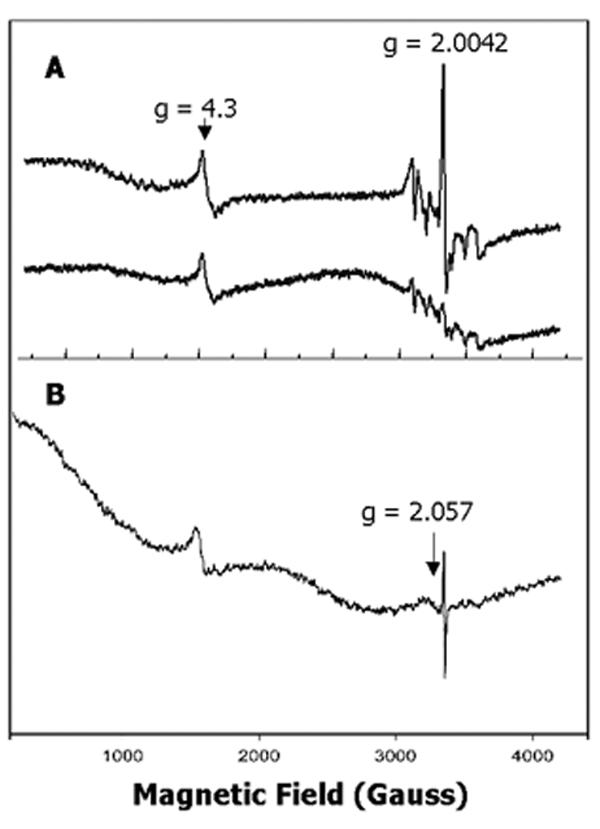
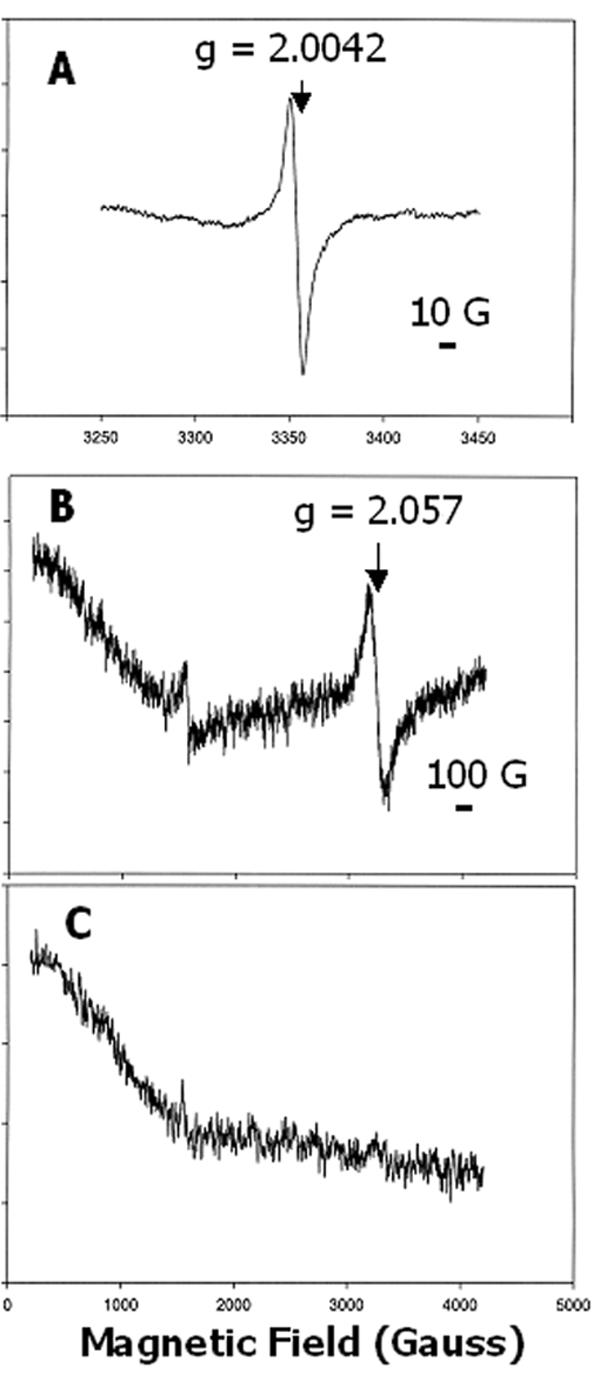
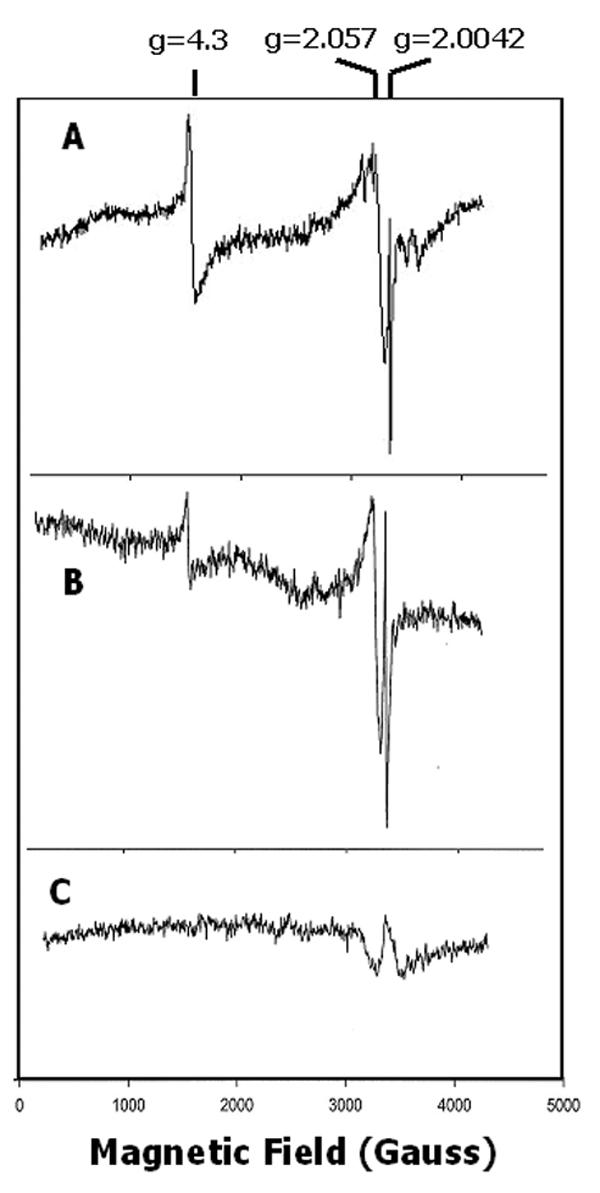
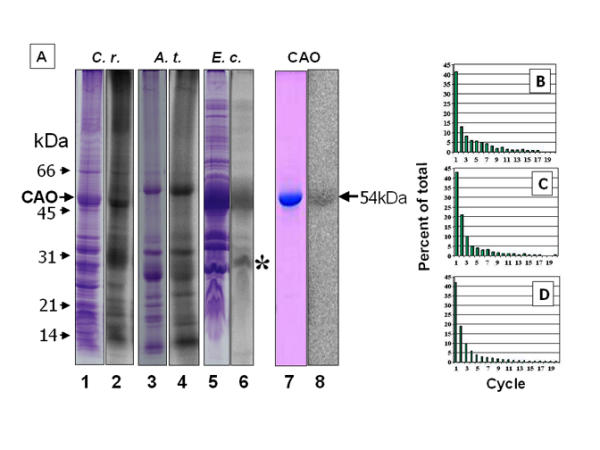
Fluorescence of a CAO-GFP fusion protein, transiently expressed in young pea leaves, was found at the periphery of mature chloroplasts and on thylakoid membranes by confocal fluorescence microscopy. However, when membranes from partially degreened cells of Chlamydomonas reinhardtii cw15 were resolved on sucrose gradients, full-length CAO was detected by immunoblot analysis only on the chloroplast envelope inner membrane. The electron paramagnetic resonance spectrum of CAO included a resonance at g = 4.3, assigned to the predicted mononuclear iron center. Instead of a spectrum of the predicted Rieske iron-sulfur center, a nearly symmetrical, approximately 100 Gauss peak-to-trough signal was observed at g = 2.057, with a sensitivity to temperature characteristic of an iron-sulfur center. A remarkably stable radical in the protein was revealed by an isotropic, 9 Gauss peak-to-trough signal at g = 2.0042. Fragmentation of the protein after incorporation of 125I- identified a conserved tyrosine residue (Tyr-422 in Chlamydomonas and Tyr-518 in Arabidopsis) as the radical species. The radical was quenched by chlorophyll a, an indication that it may be involved in the enzymatic reaction.
CAO was found on the chloroplast envelope and thylakoid membranes in mature chloroplasts but only on the envelope inner membrane in dark-grown C. reinhardtii cells. Such localization provides further support for the envelope membranes as the initial site of Chl b synthesis and assembly of LHCs during chloroplast development. Identification of a tyrosine radical in the protein provides insight into the mechanism of Chl b synthesis.
绿藻和植物叶绿体中稳定的捕光复合物(LHC)的组装需要叶绿素(Chl)b的合成,该反应涉及将Chl a的7-甲基氧化为甲酰基。此反应利用分子氧,并由叶绿素酸酯a加氧酶(CAO)催化。CAO的氨基酸序列预测该蛋白中存在单核铁和 Rieske 铁硫中心。Chl b的合成机制及其在叶绿体中的定位是理解LHC组装的关键步骤。
通过共聚焦荧光显微镜观察发现,在幼嫩豌豆叶片中瞬时表达的CAO-GFP融合蛋白的荧光出现在成熟叶绿体的周边和类囊体膜上。然而,当莱茵衣藻cw15部分脱绿细胞的膜在蔗糖梯度上分离时,免疫印迹分析仅在叶绿体被膜内膜上检测到全长CAO。CAO的电子顺磁共振谱在g = 4.3处有一个共振峰,归因于预测的单核铁中心。在g = 2.057处观察到的不是预测的 Rieske 铁硫中心的谱图,而是一个近乎对称、约100高斯峰谷信号,具有铁硫中心的温度敏感性特征。在g = 2.0042处有一个各向同性的9高斯峰谷信号,揭示了该蛋白中一个非常稳定的自由基。掺入125I后蛋白质的片段化鉴定出一个保守的酪氨酸残基(莱茵衣藻中为Tyr-422,拟南芥中为Tyr-518)作为自由基物种。该自由基被叶绿素a淬灭,表明它可能参与酶促反应。
在成熟叶绿体中,CAO存在于叶绿体被膜和类囊体膜上,但在黑暗生长的莱茵衣藻细胞中仅存在于被膜内膜上。这种定位为叶绿体发育过程中被膜作为Chl b合成和LHC组装的初始位点提供了进一步支持。蛋白质中酪氨酸自由基的鉴定为Chl b合成机制提供了深入了解。