Emberley Ethan D, Murphy Leigh C, Watson Peter H
Manitoba Institute of Cell Biology, University of Manitoba, Winnipeg, Canada.
Breast Cancer Res. 2004;6(4):153-9. doi: 10.1186/bcr816. Epub 2004 Jun 4.
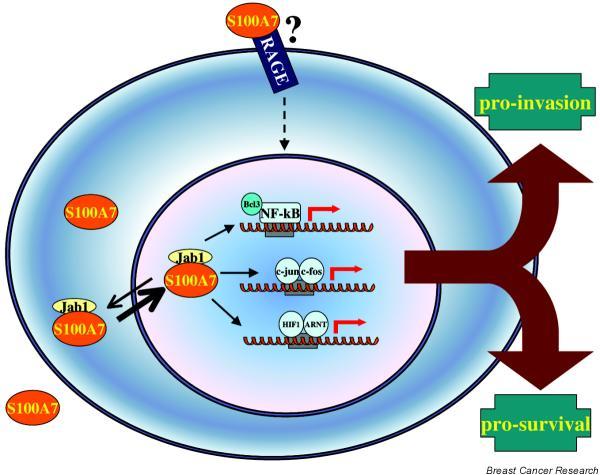
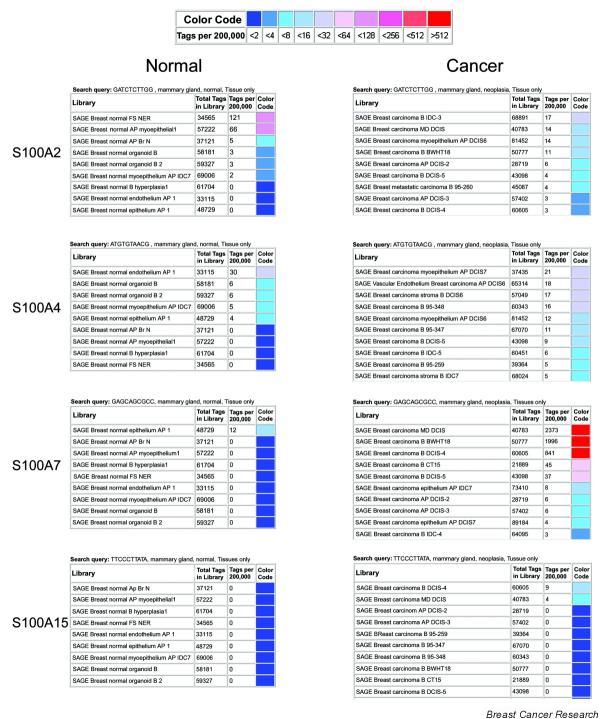
The S100 gene family comprises more than 20 members whose protein sequences encompass at least one EF-hand Ca2+ binding motif. The expression of individual family members is not ubiquitous for all tissues and there appears to be an element of tissue-specific expression. Molecular analysis of breast tumors has revealed that several S100s, including S100A2, S100A4 and S100A7, exhibit altered expression levels during breast tumorigenesis and/or progression. Subsequent studies have started to describe a functional role for these S100 proteins as well as their mechanism of action and the biochemical pathways they modify. The present review outlines what is known about S100A7 in breast cancer and summarizes the need to better understand the importance of this protein in breast cancer.
S100基因家族由20多个成员组成,其蛋白质序列包含至少一个EF手型钙离子结合基序。各个家族成员的表达并非在所有组织中都普遍存在,似乎存在组织特异性表达的因素。对乳腺肿瘤的分子分析表明,包括S100A2、S100A4和S100A7在内的几种S100蛋白在乳腺肿瘤发生和/或进展过程中表达水平发生改变。随后的研究开始描述这些S100蛋白的功能作用、作用机制以及它们所修饰的生化途径。本综述概述了关于S100A7在乳腺癌中的已知情况,并总结了更好地理解该蛋白在乳腺癌中的重要性的必要性。