Pavlopoulos Sotiris A, Stasis Antonis C H, Loukis Euripides N
National Technical University of Athens, School of Electrical and Computer Engineering, Biomedical Engineering Laboratory, Iroon Polytexniou Zografou 15773, Athens, Greece.
Biomed Eng Online. 2004 Jun 29;3(1):21. doi: 10.1186/1475-925X-3-21.
New technologies like echocardiography, color Doppler, CT, and MRI provide more direct and accurate evidence of heart disease than heart auscultation. However, these modalities are costly, large in size and operationally complex and therefore are not suitable for use in rural areas, in homecare and generally in primary healthcare set-ups. Furthermore the majority of internal medicine and cardiology training programs underestimate the value of cardiac auscultation and junior clinicians are not adequately trained in this field. Therefore efficient decision support systems would be very useful for supporting clinicians to make better heart sound diagnosis. In this study a rule-based method, based on decision trees, has been developed for differential diagnosis between "clear" Aortic Stenosis (AS) and "clear" Mitral Regurgitation (MR) using heart sounds.
For the purposes of our experiment we used a collection of 84 heart sound signals including 41 heart sound signals with "clear" AS systolic murmur and 43 with "clear" MR systolic murmur. Signals were initially preprocessed to detect 1st and 2nd heart sounds. Next a total of 100 features were determined for every heart sound signal and relevance to the differentiation between AS and MR was estimated. The performance of fully expanded decision tree classifiers and Pruned decision tree classifiers were studied based on various training and test datasets. Similarly, pruned decision tree classifiers were used to examine their differentiation capabilities. In order to build a generalized decision support system for heart sound diagnosis, we have divided the problem into sub problems, dealing with either one morphological characteristic of the heart-sound waveform or with difficult to distinguish cases.
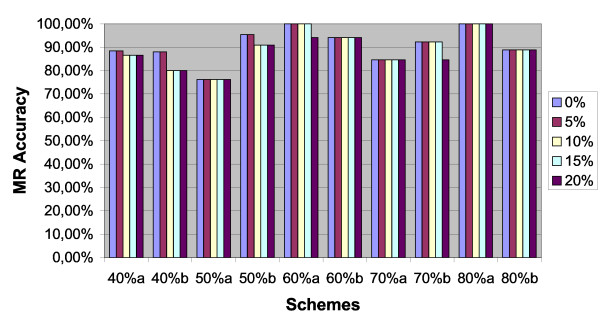
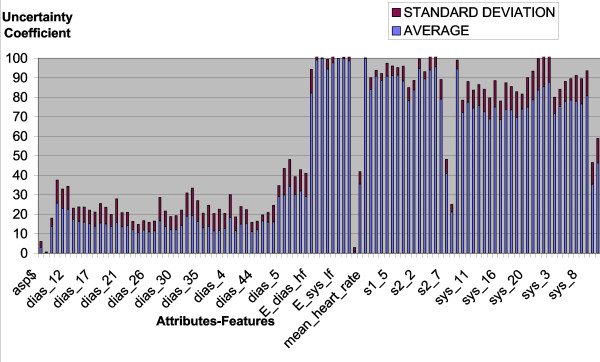
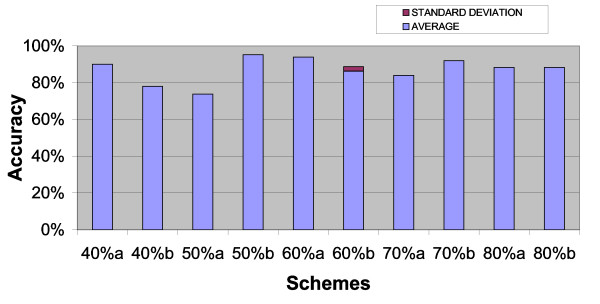
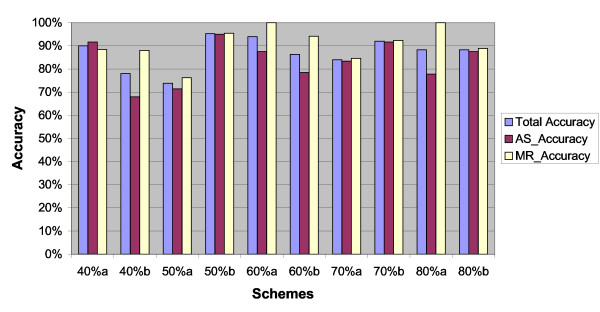
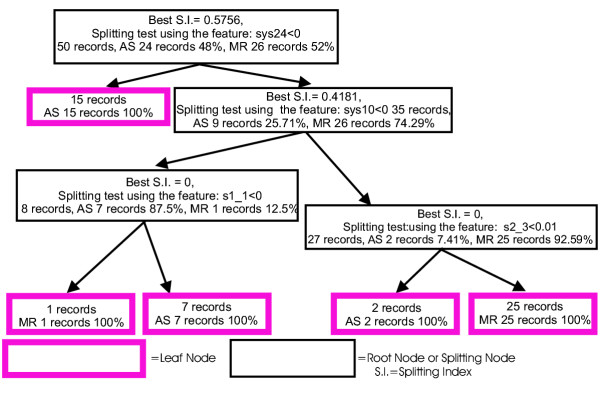
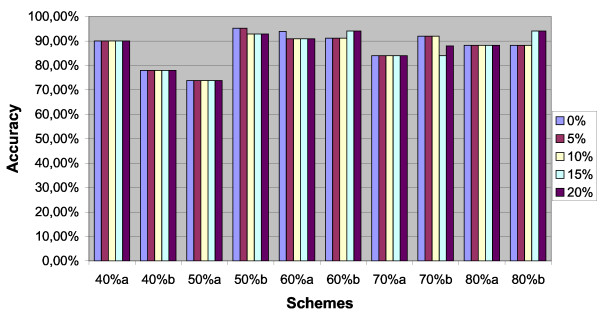
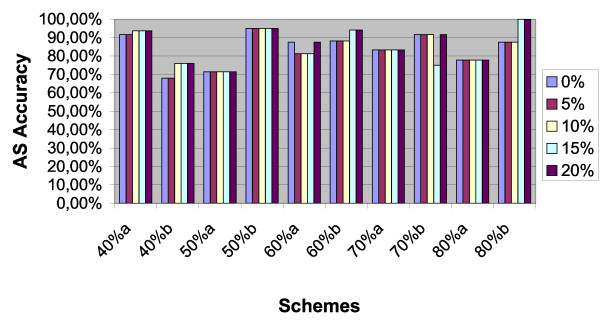
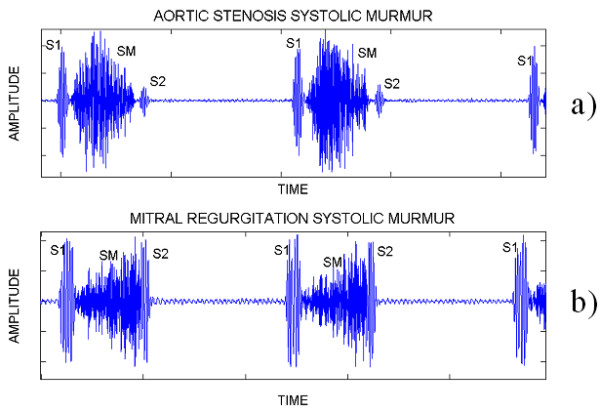
Relevance analysis on the different heart sound features demonstrated that the most relevant features are the frequency features and the morphological features that describe S1, S2 and the systolic murmur. The results are compatible with the physical understanding of the problem since AS and MR systolic murmurs have different frequency contents and different waveform shapes. On the contrary, in the diastolic phase there is no murmur in both diseases which results in the fact that the diastolic phase signals cannot contribute to the differentiation between AS and MR. We used a fully expanded decision tree classifier with a training set of 34 records and a test set of 50 records which resulted in a classification accuracy (total corrects/total tested) of 90% (45 correct/50 total records). Furthermore, the method proved to correctly classify both AS and MR cases since the partial AS and MR accuracies were 91.6% and 88.5% respectively. Similar accuracy was achieved using decision trees with a fraction of the 100 features (the most relevant). Pruned Differentiation decision trees did not significantly change the classification accuracy of the decision trees both in terms of partial classification and overall classification as well.
Present work has indicated that decision tree algorithms decision tree algorithms can be successfully used as a basis for a decision support system to assist young and inexperienced clinicians to make better heart sound diagnosis. Furthermore, Relevance Analysis can be used to determine a small critical subset, from the initial set of features, which contains most of the information required for the differentiation. Decision tree structures, if properly trained can increase their classification accuracy in new test data sets. The classification accuracy and the generalization capabilities of the Fully Expanded decision tree structures and the Pruned decision tree structures have not significant difference for this examined sub-problem. However, the generalization capabilities of the decision tree based methods were found to be satisfactory. Decision tree structures were tested on various training and test data set and the classification accuracy was found to be consistently high.
超声心动图、彩色多普勒、CT和MRI等新技术比心脏听诊能提供更直接、准确的心脏病证据。然而,这些检查方式成本高昂、体积庞大且操作复杂,因此不适合在农村地区、家庭护理以及一般的基层医疗环境中使用。此外,大多数内科和心脏病学培训项目低估了心脏听诊的价值,初级临床医生在该领域未得到充分培训。因此,高效的决策支持系统对于帮助临床医生做出更好的心音诊断非常有用。在本研究中,基于决策树开发了一种基于规则的方法,用于使用心音对“明确的”主动脉瓣狭窄(AS)和“明确的”二尖瓣反流(MR)进行鉴别诊断。
为了进行实验,我们使用了84个心音信号的集合,其中包括41个带有“明确的”AS收缩期杂音的心音信号和43个带有“明确的”MR收缩期杂音的心音信号。信号首先进行预处理以检测第一和第二心音。接下来,为每个心音信号确定总共100个特征,并评估其与AS和MR鉴别之间的相关性。基于各种训练和测试数据集研究了完全展开的决策树分类器和剪枝决策树分类器的性能。同样,使用剪枝决策树分类器来检验它们的鉴别能力。为了构建一个用于心音诊断的通用决策支持系统,我们将问题分解为子问题,分别处理心音波形的一个形态特征或难以区分的情况。
对不同心音特征的相关性分析表明,最相关的特征是描述S1、S2和收缩期杂音的频率特征和形态特征。结果与对该问题的物理理解相符,因为AS和MR收缩期杂音具有不同的频率成分和不同的波形形状。相反,在舒张期两种疾病均无杂音,这导致舒张期信号无法有助于AS和MR的鉴别。我们使用了一个完全展开的决策树分类器,其训练集为34条记录,测试集为50条记录,分类准确率(正确总数/测试总数)为90%(45正确/50条总记录)。此外,该方法被证明能够正确分类AS和MR病例,因为AS和MR的部分准确率分别为91.6%和88.5%。使用具有100个特征中的一部分(最相关的)的决策树也实现了类似的准确率。剪枝鉴别决策树在部分分类和总体分类方面均未显著改变决策树的分类准确率。
目前的工作表明,决策树算法可以成功地用作决策支持系统的基础,以帮助年轻和经验不足的临床医生做出更好的心音诊断。此外,相关性分析可用于从初始特征集中确定一个小的关键子集,该子集包含鉴别所需的大部分信息。如果经过适当训练,决策树结构可以提高其在新测试数据集中的分类准确率。对于这个研究的子问题,完全展开的决策树结构和剪枝决策树结构的分类准确率和泛化能力没有显著差异。然而,基于决策树的方法的泛化能力被认为是令人满意的。决策树结构在各种训练和测试数据集上进行了测试,发现分类准确率一直很高。