Liu Shasha, Qiu Feng, Gu Rongrong, Xu Erying
Key Laboratory of Fujian-Taiwan Animal Pathogen Biology, College of Animal Sciences, Fujian Agriculture and Forestry University, Fuzhou 350002, China.
Joint Laboratory of Animal Pathogen Prevention and Control of Fujian-Nepal, College of Animal Sciences, Fujian Agriculture and Forestry University, Fuzhou 350002, China.
Int J Mol Sci. 2024 Dec 19;25(24):13589. doi: 10.3390/ijms252413589.
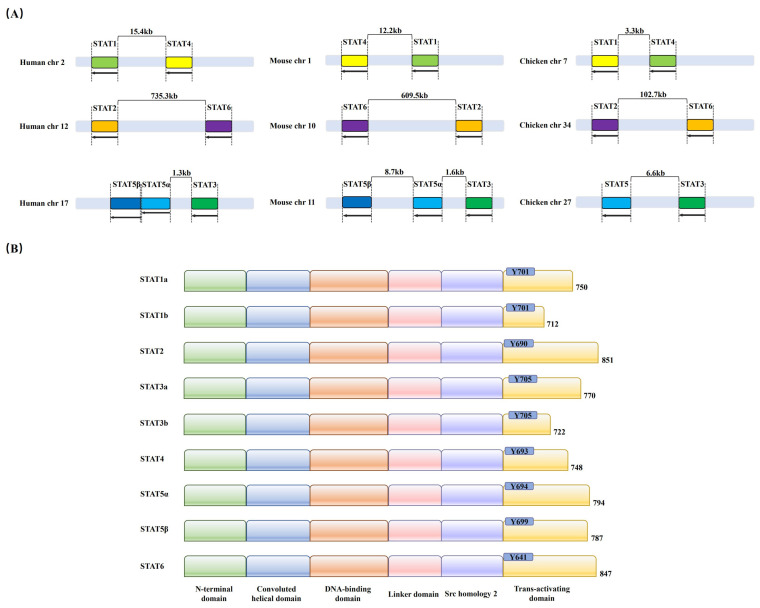
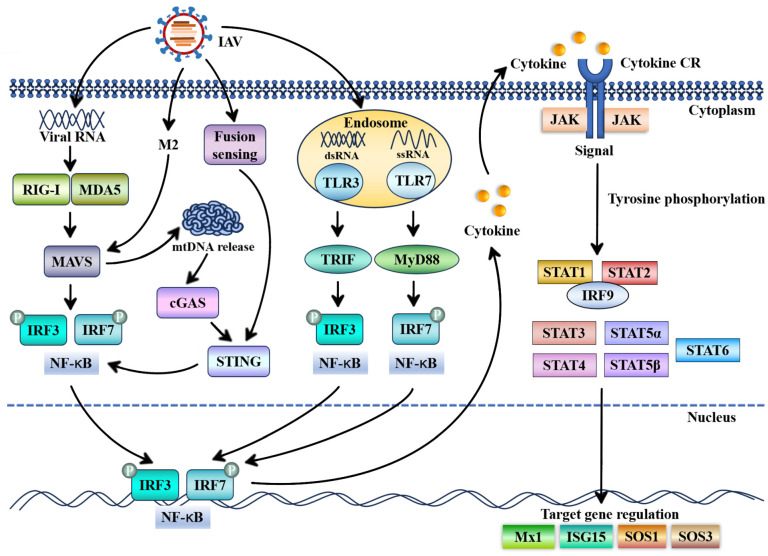
Signal transducers and activators of transcription (STATs) function both as signal transducers and transcription regulators. STAT proteins are involved in the signaling pathways of cytokines and growth factors; thus, they participate in various life activities and play especially critical roles in antiviral immunity. Convincing evidence suggests that STATs can establish innate immune status through multiple mechanisms, efficiently eliminating pathogens. STAT1 and STAT2 can activate the antiviral status by regulating the interferon (IFN) signal. In turn, suppressor of cytokine signaling-1 (SOCS1) and SOCS3 can modulate the activation of STATs and suppress the excessive antiviral immune response. STAT3 not only regulates the IFN signal, but also transduces Interleukin-6 (IL-6) to stimulate the host antiviral response. The function of STAT4 and STAT5 is related to CD4+ T helper (Th) cells, and the specific mechanism of STAT5 remains to be studied. STAT6 mainly exerts antiviral effects by mediating IL-4 and IL-13 signaling. Here, we reviewed the recent findings regarding the critical roles of STATs in the interactions between the host and viral infection, especially influenza A virus (IAV) infection. We also discuss the molecular mechanisms underlying their functions in antiviral responses.
信号转导及转录激活因子(STATs)兼具信号转导子和转录调节因子的功能。STAT蛋白参与细胞因子和生长因子的信号通路;因此,它们参与多种生命活动,在抗病毒免疫中发挥着尤为关键的作用。确凿证据表明,STATs可通过多种机制建立先天免疫状态,有效清除病原体。STAT1和STAT2可通过调节干扰素(IFN)信号激活抗病毒状态。反过来,细胞因子信号抑制因子1(SOCS1)和SOCS3可调节STATs的激活并抑制过度的抗病毒免疫反应。STAT3不仅调节IFN信号,还转导白细胞介素-6(IL-6)以刺激宿主抗病毒反应。STAT4和STAT5的功能与CD4 +辅助性T(Th)细胞有关,STAT5的具体机制仍有待研究。STAT6主要通过介导IL-4和IL-13信号发挥抗病毒作用。在此,我们综述了关于STATs在宿主与病毒感染(尤其是甲型流感病毒(IAV)感染)相互作用中的关键作用的最新研究发现。我们还讨论了它们在抗病毒反应中发挥功能的分子机制。