Abnet Christian C, Huppi Konrad, Carrera Ana, Armistead David, McKenney Keith, Hu Nan, Tang Ze-Zong, Taylor Philip R, Dawsey Sanford M
Cancer Prevention Studies Branch, Center for Cancer Research, National Cancer Institute, Bethesda, MD 20892, USA.
BMC Cancer. 2004 Jul 1;4:30. doi: 10.1186/1471-2407-4-30.
North central China has some of the highest rates of esophageal squamous cell carcinoma in the world with cumulative mortality surpassing 20%. Mitochondrial DNA (mtDNA) accumulates more mutations than nuclear DNA and because of its high abundance has been proposed as a early detection device for subjects with cancer at various sites. We wished to examine the prevalence of mtDNA mutation and polymorphism in subjects from this high risk area of China.
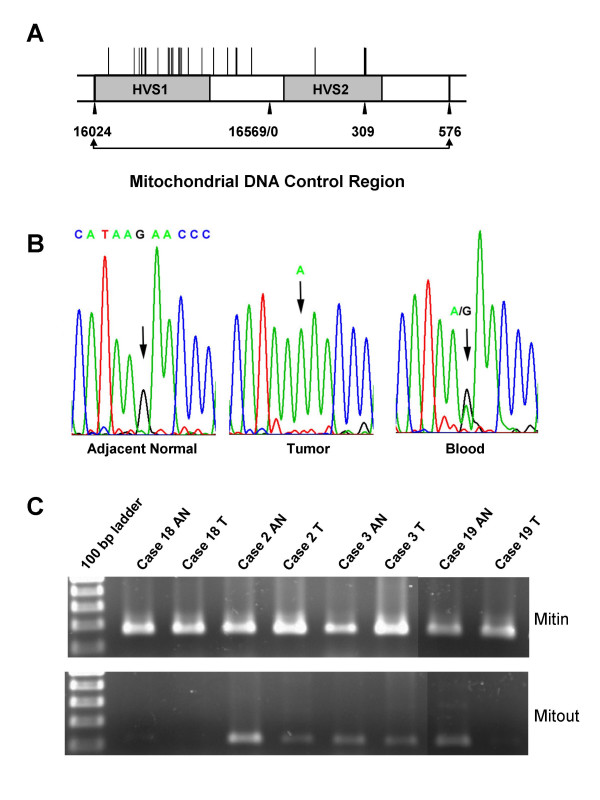
We used DNA samples isolated from tumors, adjacent normal esophageal tissue, and blood from 21 esophageal squamous cell carcinoma cases and DNA isolated from blood from 23 healthy persons. We completely sequenced the control region (D-Loop) from each of these samples and used a PCR assay to assess the presence of the 4977 bp common deletion.
Direct DNA sequencing revealed that 7/21 (33%, 95% CI = 17-55%) tumor samples had mutations in the control region, with clustering evident in the hyper-variable segment 1 (HSV1) and the homopolymeric stretch surrounding position 309. The number of mutations per subject ranged from 1 to 16 and there were a number of instances of heteroplasmy. We detected the 4977 bp 'common deletion' in 92% of the tumor and adjacent normal esophageal tissue samples examined, whereas no evidence of the common deletion was found in corresponding peripheral blood samples.
Control region mutations were insufficiently common to warrant attempts to develop mtDNA mutation screening as a clinical test for ESCC. The common deletion was highly prevalent in the esophageal tissue of cancer cases but absent from peripheral blood. The potential utility of the common deletion in an early detection system will be pursued in further studies.
中国中部地区是世界上食管鳞状细胞癌发病率最高的地区之一,累积死亡率超过20%。线粒体DNA(mtDNA)比核DNA积累更多的突变,并且由于其丰度高,已被提议作为检测不同部位癌症患者的早期检测手段。我们希望研究中国这个高风险地区人群中mtDNA突变和多态性的发生率。
我们使用了从21例食管鳞状细胞癌患者的肿瘤组织、相邻正常食管组织和血液中分离得到的DNA样本,以及从23名健康人的血液中分离得到的DNA。我们对这些样本的控制区(D-环)进行了全序列测定,并使用聚合酶链反应(PCR)检测来评估4977bp常见缺失的存在情况。
直接DNA测序显示,7/21(33%,95%可信区间=17-55%)的肿瘤样本在控制区存在突变,在高变区1(HSV1)和309位点周围的同聚物延伸区有明显的聚集现象。每个受试者的突变数量从1到16不等,并且有许多异质性的情况。在92%检测的肿瘤和相邻正常食管组织样本中检测到了4977bp的“常见缺失”,而在相应的外周血样本中未发现常见缺失的证据。
控制区突变不够常见,不足以尝试将mtDNA突变筛查开发为食管鳞状细胞癌的临床检测方法。常见缺失在癌症患者的食管组织中高度普遍,但在外周血中不存在。在进一步的研究中将探讨常见缺失在早期检测系统中的潜在应用价值。