Li Jianhong, Guo Yin, Schroeder Frederick A, Youngs Rachael M, Schmidt Thomas W, Ferris Craig, Konradi Christine, Akbarian Schahram
Department of Psychiatry, Brudnick Neuropsychiatric Research Institute, University of Massachusetts Medical School, Worcester, Massachusetts 01604, USA.
J Neurochem. 2004 Sep;90(5):1117-31. doi: 10.1111/j.1471-4159.2004.02569.x.
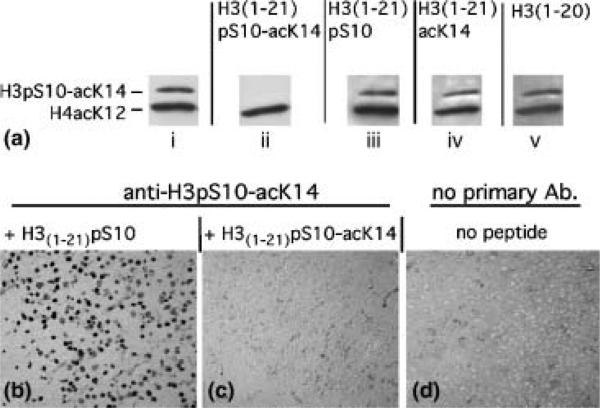
Antipsychotic drugs regulate gene transcription in striatal neurons by blocking dopamine D2-like receptors. Little is known about the underlying changes in chromatin structure, including covalent modifications at histone N-terminal tails that are epigenetic regulators of gene expression. We show that treatment with D2-like antagonists rapidly induces the phosphorylation of histone H3 at serine 10 and the acetylation of H3-lysine 14 in bulk chromatin from striatum and in nuclei of striatal neurons. We find that, in vivo, D2-like antagonist-induced H3 phospho-acetylation is inhibited by the NMDA receptor antagonist MK-801 and by the protein kinase A (PKA) inhibitor Rp-adenosine 3c',5c'-cyclic monophosphorothioate triethylammonium salt but increased by the PKA activator Sp-adenosine 3c',5c'-cyclic monophosphorothioate triethylammonium salt. Furthermore, in dissociated striatal cultures which lack midbrain and cortical pre-synaptic inputs, H3 phospho-acetylation was induced by glutamate, L-type Ca2+ channel agonists and activators of cAMP-dependent PKA but inhibited by NMDA receptor antagonists or PKA antagonists. The dual modification, H3pS10-acK14, was enriched at genomic sites with active transcription and showed the kinetics of the early response. Together, these results suggest that histone modifications and chromatin structure in striatal neurons are dynamically regulated by dopaminergic and glutamatergic inputs converging on the cellular level. Blockade of D2-like receptors induces H3 phospho-acetylation, H3pS10-acK14, through cAMP-dependent PKA, and post-synaptic NMDA receptor signaling.
抗精神病药物通过阻断多巴胺D2样受体来调节纹状体神经元中的基因转录。关于染色质结构的潜在变化,包括作为基因表达表观遗传调节因子的组蛋白N末端尾巴上的共价修饰,我们所知甚少。我们发现,用D2样拮抗剂处理可迅速诱导纹状体整体染色质以及纹状体神经元细胞核中组蛋白H3丝氨酸10位点的磷酸化和H3赖氨酸14位点的乙酰化。我们发现,在体内,D2样拮抗剂诱导的H3磷酸化乙酰化被NMDA受体拮抗剂MK-801和蛋白激酶A(PKA)抑制剂Rp-腺苷3',5'-环磷硫代酸三乙铵盐抑制,但被PKA激活剂Sp-腺苷3',5'-环磷硫代酸三乙铵盐增强。此外,在缺乏中脑和皮质突触前输入的解离纹状体培养物中,谷氨酸、L型钙通道激动剂和cAMP依赖性PKA的激活剂可诱导H3磷酸化乙酰化,但被NMDA受体拮抗剂或PKA拮抗剂抑制。双重修饰H3pS10-acK14在具有活跃转录的基因组位点富集,并显示出早期反应的动力学。总之,这些结果表明,纹状体神经元中的组蛋白修饰和染色质结构受到在细胞水平上汇聚的多巴胺能和谷氨酸能输入的动态调节。阻断D2样受体通过cAMP依赖性PKA和突触后NMDA受体信号传导诱导H3磷酸化乙酰化,即H3pS10-acK14。