Kelly-Spratt Karen S, Gurley Kay E, Yasui Yutaka, Kemp Christopher J
Fred Hutchinson Cancer Research Center, Seattle, Washington, USA.
PLoS Biol. 2004 Aug;2(8):E242. doi: 10.1371/journal.pbio.0020242. Epub 2004 Aug 17.
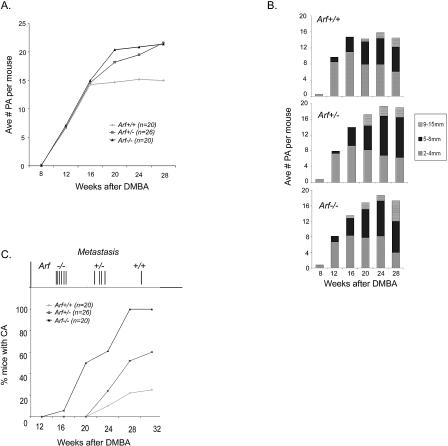
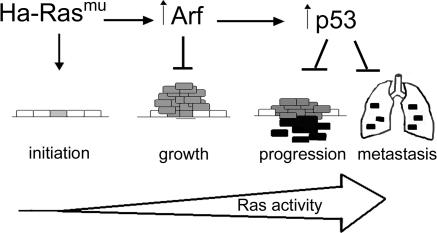
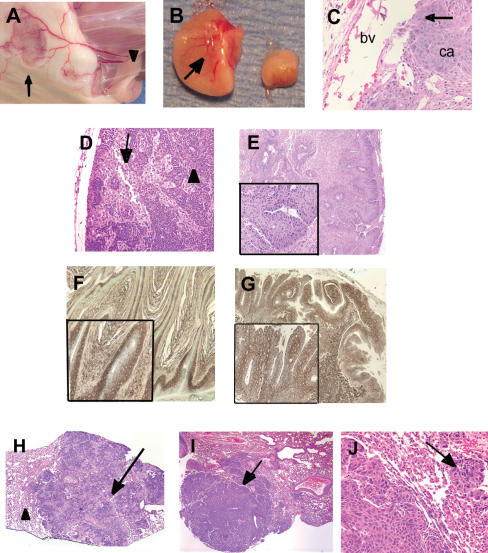
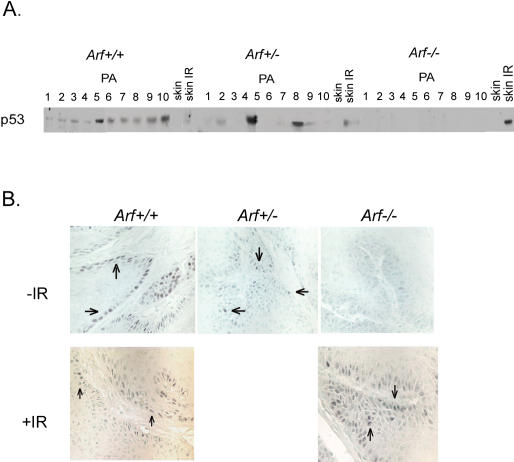
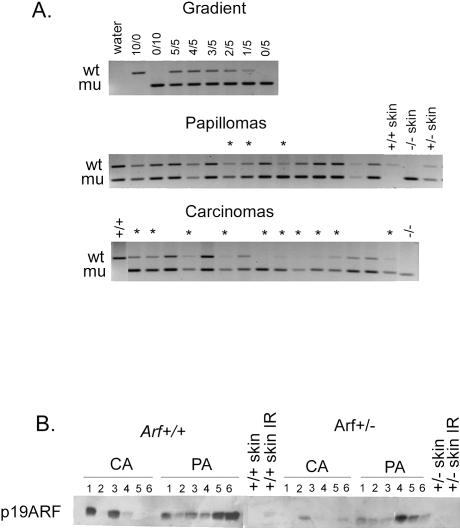
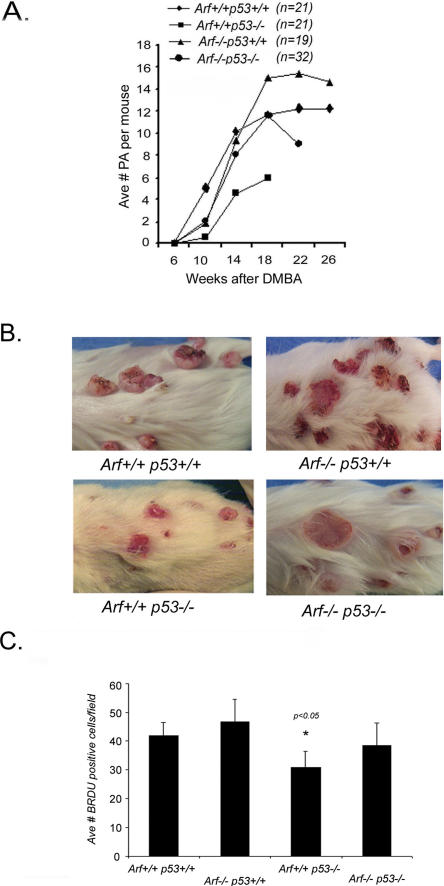
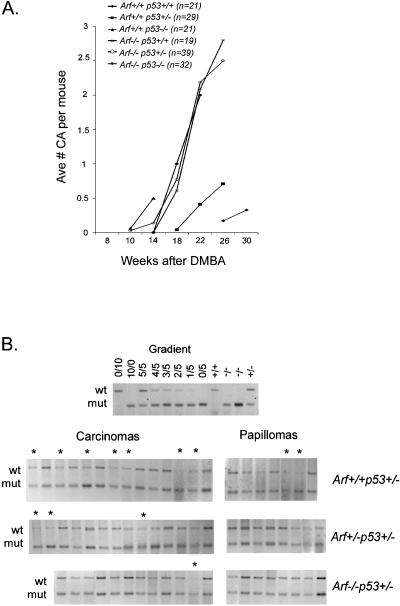
Ectopic expression of oncogenes such as Ras induces expression of p19(Arf), which, in turn, activates p53 and growth arrest. Here, we used a multistage model of squamous cell carcinoma development to investigate the functional interactions between Ras, p19(Arf), and p53 during tumor progression in the mouse. Skin tumors were induced in wild-type, p19(Arf)-deficient, and p53-deficient mice using the DMBA/TPA two-step protocol. Activating mutations in Hras were detected in all papillomas and carcinomas examined, regardless of genotype. Relative to wild-type mice, the growth rate of papillomas was greater in p19(Arf)-deficient mice, and reduced in p53-deficient mice. Malignant conversion of papillomas to squamous cell carcinomas, as well as metastasis to lymph nodes and lungs, was markedly accelerated in both p19 (Arf)- and p53-deficient mice. Thus, p19(Arf) inhibits the growth rate of tumors in a p53-independent manner. Through its regulation of p53, p19(Arf) also suppresses malignant conversion and metastasis. p53 expression was upregulated in papillomas from wild-type but not p19( Arf)-null mice, and p53 mutations were more frequently seen in wild-type than in p19( Arf)-null carcinomas. This indicates that selection for p53 mutations is a direct result of signaling from the initiating oncogenic lesion, Hras, acting through p19(Arf).
癌基因如Ras的异位表达可诱导p19(Arf)的表达,进而激活p53并导致生长停滞。在此,我们使用鳞状细胞癌发展的多阶段模型来研究Ras、p19(Arf)和p53在小鼠肿瘤进展过程中的功能相互作用。使用DMBA/TPA两步法在野生型、p19(Arf)缺陷型和p53缺陷型小鼠中诱导皮肤肿瘤。在所有检测的乳头状瘤和癌中均检测到Hras的激活突变,与基因型无关。相对于野生型小鼠,p19(Arf)缺陷型小鼠中乳头状瘤的生长速率更高,而p53缺陷型小鼠中则降低。在p19(Arf)缺陷型和p53缺陷型小鼠中,乳头状瘤向鳞状细胞癌的恶性转化以及向淋巴结和肺的转移均明显加速。因此,p19(Arf)以不依赖p53的方式抑制肿瘤的生长速率。通过对p53的调节,p19(Arf)还可抑制恶性转化和转移。野生型而非p19(Arf)基因敲除小鼠的乳头状瘤中p53表达上调,并且野生型癌中p53突变比p19(Arf)基因敲除癌中更常见。这表明对p53突变的选择是起始致癌病变Hras通过p19(Arf)发出信号的直接结果。