Page Angustias, Navarro Manuel, Suarez-Cabrera Cristian, Alameda Josefa P, Casanova M Llanos, Paramio Jesús M, Bravo Ana, Ramirez Angel
Molecular Oncology Unit, Centro de Investigaciones Energéticas, Medioambientales y Tecnológicas (CIEMAT), Madrid, Spain.
Biomedical Research Institute I+12, University Hospital "12 de Octubre", Madrid, Spain.
Oncotarget. 2016 Apr 12;7(15):20902-18. doi: 10.18632/oncotarget.7897.
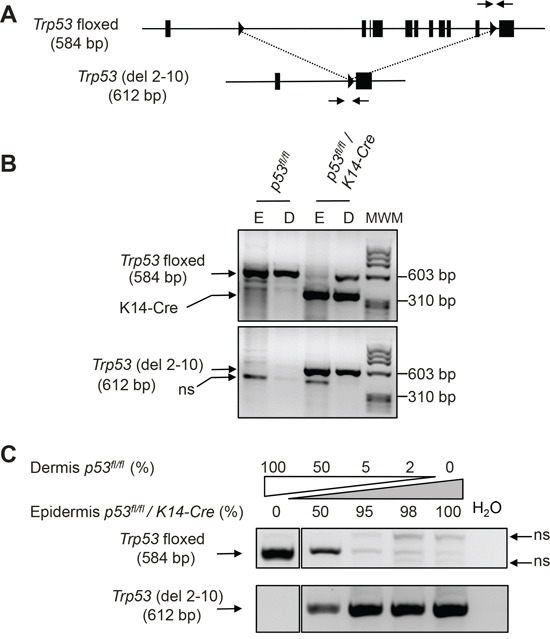
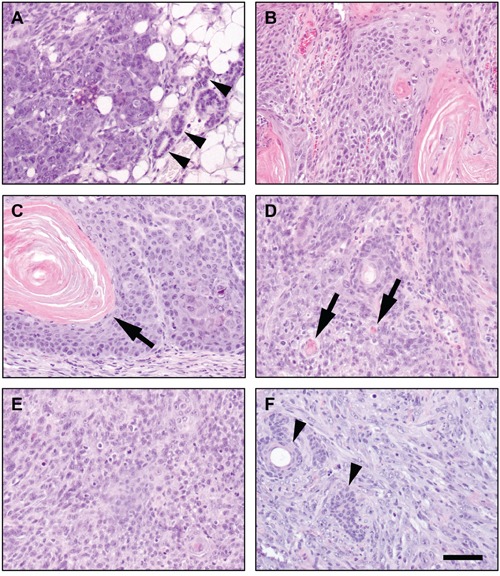
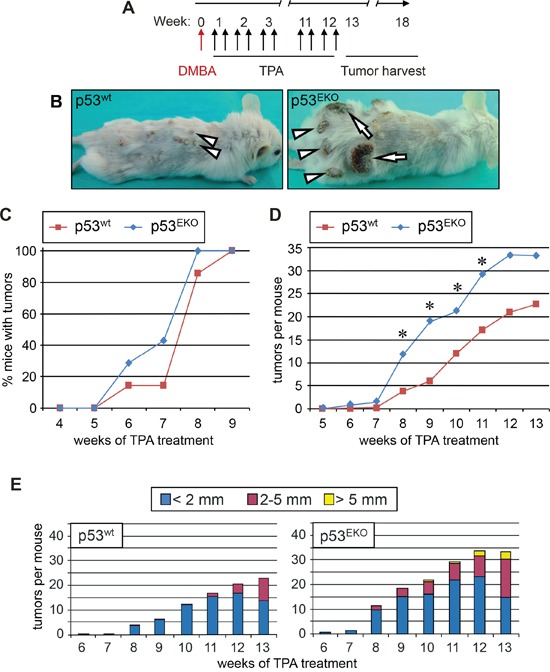
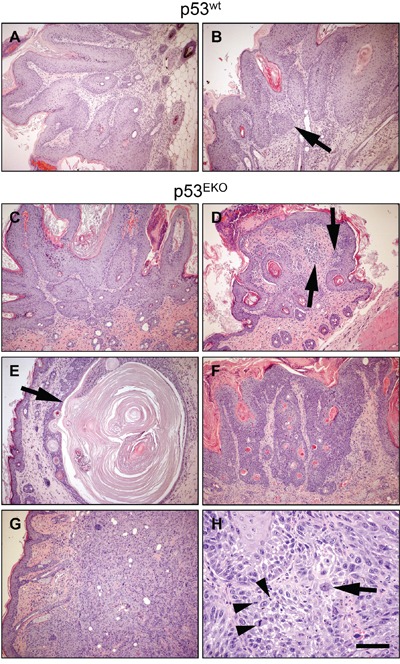
p53 is a protein that causes cell cycle arrest, apoptosis or senescence, being crucial in the process of tumor suppression in several cell types. Different in vitro and animal models have been designed for the study of p53 role in skin cancer. These models have revealed opposing results, as in some experimental settings it appears that p53 protects against skin cancer, but in others, the opposite conclusion emerges. We have generated cohorts of mice with efficient p53 deletion restricted to stratified epithelia and control littermates expressing wild type p53 and studied their sensitivity to both chemically-induced and spontaneous tumoral transformation, as well as the tumor types originated in each experimental group. Our results indicate that the absence of p53 in stratified epithelia leads to the appearance, in two-stage skin carcinogenesis experiments, of a higher number of tumors that grow faster and become malignant more frequently than tumors arisen in mice with wild type p53 genotype. In addition, the histological diversity of the tumor type is greater in mice with epidermal p53 loss, indicating the tumor suppressive role of p53 in different epidermal cell types. Aging mice with p53 inactivation in stratified epithelia developed spontaneous carcinomas in skin and other epithelia. Overall, these results highlight the truly protective nature of p53 functions in the development of cancer in skin and in other stratified epithelia.
p53是一种可导致细胞周期停滞、凋亡或衰老的蛋白质,在多种细胞类型的肿瘤抑制过程中起着关键作用。人们设计了不同的体外和动物模型来研究p53在皮肤癌中的作用。这些模型得出了相互矛盾的结果,例如在某些实验环境中,p53似乎能预防皮肤癌,但在其他实验中却得出了相反的结论。我们构建了p53有效缺失仅限于复层上皮的小鼠队列以及表达野生型p53的对照同窝小鼠,并研究了它们对化学诱导和自发肿瘤转化的敏感性,以及每个实验组产生的肿瘤类型。我们的结果表明,在两阶段皮肤致癌实验中,复层上皮中缺乏p53会导致出现更多肿瘤,这些肿瘤生长更快,比野生型p53基因型小鼠产生的肿瘤更频繁地发生恶变。此外,表皮p53缺失的小鼠肿瘤类型的组织学多样性更大,这表明p53在不同表皮细胞类型中具有肿瘤抑制作用。复层上皮中p53失活的衰老小鼠在皮肤和其他上皮中发生了自发癌。总体而言,这些结果突出了p53功能在皮肤和其他复层上皮癌症发生过程中真正的保护性质。