Rajkumar Revathi, Kashyap V K
DNA Typing Unit, Central Forensic Science Laboratory, 30 Gorachand Road, Kolkata, India-700014.
BMC Genet. 2004 Aug 19;5:23. doi: 10.1186/1471-2156-5-23.
A large number of microsatellites have been extensively used to comprehend the genetic diversity of different global groups. This paper entails polymorphism at 15 STR in four predominant and endogamous populations representing Karnataka, located on the southwest coast of India. The populations residing in this region are believed to have received gene flow from south Indian populations and world migrants, hence, we carried out a detailed study on populations inhabiting this region to understand their genetic structure, diversity related to geography and linguistic affiliation and relatedness to other Indian and global migrant populations.
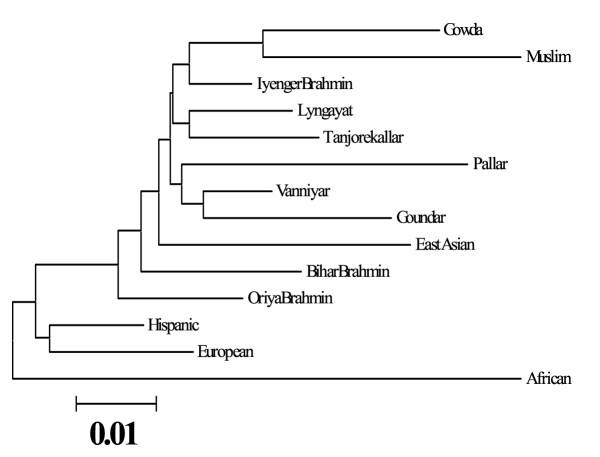
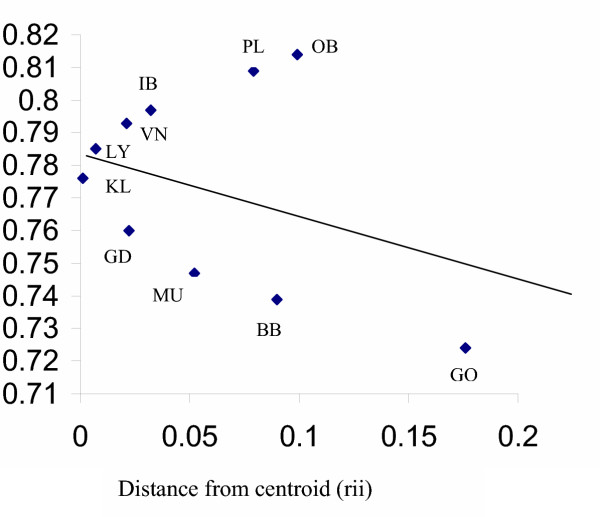
Various statistical analyses were performed on the microsatellite data to accomplish the objectives of the paper. The heretozygosity was moderately high and similar across the loci, with low average GST value. Iyengar and Lyngayat were placed above the regression line in the R-matrix analysis as opposed to the Gowda and Muslim. AMOVA indicated that majority of variation was confined to individuals within a population, with geographic grouping demonstrating lesser genetic differentiation as compared to linguistic clustering. DA distances show the genetic affinity among the southern populations, with Iyengar, Lyngayat and Vanniyar displaying some affinity with northern Brahmins and global migrant groups from East Asia and Europe.
The microsatellite study divulges a common ancestry for the four diverse populations of Karnataka, with the overall genetic differentiation among them being largely confined to intra-population variation. The practice of consanguineous marriages might have attributed to the relatively lower gene flow displayed by Gowda and Muslim as compared to Iyengar and Lyngayat. The various statistical analyses strongly suggest that the studied populations could not be differentiated on the basis of caste or spatial location, although, linguistic affinity was reflected among the southern populations, distinguishing them from the northern groups. Our study also indicates a heterogeneous origin for Lyngayat and Iyengar owing to their genetic proximity with southern populations and northern Brahmins. The high-ranking communities, in particular, Iyengar, Lyngayat, Vanniyar and northern Brahmins might have experienced genetic admixture from East Asian and European ethnic groups.
大量微卫星已被广泛用于理解不同全球群体的遗传多样性。本文研究了印度西南海岸卡纳塔克邦四个主要的内婚制群体中15个短串联重复序列(STR)的多态性。据信,居住在该地区的人群接受了来自南印度人群和世界移民的基因流动,因此,我们对居住在该地区的人群进行了详细研究,以了解他们的遗传结构、与地理和语言归属相关的多样性以及与其他印度和全球移民群体的亲缘关系。
对微卫星数据进行了各种统计分析,以实现本文的目标。杂合度中等偏高,各基因座相似,平均GST值较低。在R矩阵分析中,伊扬格人和林加亚特人位于回归线之上,而古达人和穆斯林则相反。分子方差分析(AMOVA)表明,大部分变异局限于群体内的个体,与语言聚类相比,地理分组显示出较小的遗传分化。DA距离显示了南方群体之间的遗传亲和力,伊扬格人、林加亚特人和万尼亚尔人与北方婆罗门以及来自东亚和欧洲的全球移民群体表现出一定的亲和力。
微卫星研究揭示了卡纳塔克邦四个不同群体的共同祖先,它们之间的总体遗传分化主要局限于群体内变异。近亲结婚的习俗可能是古达人和穆斯林与伊扬格人和林加亚特人相比基因流动相对较低的原因。各种统计分析强烈表明,尽管南方群体之间反映出语言亲和力,将它们与北方群体区分开来,但所研究的群体不能根据种姓或空间位置进行区分。我们的研究还表明,林加亚特人和伊扬格人起源异质,因为他们与南方群体和北方婆罗门在基因上接近。特别是高等级群体,如伊扬格人、林加亚特人、万尼亚尔人和北方婆罗门,可能经历了来自东亚和欧洲族群的基因混合。