Thompson Kirk G, Bichot Narcisse P, Sato Takashi R
Laboratory of Sensorimotor Research, National Eye Institute, NIH, Bldg. 49, Rm. 2A50, Bethesda, MD 20892, USA.
J Neurophysiol. 2005 Jan;93(1):337-51. doi: 10.1152/jn.00330.2004. Epub 2004 Aug 18.
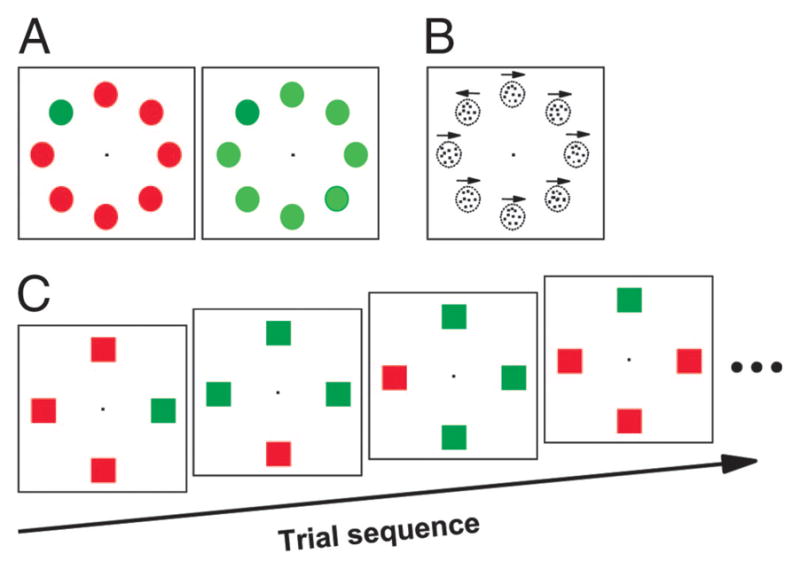
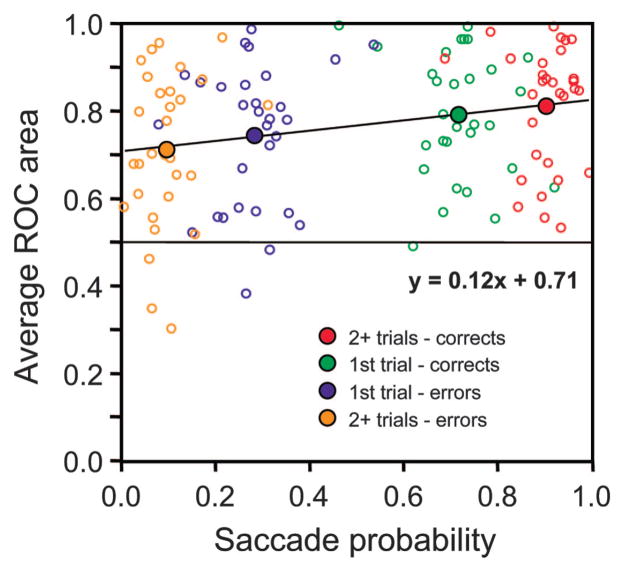
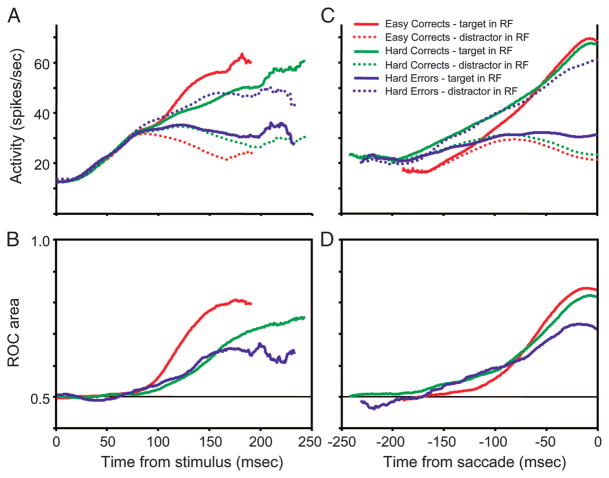
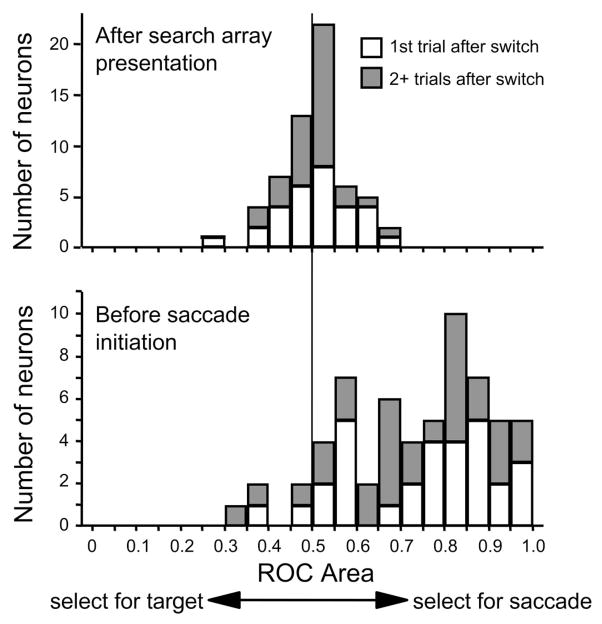
We investigated the saccade decision process by examining activity recorded in the frontal eye field (FEF) of monkeys performing 2 separate visual search experiments in which there were errors in saccade target choice. In the first experiment, the difficulty of a singleton search task was manipulated by varying the similarity between the target and distractors; errors were made more often when the distractors were similar to the target. On catch trials in which the target was absent the monkeys occasionally made false alarm errors by shifting gaze to one of the distractors. The second experiment was a popout color visual search task in which the target and distractor colors switched unpredictably across trials. Errors occurred most frequently on the first trial after the switch and less often on subsequent trials. In both experiments, FEF neurons selected the saccade goal on error trials, not the singleton target of the search array. Although saccades were made to the same stimulus locations, presaccadic activation and the magnitude of selection differed across trial conditions. The variation in presaccadic selective activity was accounted for by the variation in saccade probability across the stimulus-response conditions, but not by variations in saccade metrics. These results suggest that FEF serves as a saccade probability map derived from the combination of bottom-up and top-down influences. Peaks on this map represent the behavioral relevance of each item in the visual field rather than just reflecting saccade preparation. This map in FEF may correspond to the theoretical salience map of many models of attention and saccade target selection.
我们通过检查在执行两项单独视觉搜索实验的猴子的额叶眼区(FEF)中记录的活动,来研究扫视决策过程。在这两项实验中,扫视目标选择存在错误。在第一个实验中,通过改变目标与干扰项之间的相似度来操纵单一目标搜索任务的难度;当干扰项与目标相似时,错误出现得更频繁。在目标缺失的捕捉试验中,猴子偶尔会通过将目光转向其中一个干扰项而出现误报错误。第二个实验是一个弹出式颜色视觉搜索任务,其中目标和干扰项的颜色在各试验中不可预测地切换。错误在切换后的第一次试验中出现得最频繁,而在随后的试验中出现得较少。在这两项实验中,FEF神经元在错误试验中选择扫视目标,而不是搜索阵列中的单一目标。尽管扫视是针对相同的刺激位置进行的,但扫视前的激活和选择的幅度在不同试验条件下有所不同。扫视前选择性活动的变化是由刺激-反应条件下扫视概率的变化引起的,而不是由扫视指标的变化引起的。这些结果表明,FEF作为一个由自下而上和自上而下影响相结合而产生的扫视概率图。这张图上的峰值代表视野中每个项目的行为相关性,而不仅仅反映扫视准备。FEF中的这张图可能对应于许多注意力和扫视目标选择模型的理论显著性图。