Carraway Hetty, Hidalgo Manuel
Sidney Kimmel Comprehensive Cancer Center at Johns Hopkins Hospital, Cancer Research Building, Baltimore, Maryland, USA.
Breast Cancer Res. 2004;6(5):219-24. doi: 10.1186/bcr927. Epub 2004 Aug 12.
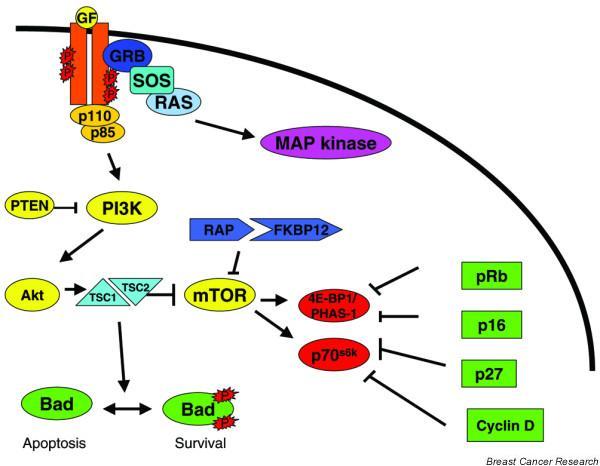
Mammalian target of rapamycin (mTOR) is a serine-threonine kinase member of the cellular phosphatidylinositol 3-kinase (PI3K) pathway, which is involved in multiple biologic functions such as transcriptional and translational control. mTOR is a downstream mediator in the PI3K/Akt signaling pathway and plays a critical role in cell survival. In breast cancer this pathway can be activated by membrane receptors, including the HER (or ErbB) family of growth factor receptors, the insulin-like growth factor receptor, and the estrogen receptor. There is evidence suggesting that Akt promotes breast cancer cell survival and resistance to chemotherapy, trastuzumab, and tamoxifen. Rapamycin is a specific mTOR antagonist that targets this pathway and blocks the downstream signaling elements, resulting in cell cycle arrest in the G1 phase. Targeting the Akt/PI3K pathway with mTOR antagonists may increase the therapeutic efficacy of breast cancer therapy.
雷帕霉素的哺乳动物靶点(mTOR)是细胞磷脂酰肌醇3激酶(PI3K)信号通路中的一种丝氨酸 - 苏氨酸激酶成员,该信号通路参与多种生物学功能,如转录和翻译控制。mTOR是PI3K/Akt信号通路的下游介质,在细胞存活中起关键作用。在乳腺癌中,该信号通路可被膜受体激活,包括HER(或ErbB)家族的生长因子受体、胰岛素样生长因子受体和雌激素受体。有证据表明,Akt可促进乳腺癌细胞的存活以及对化疗、曲妥珠单抗和他莫昔芬的耐药性。雷帕霉素是一种特异性mTOR拮抗剂,作用于该信号通路并阻断下游信号元件,导致细胞周期停滞于G1期。用mTOR拮抗剂靶向Akt/PI3K信号通路可能会提高乳腺癌治疗的疗效。